
What Is Molality?
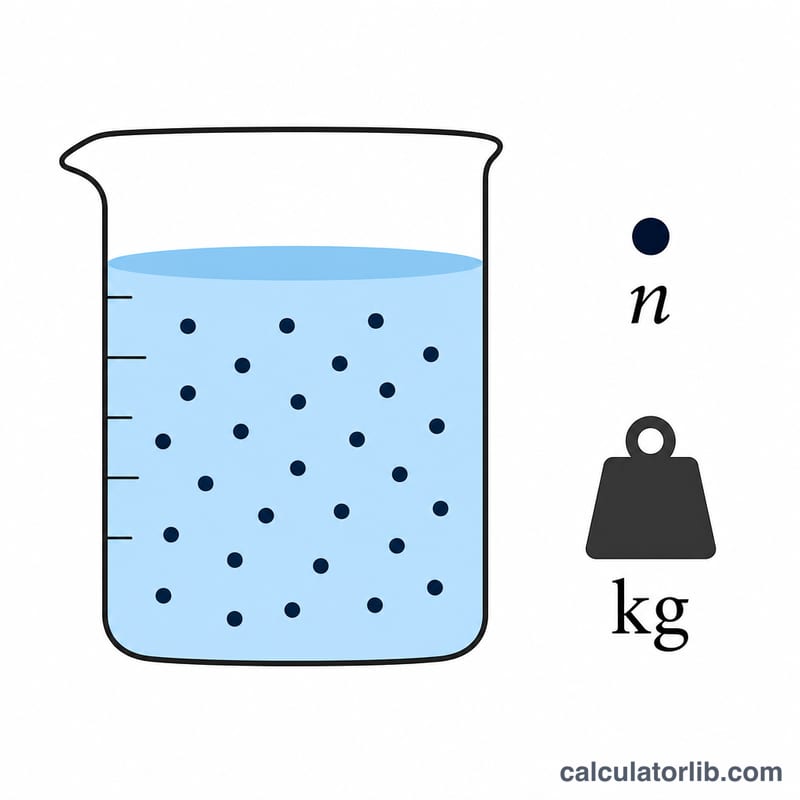
Molality (symbol m) is a measure of the concentration of a solution defined as the number of moles of solute dissolved per kilogram of solvent. Unlike molarity, which depends on the total volume of the solution, molality depends only on mass. Because mass does not change with temperature, molality is the preferred concentration unit for experiments involving heating, cooling, or colligative properties such as boiling point elevation and freezing point depression.
How to Use This Calculator
Enter the moles of solute (in mol) and the mass of the solvent (in kilograms). The calculator instantly divides moles by mass to give molality in mol/kg. If you only know the mass of solute in grams, first convert to moles by dividing by its molar mass. Remember to use the mass of the solvent, not the total solution.
The Formula Explained
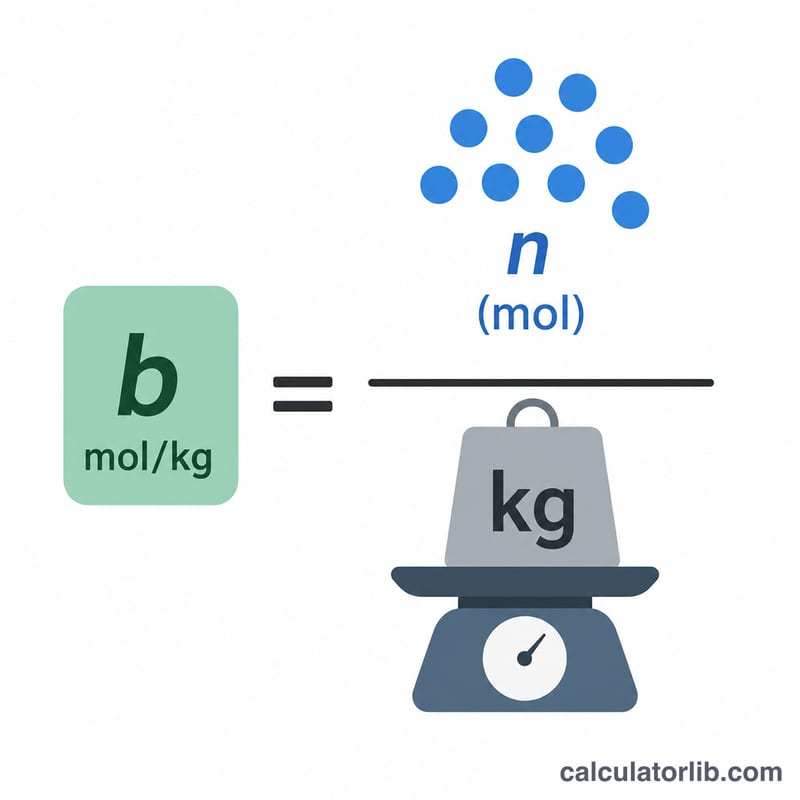
The defining equation is:
$$m = \dfrac{n_{solute}}{m_{solvent}\,(\text{kg})}$$
For example, dissolving 0.5 mol of sodium chloride in 2 kg of water gives a molality of \(0.5 \div 2 = 0.25\) mol/kg, written as 0.25 m.
Worked Example
Suppose you dissolve 1.5 mol of glucose in 0.75 kg of water. $$\text{Molality} = 1.5 \div 0.75 = 2.0 \text{ mol/kg}$$ The solution is therefore 2.0 molal.
FAQ
What is the difference between molality and molarity? Molality uses kilograms of solvent (mass), while molarity uses liters of solution (volume). Molality is temperature-independent.
What unit is molality measured in? Molality is expressed in mol/kg, often abbreviated to lowercase m.
Why use molality instead of molarity? Because mass is unaffected by temperature changes, molality is more accurate for studies of colligative properties and high-temperature reactions.