What is the Molarity to Molality Calculator?
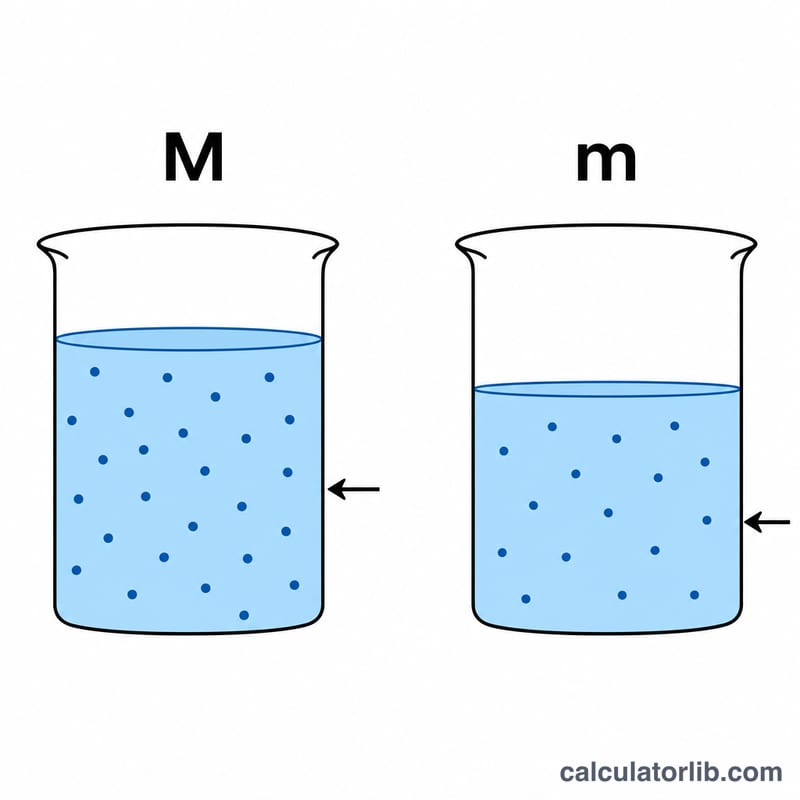
This tool converts molarity (moles of solute per litre of solution, mol/L) into molality (moles of solute per kilogram of solvent, mol/kg). The two concentration units differ because molarity is based on the total volume of solution while molality is based only on the mass of the solvent. Converting between them requires knowing the solution's density and the molar mass of the dissolved solute.
How to use it
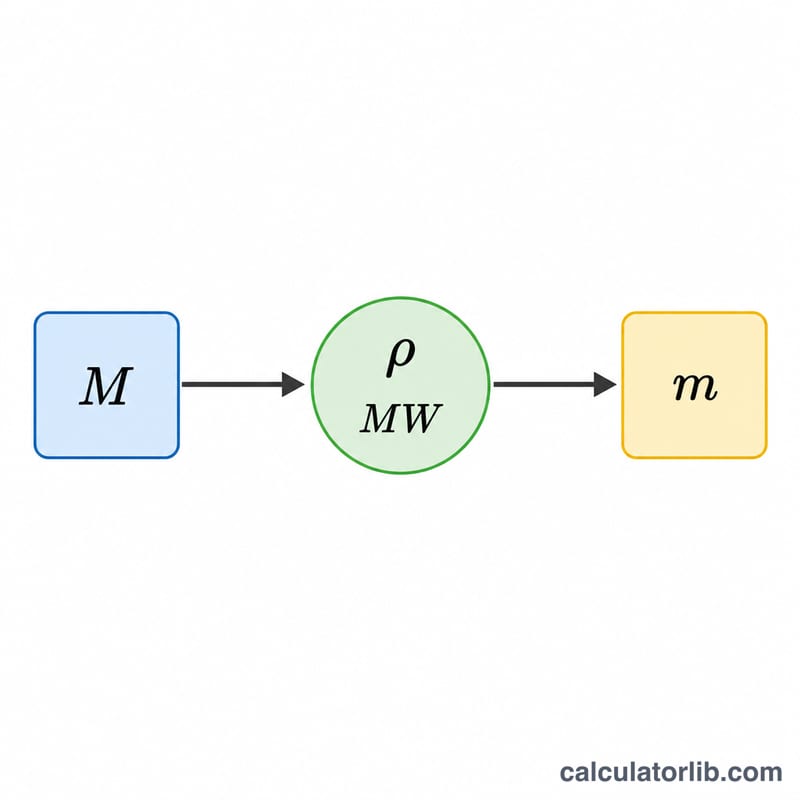
Enter the molarity (M) in mol/L, the measured density of the solution (ρ) in g/mL, and the molar mass (MW) of the solute in g/mol. The calculator returns the molality in mol/kg along with the mass of solvent contained in one litre of solution.
The formula explained
Consider 1 litre (1000 mL) of solution. Its total mass is \(1000\cdot\rho\) grams. It contains \(M\) moles of solute, whose mass is \(M\cdot MW\) grams. The solvent mass is therefore \((1000\cdot\rho - M\cdot MW)\) grams \(= (1000\cdot\rho - M\cdot MW)/1000\) kg. Molality is moles of solute divided by kilograms of solvent:
$$m = \frac{1000 \cdot \text{M (mol/L)}}{1000 \cdot \text{$\rho$ (g/mL)} - \text{M} \cdot \text{MW (g/mol)}}$$
Worked example
A 1 mol/L NaCl solution (MW = 58.44 g/mol) has a density of 1.05 g/mL. The solvent mass is $$(1000\times1.05 - 1\times58.44)/1000 = 0.99156 \text{ kg}.$$ Molality $$= 1 / 0.99156 \approx 1.0085 \text{ mol/kg}.$$ Because some solution mass is solute, molality is slightly larger than molarity.
Molar Masses and Densities of Common Solutes
The converter needs three inputs: molarity (mol/L), solution density (g/mL) and the solute's molar mass (g/mol). The table lists molar masses (rounded to two decimals) for common solutes. It also gives an example molarity and an approximate solution density at about 20–25 °C.
| Solute | Molar mass (g/mol) | Example molarity (M) | Approx. solution density (g/mL) |
|---|---|---|---|
| NaCl | 58.44 | 1.0 | ≈ 1.036 |
| KCl | 74.55 | 1.0 | ≈ 1.04 |
| NaOH | 40.00 | 1.0 | ≈ 1.04 |
| HCl | 36.46 | 1.0 | ≈ 1.016 |
| H2SO4 | 98.08 | 1.0 | ≈ 1.06 |
| Glucose (C6H12O6) | 180.16 | 0.5 | ≈ 1.03 |
| Sucrose (C12H22O11) | 342.30 | 1.0 | ≈ 1.13 |
| Acetic acid (CH3COOH) | 60.05 | 1.0 | ≈ 1.005 |
| Ammonia (NH3) | 17.03 | 1.0 | ≈ 0.99 |
Note: the densities are approximate and depend on concentration and temperature. For accurate work, measure the density of your own solution or take it from a trusted source such as a chemistry handbook. Even small density errors can change the result noticeably, especially for concentrated solutions.
Key Terms and Symbols
- Molarity (M, mol/L): moles of solute per litre of solution.
- Molality (m, mol/kg): moles of solute per kilogram of solvent.
- Solution density ρ (g/mL): mass of solution per unit volume. It links the volume basis of molarity to the mass basis of molality.
- Molar mass MW (g/mol): mass of one mole of the solute.
- Solute: the substance that is dissolved, such as NaCl or sucrose.
- Solvent: the substance that does the dissolving, usually water.
- Solution: the homogeneous mixture of solute and solvent.
Temperature note: molality is independent of temperature because it uses masses only. Molarity changes with temperature because the solution volume expands or contracts. Molality is therefore preferred for colligative properties such as boiling-point elevation and freezing-point depression. Use the density measured at the same temperature as the stated molarity.
FAQ
Why are molarity and molality different? Molarity uses solution volume (temperature dependent), while molality uses solvent mass (temperature independent), so they only match in very dilute aqueous solutions.
What density should I use? Use the measured density of the whole solution, not the pure solvent.
Can the result be negative or undefined? If \(M\cdot MW\) exceeds \(1000\cdot\rho\) the inputs are physically inconsistent; double-check the molar mass and density.