
What is the %w/v to Molarity Calculator?
This calculator converts a percent weight/volume (% w/v) concentration into molarity, expressed in moles per liter (mol/L or M). Percent w/v tells you how many grams of solute are dissolved in 100 mL of solution, while molarity tells you how many moles of solute are present in one liter. Because chemistry calculations such as dilutions, reaction stoichiometry, and titrations depend on molarity, converting from a labeled %w/v value is a routine but essential task in the lab.
How to use it
Enter the concentration as a percent w/v (for example, 0.9 for normal saline), then enter the molar mass of the solute in grams per mole. The calculator returns the molarity in mol/L along with the equivalent mass concentration in grams per liter. Be sure the molar mass corresponds to the exact compound you are using, including any water of hydration.
The formula explained
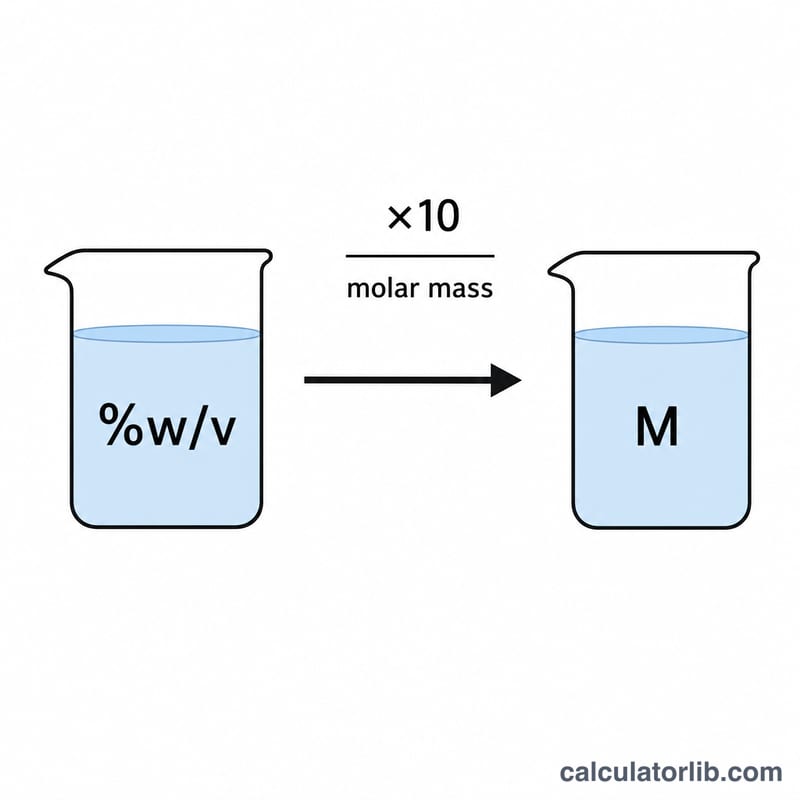
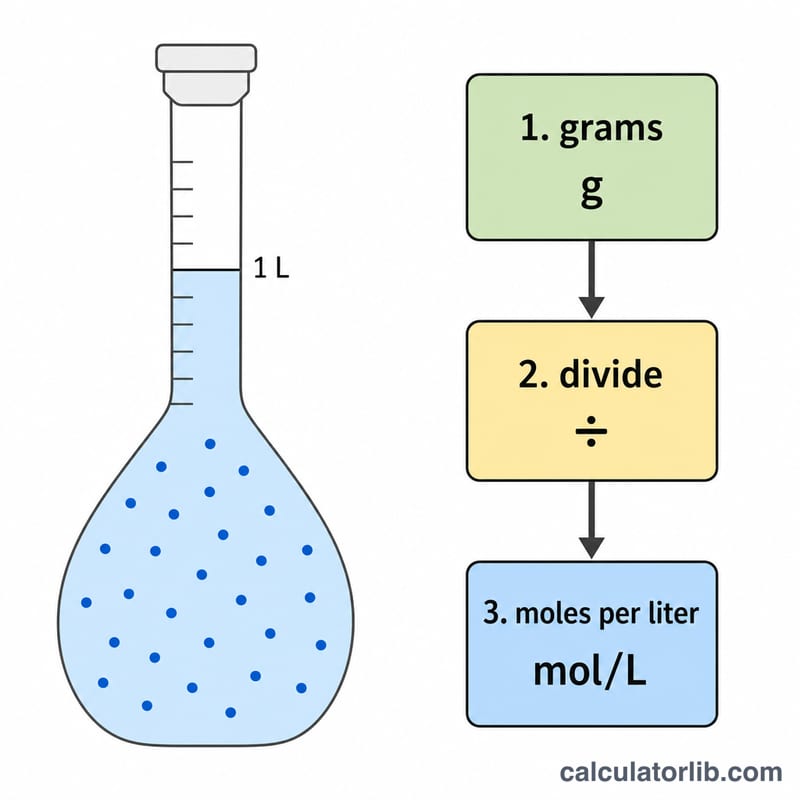
A solution that is X % w/v contains X grams of solute per 100 mL of solution. Scaling to one liter multiplies by 10, giving X × 10 grams per liter. Dividing grams per liter by the molar mass (g/mol) yields moles per liter:
$$\text{Molarity (mol/L)} = \frac{\text{Concentration (\% w/v)} \times 10}{\text{Molar Mass (g/mol)}}$$
Worked example
Consider a 0.9% w/v sodium chloride (NaCl) solution, the standard physiological saline. The molar mass of NaCl is 58.44 g/mol. First, \(0.9 \times 10 = 9\) g/L. Then \(9 \div 58.44 = 0.154\) mol/L. So normal saline is roughly 0.154 M, which matches the well-known value.
FAQ
Why multiply by 10? Percent w/v is grams per 100 mL; multiplying by 10 converts to grams per 1000 mL (1 liter).
Does temperature matter? Molarity depends on solution volume, which changes slightly with temperature, but for most lab work the effect is negligible.
What molar mass should I use for hydrates? Use the molar mass that includes the bound water (for example, CuSO4·5H2O = 249.69 g/mol) if you weighed out the hydrate.