
What is the mg/mL to Molarity Calculator?
This tool converts a solution concentration expressed in milligrams per milliliter (mg/mL) into molarity, the number of moles of solute per liter of solution (mol/L, or M). It is widely used in chemistry, biochemistry, pharmacology, and molecular biology labs whenever you have a mass-based concentration but need a molar concentration for reactions, dilutions, or assay setup.
How to Use It
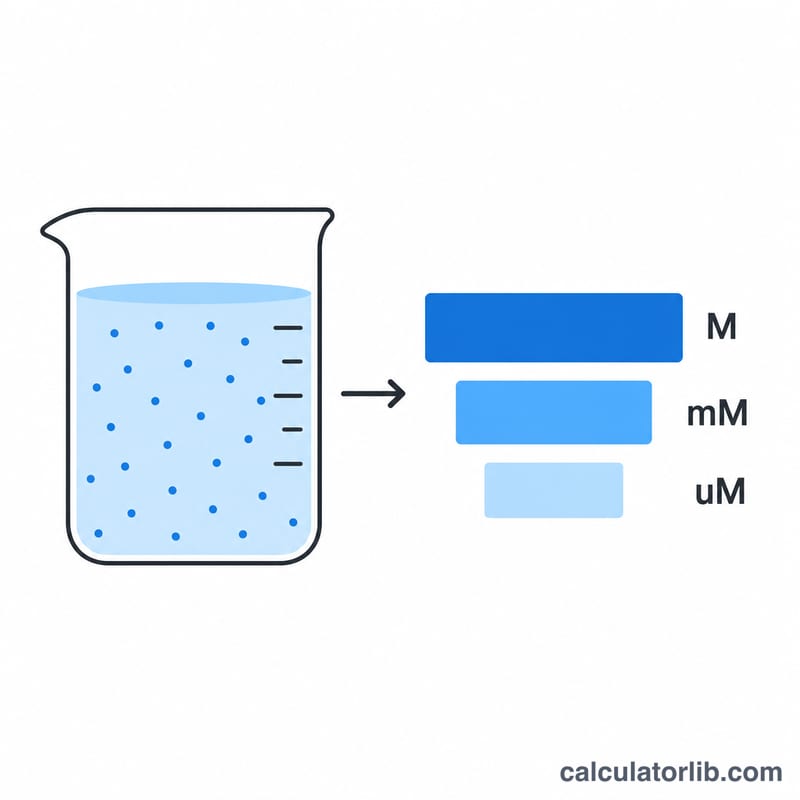
Enter two values: the concentration of your solution in mg/mL and the molar mass (molecular weight) of the compound in g/mol. The calculator returns molarity in M, plus the equivalent millimolar (mM) and micromolar (µM) values for convenience.
The Formula Explained
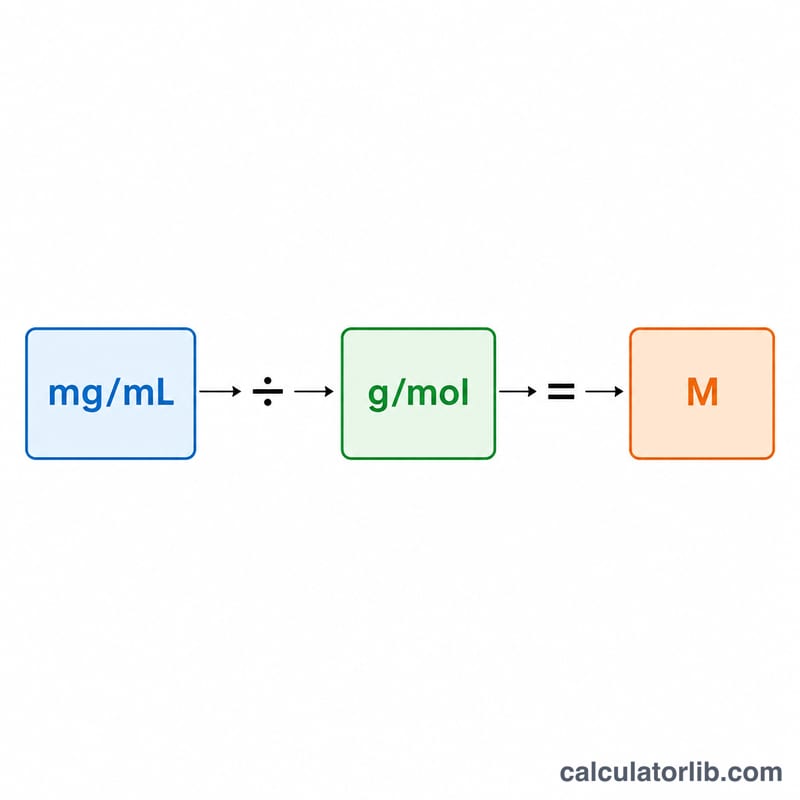
The key insight is that 1 mg/mL is exactly equal to 1 g/L. Molarity is moles per liter, and moles equal grams divided by molar mass. Therefore:
$$\text{Molarity (M)} = \frac{\text{Concentration (mg/mL)}}{\text{Molar Mass (g/mol)}}$$Because the mg/mL value already represents grams per liter, no extra unit conversion is needed — just divide by the molar mass.
Worked Example
Suppose you have a glucose solution at 10 mg/mL. Glucose has a molar mass of about 180.16 g/mol. The molarity is $$10 \div 180.16 = 0.0555 \text{ mol/L},$$ which equals 55.51 mM or 55,510 µM.
FAQ
Why does 1 mg/mL equal 1 g/L? Multiply mg/mL by 1000 mL/L to get mg/L, then divide by 1000 mg/g to get g/L — the factors cancel, so the number is identical.
Where do I find the molar mass? It is listed on the chemical's safety data sheet or product page, or you can sum the atomic masses from the molecular formula.
Can I use this for proteins? Yes, but use the protein's molecular weight in g/mol (Da). Large proteins give very low molar concentrations, so the µM output is usually most useful.