
What is the Average Temperature Calculator?
This tool computes the daily mean temperature — the simplest and most widely used measure of a day's typical warmth. Meteorologists, gardeners, climate hobbyists and students often summarize a day with a single number by averaging the highest and lowest readings. The calculator is unit-agnostic: enter both values in Celsius or both in Fahrenheit and the answer comes back in the same unit.
How to use it
Enter the day's maximum (high) temperature and minimum (low) temperature, then read off the average. The calculator also reports the daily temperature range, which tells you how much the temperature swung between the warmest and coolest part of the day. Larger ranges are common in dry, clear climates; smaller ranges occur in humid or cloudy conditions.
The formula explained
The daily mean is defined as:
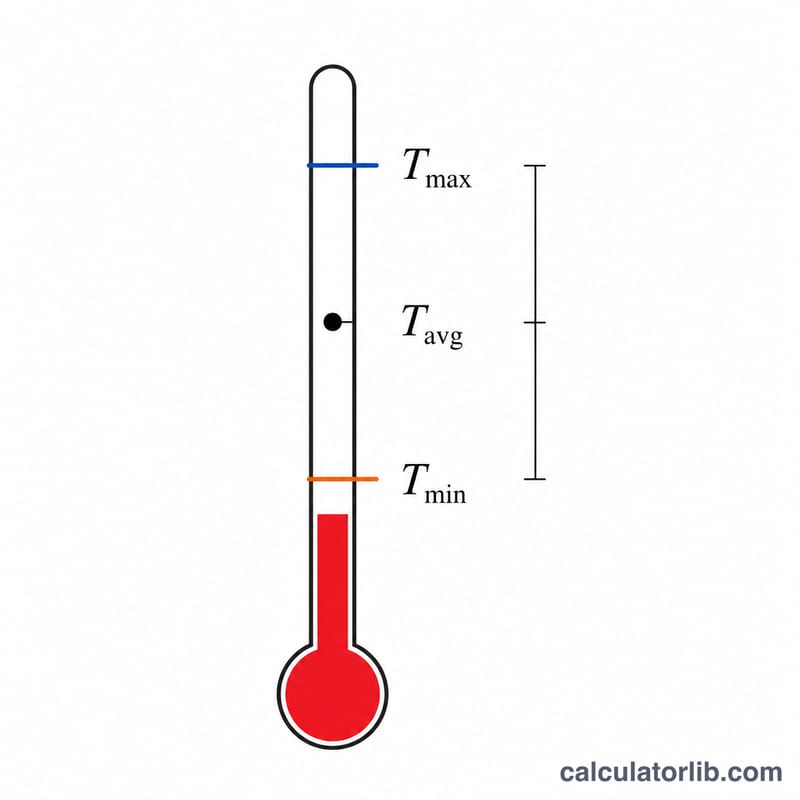
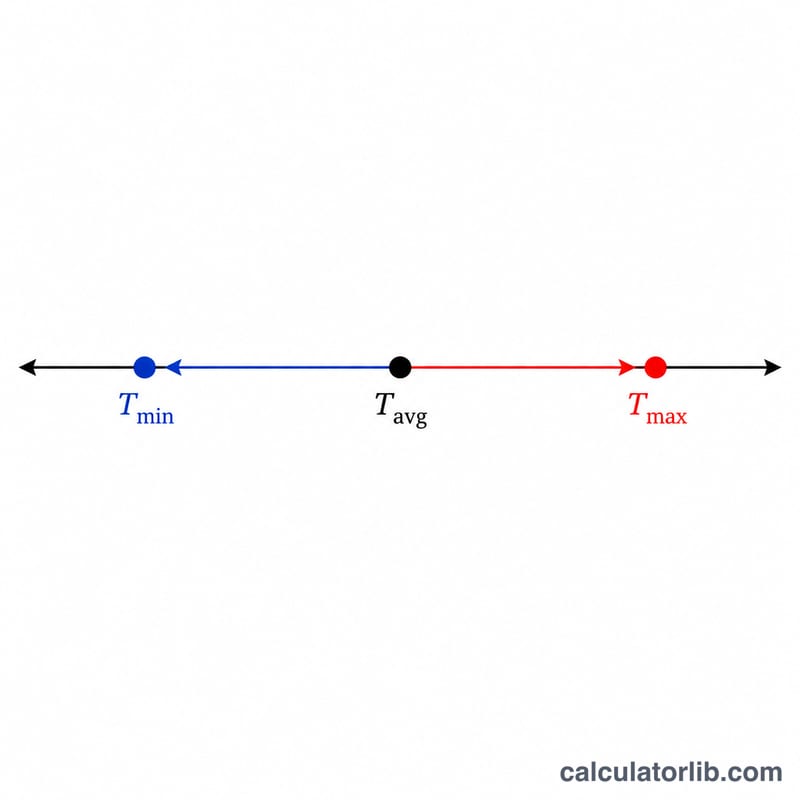
$$T_{avg} = \frac{T_{max} + T_{min}}{2}$$
It is the arithmetic midpoint of the high and the low. This "min–max average" is the official method used by many national weather services to record long-term climate normals, precisely because it only needs two easily-measured numbers per day.
Worked example
Suppose a summer day reaches a high of 30°C and dips to a low of 18°C overnight. The mean temperature is $$\frac{30 + 18}{2} = 24\,°\text{C}$$ and the daily range is \(30 - 18 = 12\,°\text{C}\).
Celsius to Fahrenheit Conversion Table
Daily mean temperatures are often reported in either Celsius or Fahrenheit. Because the average temperature formula \(T_{avg} = (T_{max} + T_{min})/2\) works identically in both scales, you can compute the mean in whichever unit your high and low readings use. To switch a final result between scales, use the standard conversion formula:
$$F = C \times \frac{9}{5} + 32$$
The table below lists common everyday and climate-relevant temperatures in Celsius alongside their Fahrenheit equivalents.
| Celsius (°C) | Fahrenheit (°F) | Typical context |
|---|---|---|
| -20 | -4 | Severe winter cold |
| -10 | 14 | Hard freeze |
| 0 | 32 | Water freezing point |
| 10 | 50 | Cool spring day |
| 20 | 68 | Mild room temperature |
| 25 | 77 | Warm comfortable day |
| 30 | 86 | Hot summer day |
| 37 | 98.6 | Human body temperature |
| 40 | 104 | Extreme heat |
For example, a day with a high of 30°C and a low of 20°C has a mean of \((30 + 20)/2 = 25\)°C, which converts to 77°F.
FAQ
Is this the same as the true average over 24 hours? Not exactly. The true average integrates temperature continuously across the day; the min–max method is a standardized approximation that is close enough for climate records.
Can I mix Celsius and Fahrenheit? No — both inputs must use the same unit, and the result is in that unit.
What if the minimum is higher than the maximum? Re-check your readings; by definition the maximum should be the larger value. The math still works, but the range will be negative.