
What this calculator does
This tool converts a temperature value between any two of five temperature scales: Celsius (°C), Fahrenheit (°F), Kelvin (K), Rankine (°R), and Reaumur (°Re). It is a pure physics unit conversion, so the results are identical everywhere in the world with no regional rules or assumptions involved.
How to use it
Choose the scale you are converting From, choose the scale you want to convert To, and type the temperature in the Value to Convert field. Negative values are allowed (for example -40, or any sub-zero Celsius reading). Press calculate to see the answer along with the intermediate Celsius value. If you pick the same scale for From and To, the value is returned unchanged.
The formula explained
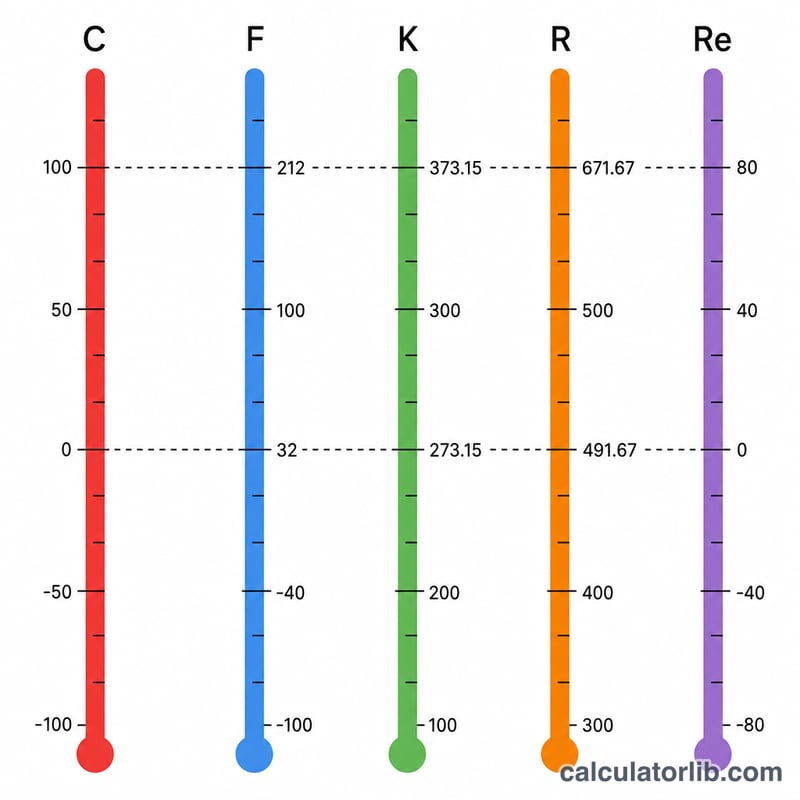
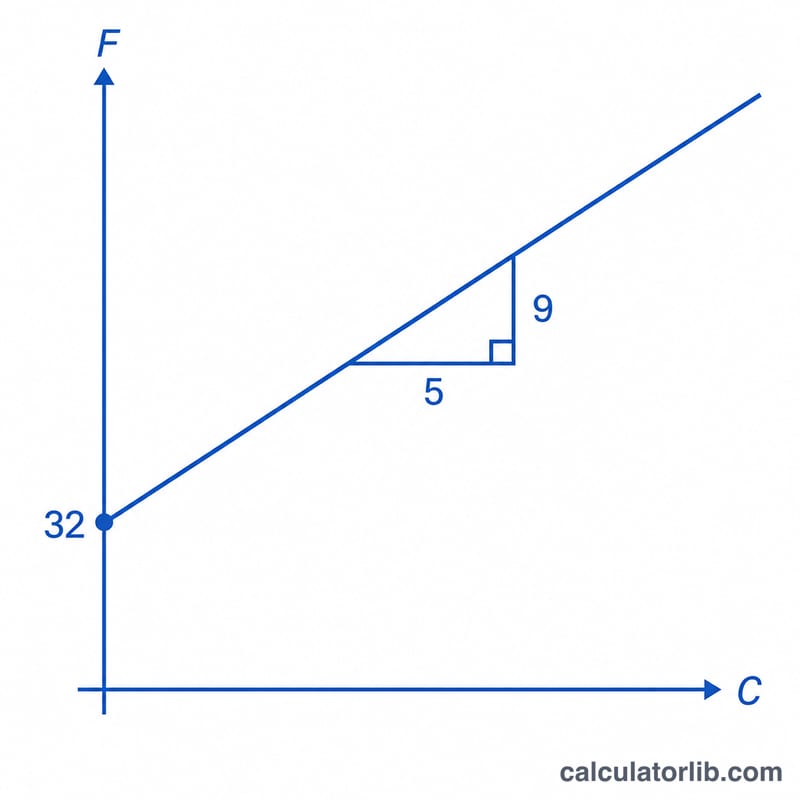
The calculator uses Celsius as a pivot. Step 1 converts your input into Celsius: from Fahrenheit, \(^{\circ}C = (^{\circ}F - 32) \times \tfrac{5}{9}\); from Kelvin, \(^{\circ}C = K - 273.15\); from Rankine, \(^{\circ}C = (^{\circ}R - 491.67) \times \tfrac{5}{9}\); from Reaumur, \(^{\circ}C = {}^{\circ}Re \times \tfrac{5}{4}\). Step 2 converts that Celsius value into the target scale: $$^{\circ}F = {}^{\circ}C \times \tfrac{9}{5} + 32$$ \(K = {}^{\circ}C + 273.15\); \(^{\circ}R = {}^{\circ}C \times \tfrac{9}{5} + 491.67\); \(^{\circ}Re = {}^{\circ}C \times \tfrac{4}{5}\). Using exact fractions (\(\tfrac{9}{5}\), \(\tfrac{5}{9}\), \(\tfrac{4}{5}\), \(\tfrac{5}{4}\)) avoids rounding drift. These scales are affine (multiply and add) because their zero points differ - Kelvin and Rankine start at absolute zero, while Reaumur sets water freezing at 0 and boiling at 80.
Worked example
Convert 50 °C to °F. Step 1: the input is already Celsius, so \(^{\circ}C = 50\). Step 2: $$^{\circ}F = 50 \times \tfrac{9}{5} + 32 = 90 + 32 = 122$$ Therefore 50 °C = 122 °F. As another check, 80 °Re converts to \(^{\circ}C = 80 \times \tfrac{5}{4} = 100\,^{\circ}C\), which is \(100 \times \tfrac{9}{5} + 32 = 212\,^{\circ}F\), the boiling point of water.
FAQ
Why does -40 give the same number in C and F? The Celsius and Fahrenheit lines cross at -40, so -40 °C equals exactly -40 °F.
What is absolute zero? It is 0 K, which equals -273.15 °C and 0 °R (-459.67 °F). On the absolute scales (Kelvin and Rankine) a value below zero is physically impossible.
What is the Reaumur scale? An older scale where water freezes at 0 °Re and boils at 80 °Re, so each Reaumur degree spans 1.25 Celsius degrees.