
What is the Roman Numeral Date Converter?
This tool turns an ordinary calendar date into a Roman numeral string such as XII_XXV_MMXXIV, and can also reverse the process, converting Roman numerals back into ordinary numbers. It is widely used for tattoos, engraved jewelry, wedding bands, anniversary gifts and monument inscriptions, where Roman numeral dates have a classic, timeless look.
How to use it
Enter a value in each of the Month, Day and Year fields. Each field accepts either an Arabic number (like 12) or a Roman numeral (like XII) — the converter detects which you typed and outputs the other form, so it works in both directions, field by field. Choose a Format to set the order the three parts appear: US (month, day, year), EU (day, month, year) or ISO (year, month, day). Pick a Delimiter to set the character placed between parts: dot, mid dot, bullet, dash, space, underline or slash. Leave a field blank to omit it from the result.
The formula explained
To go from Arabic to Roman, the converter uses standard subtractive notation. It walks through value/symbol pairs in descending order \((1000{=}M,\ 900{=}CM,\ 500{=}D,\ 400{=}CD,\ 100{=}C,\ 90{=}XC,\ 50{=}L,\ 40{=}XL,\ 10{=}X,\ 9{=}IX,\ 5{=}V,\ 4{=}IV,\ 1{=}I)\) and greedily appends the largest symbol that fits, subtracting its value, until nothing remains:
$$n = \sum_{i} \text{symbol}_i \quad \text{(greedy subtractive: }1000{=}M,\ 900{=}CM,\ \dots,\ 1{=}I\text{)}$$The greedy loop can be written as:
$$\text{while } n>0:\ \text{append largest symbol} \le n,\ n \mathrel{-}= \text{its value}$$To go from Roman to Arabic, it scans left to right and subtracts a symbol when a larger symbol follows it (as in \(IX = 9\)), otherwise it adds:
$$v = \sum_i \begin{cases} -s_i & s_i < s_{i+1} \\ +s_i & \text{otherwise} \end{cases}$$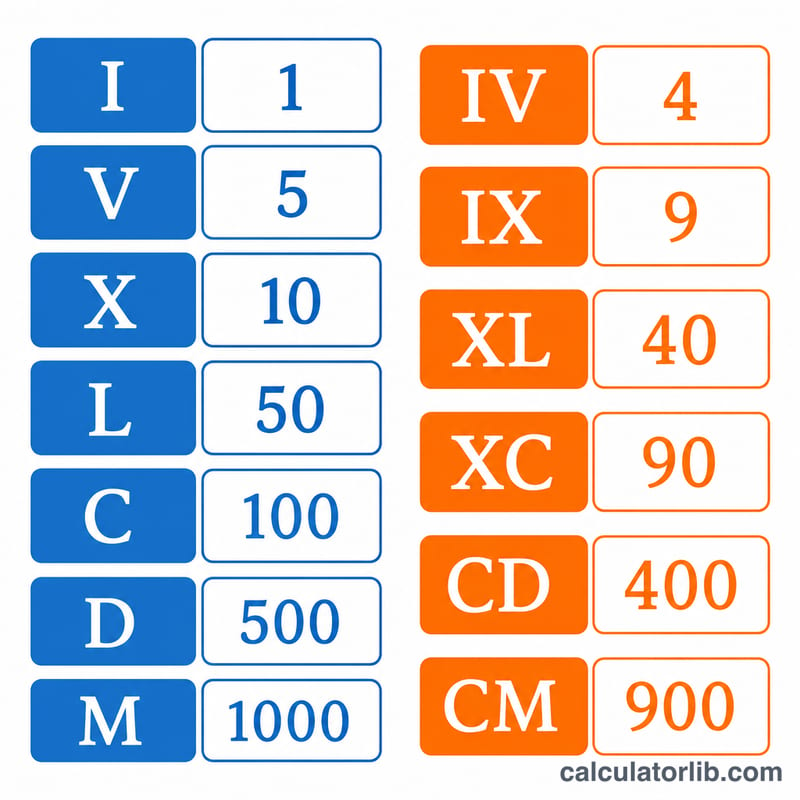
Worked example
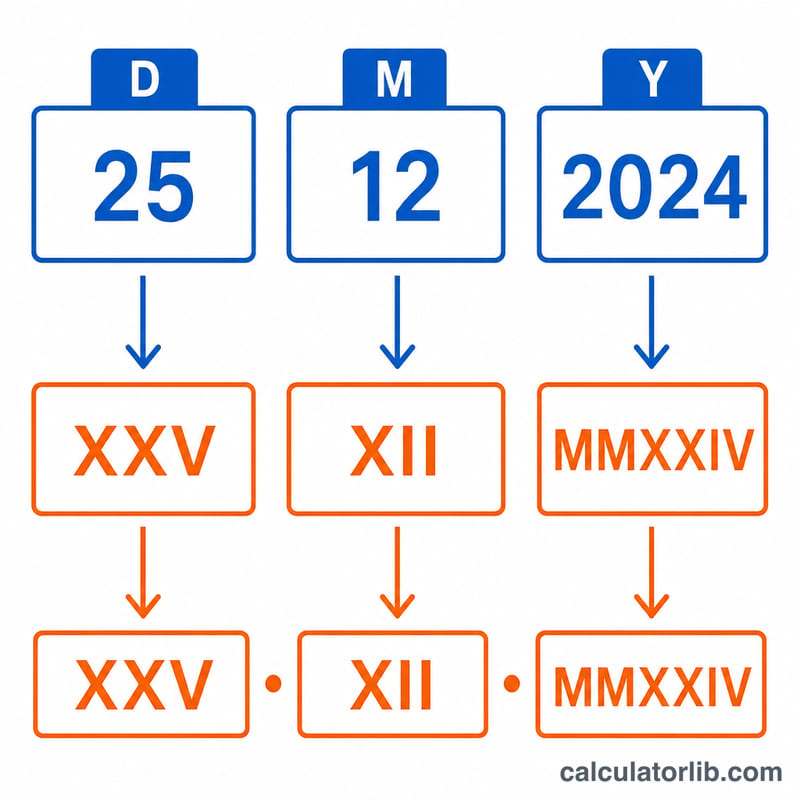
For month=12, day=25, year=2024 with US format and an underline delimiter: \(12\) becomes \(XII\), \(25\) becomes \(XXV\), and \(2024\) becomes \(MMXXIV\) \((MM=2000,\ XX=20,\ IV=4)\). Joined in US order they give XII_XXV_MMXXIV. Switch to ISO order with a dot delimiter and you get MMXXIV.XII.XXV.
FAQ
What is the largest number it can convert? \(3999\) (MMMCMXCIX). Standard Roman numerals have no single symbol for 4000, so larger values are not supported.
Can it show year 0 or negatives? No. Roman numerals have no symbol for zero, and the minimum representable value is \(1\).
Does it check that the date is real? No. Each component is converted independently, so the tool will happily convert a day of 31 in a month of 2 — it is a pure number converter, not a calendar validator.