
What is a Roman Numeral Converter?
This tool converts a standard whole number (an Arabic numeral) into its Roman numeral form. Roman numerals were used throughout the Roman Empire and still appear today on clock faces, book chapters, movie copyright years, and monarch names. The classic system can represent values from 1 to 3999 using seven base symbols.
The Roman Numeral Symbols
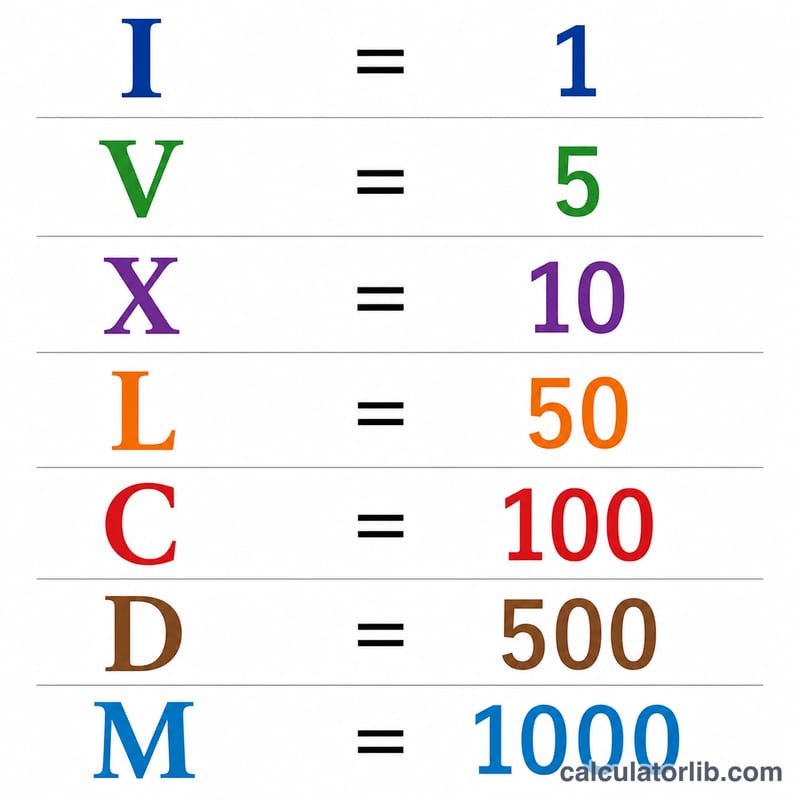
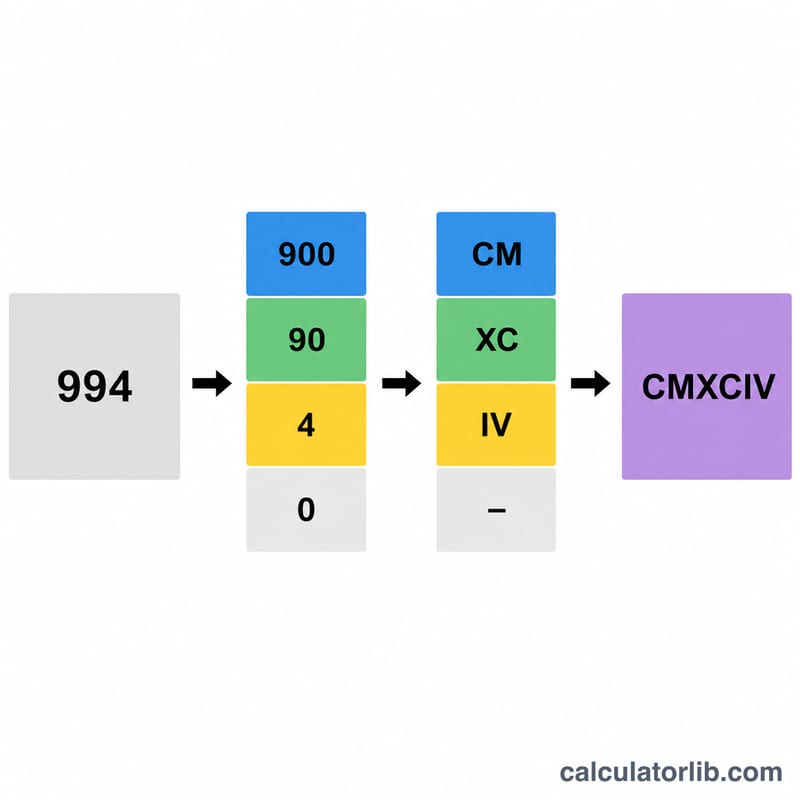
The seven core symbols are: I = 1, V = 5, X = 10, L = 50, C = 100, D = 500 and M = 1000. To avoid four identical symbols in a row, subtractive pairs are used: IV (4), IX (9), XL (40), XC (90), CD (400) and CM (900).
How the Conversion Works
The converter uses a greedy algorithm over an ordered list of 13 value-symbol pairs, from largest (1000 = M) to smallest (1 = I). Starting with the full number, it repeatedly subtracts the largest pair value that still fits and appends that symbol, until nothing remains. Because the pairs include the subtractive forms (CM, CD, XC, XL, IX, IV), the output is always the correct, standard representation.
$$\text{Roman} = \bigoplus_{i}\; \text{sym}_i \times \left\lfloor \frac{R_i}{v_i} \right\rfloor, \quad R_0 = \text{Number}$$
Worked Example
Take 2024. Subtract 1000 (M) → 1024, append M again → 24 left? No: \(2024 - 1000 = 1024\), then \(-\,1000 = 24\) gives "MM". Now 24: subtract 10 (X) twice → 4 left, output "XX". Finally \(4 = \text{IV}\). The result is MMXXIV.
FAQ
Why does it stop at 3999? The standard Roman system has no symbol above M, so the largest cleanly writable value with only M is 3999 (MMMCMXCIX). Larger numbers require bars (vinculum) that are not part of the basic notation.
Is there a Roman numeral for zero? No. The Romans had no symbol for zero; the system only represents positive integers.
Why use IV instead of IIII? The subtractive rule keeps numerals short and avoids more than three repeats of a symbol — though IIII is sometimes seen on clocks for visual balance.