
What is the Roman Numeral Calculator?
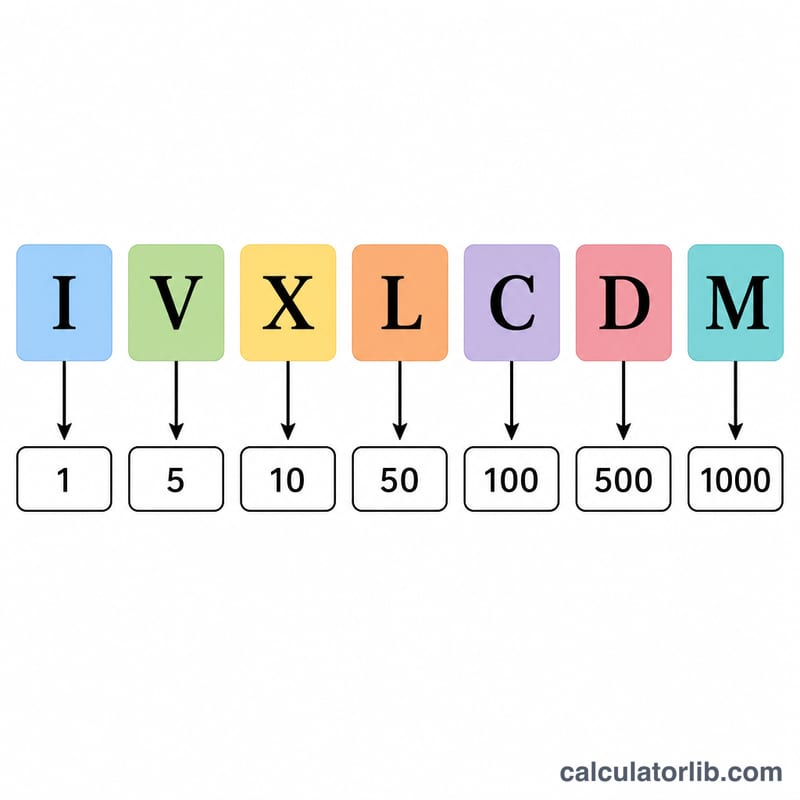
This tool performs arithmetic on Roman numerals. Enter two values - each can be a Roman numeral (using I, V, X, L, C, D, M) or an ordinary integer - choose an operator, and the calculator returns the answer as both a Roman numeral and a standard Arabic (decimal) number, along with a short step trace. It is ideal for students, teachers, history and Latin classes, puzzle-solvers, and anyone decoding clock faces, copyrights, or building cornerstones.
How to use it
Type Numeral 1 (for example DCCXXVI or simply 726), pick the operator - add, subtract, multiply or divide - then type Numeral 2 (for example XLVIII or 48). Input is case-insensitive and is shown in uppercase. Results that are zero or negative, and division by zero, are flagged because Roman numerals have no symbol for zero, negatives, or fractions.
The formula explained
First each input is parsed to an integer using the standard subtractive rule: scanning left to right, a symbol is subtracted when it is smaller than the symbol immediately to its right, otherwise it is added.
$$\text{value} = \sum_i \begin{cases} -v_i & v_i < v_{i+1} \\ +v_i & \text{otherwise} \end{cases}$$Then the chosen operation (\(a + b\), \(a - b\), \(a \times b\), or \(a / b\)) is applied to the two integers.
$$\text{result} = \text{value}(N_1) \; \square \; \text{value}(N_2) \;\rightarrow\; \text{Roman}$$Finally the integer result is converted back to Roman with a greedy algorithm using the ordered values 1000=M, 900=CM, 500=D, 400=CD, 100=C, 90=XC, 50=L, 40=XL, 10=X, 9=IX, 5=V, 4=IV, 1=I.
$$\text{result} = \text{Roman}\big(a \;\square\; b\big)$$Division uses the whole-number (floor) quotient because Roman numerals cannot express fractions.
Worked example
DCCXXVI (726) + XLVIII (48) = 774. Converting 774:
$$\text{DCC}\,(700) + \text{L}\,(50) + \text{XX}\,(20) + \text{IV}\,(4) = \textbf{DCCLXXIV}$$So the result is DCCLXXIV, or 774 in Arabic numerals. Another:
$$\text{XII}\,(12) \times \text{IV}\,(4) = 48 = \text{XLVIII}$$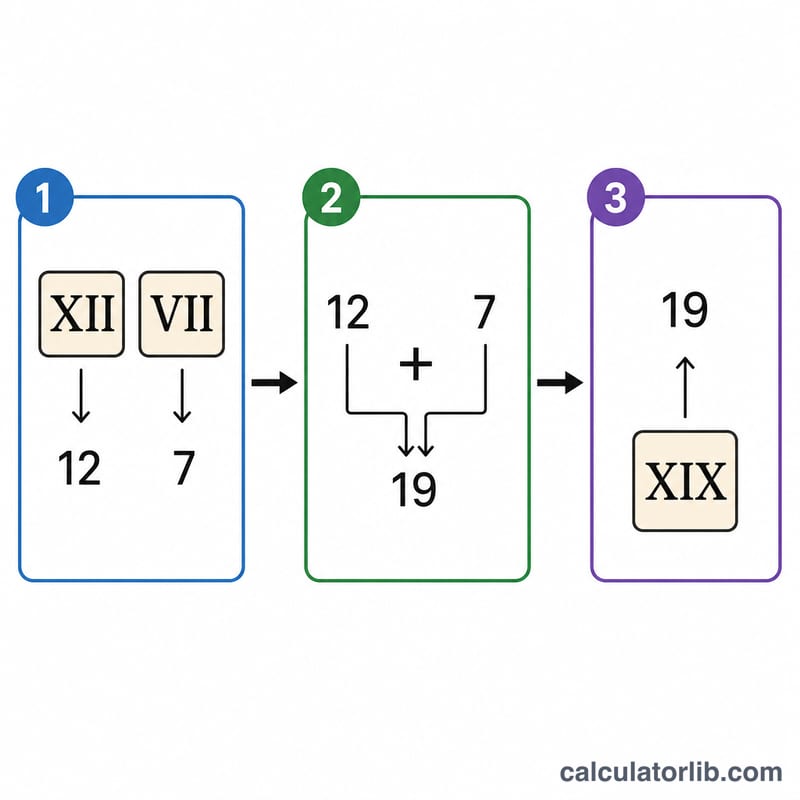
FAQ
Can I mix Roman and Arabic input? Yes - either field accepts a Roman numeral string or a plain integer, in any combination.
What if subtraction gives zero or a negative? Roman numerals have no representation for zero or negative numbers, so the calculator returns a note instead of a numeral.
How is division handled? The result is the integer quotient (the remainder, if any, is reported and dropped) since Roman numerals have no fractions.