
What Is the Kelvin to Rankine Converter?
This tool converts a temperature from the Kelvin (K) scale to the Rankine (°R) scale. Both are absolute temperature scales that start at absolute zero, the coldest possible temperature. The difference is the size of one degree: the Kelvin uses the same degree size as Celsius, while the Rankine uses the same degree size as Fahrenheit. Because they share the same zero point, converting between them needs only a simple multiplication.
How to Use It
Enter a temperature in Kelvin in the input box and the converter instantly returns the equivalent value in Rankine, along with the substitution steps. Kelvin and Rankine are both absolute scales, so values should be zero or positive; a negative value would lie below absolute zero, which is not physically meaningful.
The Formula Explained
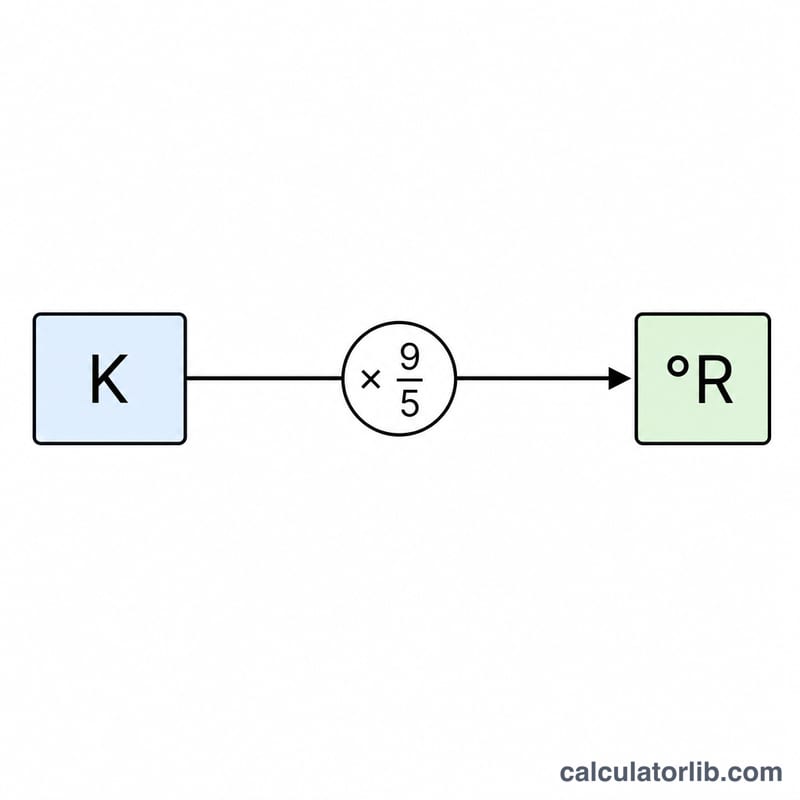
The conversion is $$\text{°R} = \text{K} \times \frac{9}{5}$$ which is the same as $$\text{°R} = \text{K} \times 1.8$$ There is no offset or intercept term because 0 K equals 0 °R exactly. Each single Kelvin therefore equals 1.8 Rankine degrees. The reverse conversion divides by 1.8 \((\text{K} = \text{°R} \times \frac{5}{9})\).
Worked Example
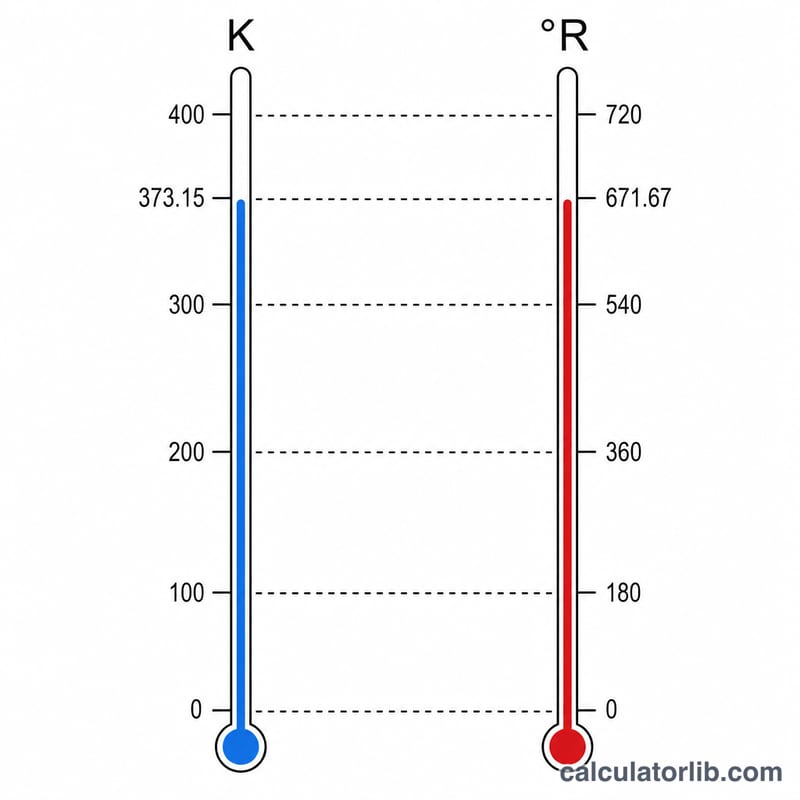
Convert 100 K to Rankine: $$\text{°R} = 100 \times \frac{9}{5} = 100 \times 1.8 = 180 \text{ °R}$$ As a check, the freezing point of water, 273.15 K, converts to \(273.15 \times 1.8 = 491.67 \text{ °R}\), which matches the known reference value.
Reference Points
Absolute zero: \(0 \text{ K} = 0 \text{ °R}\). Freezing point of water: \(273.15 \text{ K} = 491.67 \text{ °R}\). Boiling point of water: \(373.15 \text{ K} = 671.67 \text{ °R}\).
FAQ
Is there an offset like in Celsius-to-Fahrenheit? No. Both Kelvin and Rankine begin at absolute zero, so you only multiply by 1.8 with no added or subtracted constant.
Can the input be negative? Not physically. Negative Kelvin would be below absolute zero, which does not exist, so inputs should be zero or positive.
How do I convert back from Rankine to Kelvin? Divide the Rankine value by 1.8, since \(\text{K} = \text{°R} \times \frac{5}{9}\).