
What is the Celsius to Rankine Converter?
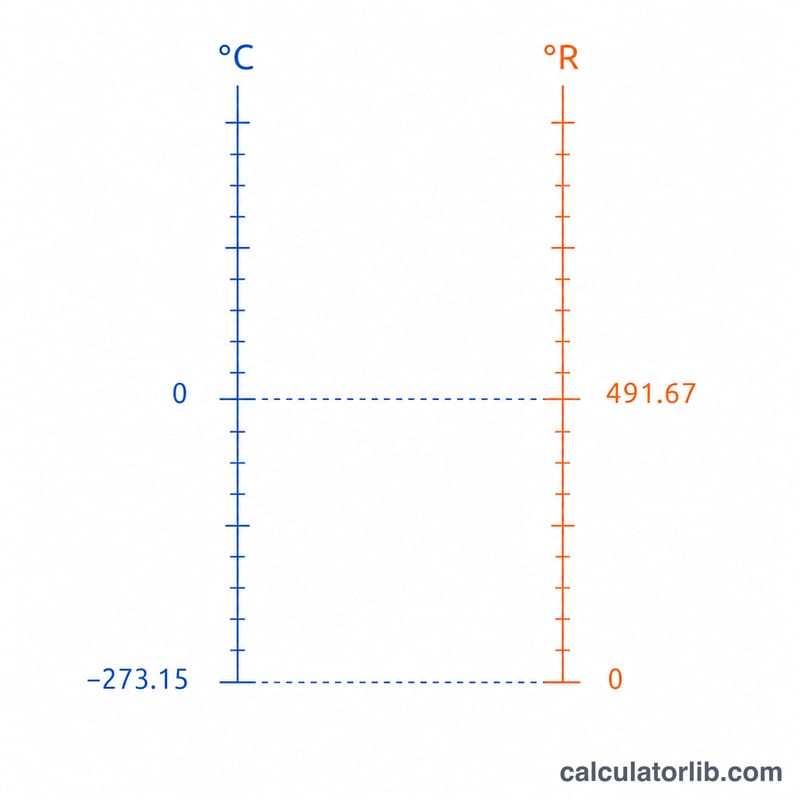
This tool converts a temperature given in degrees Celsius (°C) to degrees Rankine (°R). Rankine is an absolute temperature scale where 0 °R is absolute zero, but each Rankine degree is the same size as a Fahrenheit degree rather than a Celsius/Kelvin degree. The scale is used mainly in some engineering and thermodynamics contexts in the United States.
How to use it
Enter your temperature in the Celsius field (it can be negative) and the converter returns the equivalent Rankine value rounded to two decimal places, along with the two calculation steps. The default value is 15 °C.
The formula explained
The conversion is a simple affine (linear) transform:
$$\text{°R} = \text{°C} \times 1.8 + 491.67$$
The factor 1.8 (equal to \(9/5\)) rescales each Celsius degree into Fahrenheit/Rankine sized degrees. The offset 491.67 shifts the zero point so that the freezing point of water (0 °C) lands at 491.67 °R. It comes from converting through Kelvin: \(K = \text{°C} + 273.15\) and \(\text{°R} = K \times 1.8\), which gives $$\text{°R} = (\text{°C} + 273.15) \times 1.8 = \text{°C} \times 1.8 + 491.67.$$
Worked example
Convert 15 °C to Rankine:
Step 1: \(15 \times 1.8 = 27\). Step 2: \(27 + 491.67 = 518.67\). So \(15\ \text{°C} = 518.67\ \text{°R}\).
FAQ
What is 0 °C in Rankine? \(0 \times 1.8 + 491.67 = 491.67\ \text{°R}\), the freezing point of water on the Rankine scale.
What is the boiling point of water in Rankine? 100 °C gives \(100 \times 1.8 + 491.67 = 671.67\ \text{°R}\).
Can Rankine be negative? Physically no — 0 °R is absolute zero. The formula can produce a negative number only if the Celsius input is below −273.15 °C, which is physically impossible; the tool warns you in that case.