What this converter does
This tool converts a temperature between the Fahrenheit and Celsius scales in either direction. Choose "°F to °C" to turn a Fahrenheit reading into Celsius, or "°C to °F" for the reverse. It is a pure unit-conversion tool, so the result is the same anywhere in the world. Both scales accept negative values, since temperatures can fall below the zero of either scale.
How to use it
Pick the conversion direction, type the temperature into the field that appears, and read the converted value plus the worked formula below it. Decimal inputs such as 98.6 are fine, and the answer is rounded to two decimal places.
The formula explained
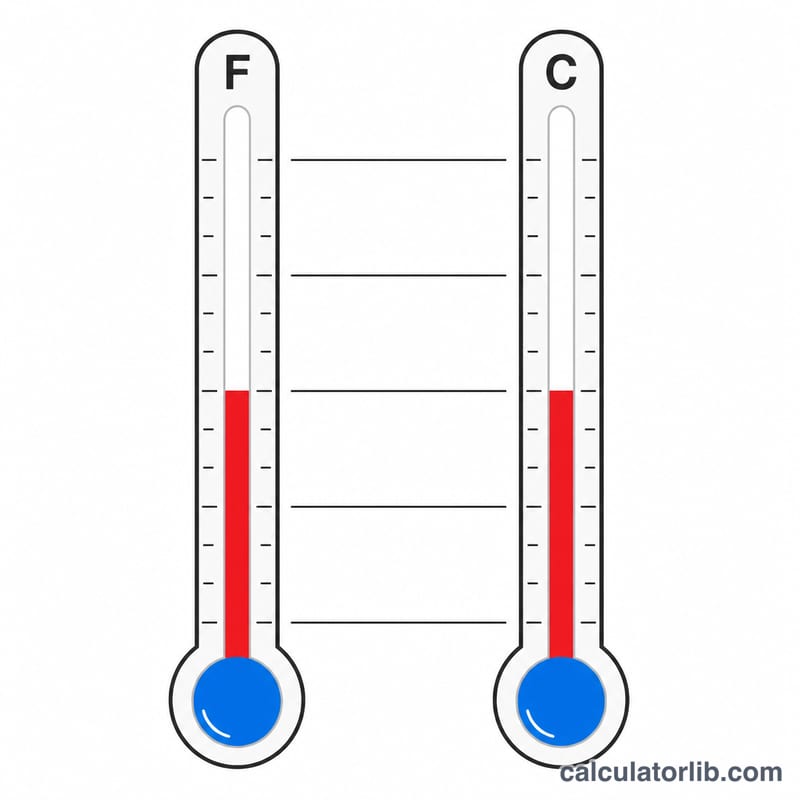
The Celsius and Fahrenheit scales are linked by an affine (straight-line) relationship. Fahrenheit puts the freezing point of water at 32 and the boiling point at 212, a span of 180 degrees, while Celsius spans 100 degrees over the same range. The ratio \(180/100 = 1.8\) (the same as \(9/5\)) is the slope between them.
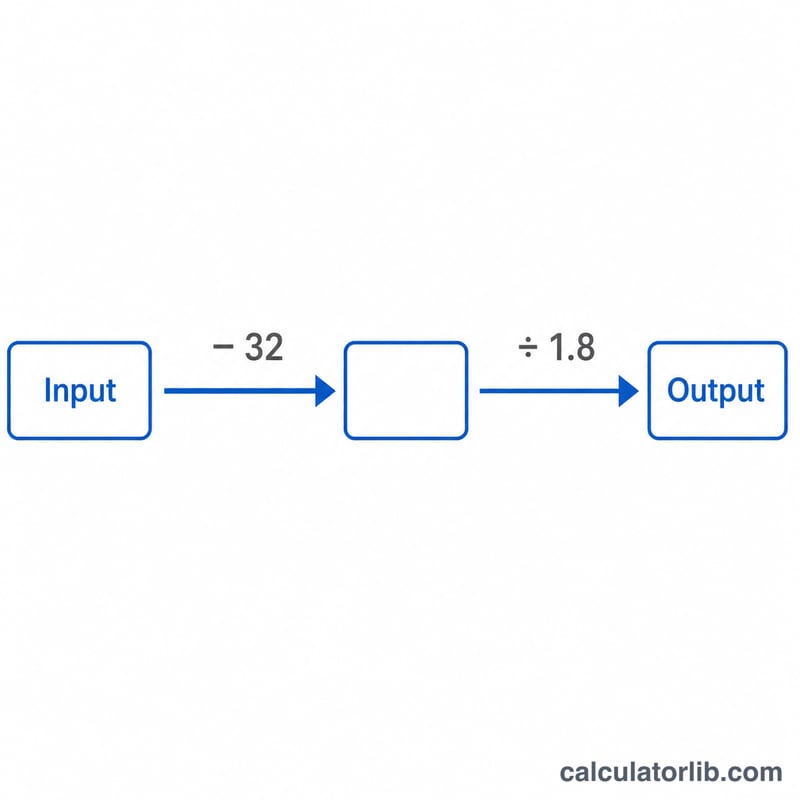
To go from Fahrenheit to Celsius: $$^{\circ}\text{C} = (^{\circ}\text{F} - 32) \div 1.8$$ To go from Celsius to Fahrenheit: $$^{\circ}\text{F} = (^{\circ}\text{C} \times 1.8) + 32$$ Note that \(1.8 = 9/5\) exactly, and dividing by 1.8 is the same as multiplying by \(5/9\) (about 0.5556).
Worked example
Convert 75 °F to Celsius: subtract 32 to get 43, then divide by 1.8 to get 23.888..., which rounds to 23.89 °C. The full calculation is $$^{\circ}\text{C} = (75 - 32) \div 1.8 = 43 \div 1.8 = 23.888\ldots \approx 23.89$$ Going the other way, 25 °C becomes $$^{\circ}\text{F} = (25 \times 1.8) + 32 = 45 + 32 = 77$$ which is 77 °F.
Key Temperature Reference Points
These anchor points are worth memorising: they let you sanity-check any conversion at a glance. Unless stated otherwise, values are given at standard atmospheric pressure, 1 atm = 101.325 kPa (roughly sea level).
| Reference point | Fahrenheit (°F) | Celsius (°C) | Notes |
|---|---|---|---|
| Absolute zero | −459.67 | −273.15 | 0 K — the lower limit of the thermodynamic temperature scale; both values are exact by definition |
| Crossover point of the two scales | −40 | −40 | The only temperature where the Fahrenheit and Celsius readings are numerically identical |
| Hard freeze threshold | 28 | −2.2 | Definition used by the US National Weather Service; other national weather services use different wording and thresholds |
| Freezing / melting point of water | 32 | 0 | At 1 atm, pure water. Exact by convention on both scales |
| Frost-risk band | 32–36 | 0–2.2 | Ground frost can form even when the air temperature measured at instrument height is a couple of degrees above freezing |
| Typical indoor comfort range | 68–72 | 20–22 | A common guideline range for sedentary indoor activity; formal comfort zones (e.g. ANSI/ASHRAE Standard 55 in the US) depend on humidity, clothing, air speed and season |
| Normal human body temperature | 98.6 | 37 | The traditional 37 °C figure; modern studies put average healthy adult temperature slightly lower and it varies by person, site of measurement and time of day |
| Fever threshold (commonly used) | 100.4 | 38 | A widely used clinical cut-off for fever; exact criteria vary by guideline and measurement site |
| Heat-advisory territory | ~90–105 | ~32–41 | Approximate band in which heat warnings are commonly issued; actual criteria are national and regional (the US NWS uses heat-index thresholds that differ by forecast office, and other countries use their own systems) |
| Boiling point of water | 212 | 100 | At 1 atm; see the note on altitude below |
Why the boiling point is conditional
Water boils when its vapour pressure equals the surrounding pressure, so the boiling point falls as you climb. A useful rule of thumb is roughly 1 °C lower per 285 m of elevation (about 1 °F per 500 ft) in the first few kilometres of altitude. At around 1,600 m (5,300 ft) water boils near 95 °C (203 °F), which is why high-altitude cooking times are longer. The freezing point moves far less with pressure and is a much more stable everyday reference.
A precision note: 100 °C is the conventional value fixed by the original definition of the Celsius scale. On the modern ITS-90 temperature scale, the boiling point of water at exactly 101.325 kPa is about 99.974 °C — a difference far below the resolution of any household thermometer, but it is the reason 100 °C is described as conventional rather than defining.
Reading the reference points in the formula
Check the body-temperature row directly:
$$\text{°C} = \frac{98.6 - 32}{1.8} = \frac{66.6}{1.8} = 37$$And the crossover point, which is the fixed point of the conversion:
$$\frac{-40 - 32}{1.8} = \frac{-72}{1.8} = -40$$Because the relationship is linear, any two of these anchors define the whole scale: the 180 Fahrenheit degrees between freezing (32 °F) and boiling (212 °F) span the same interval as the 100 Celsius degrees between 0 °C and 100 °C, which is exactly where the factor \(180/100 = 1.8\) comes from.
Health-related rows above are general information for converting units, not medical advice; interpret body temperature readings with a clinician and follow your local weather service for heat and frost warnings.
FAQ
At what temperature do the two scales meet? At −40 degrees: −40 °F equals exactly −40 °C, the only point where both scales read the same number.
What is normal body temperature? About 98.6 °F, which is 37 °C.
Can I enter values below absolute zero? The calculator does not block them, but anything below −459.67 °F (−273.15 °C) is physically impossible.