What This Calculator Does
This tool converts temperatures between Celsius (°C) and Fahrenheit (°F) in both directions. It is especially handy when adjusting a thermostat that uses one scale while you think in the other, comparing weather forecasts across regions, or following a recipe written for a different country. Choose your direction, type a temperature, and get an instant, accurate answer.
How to Use It
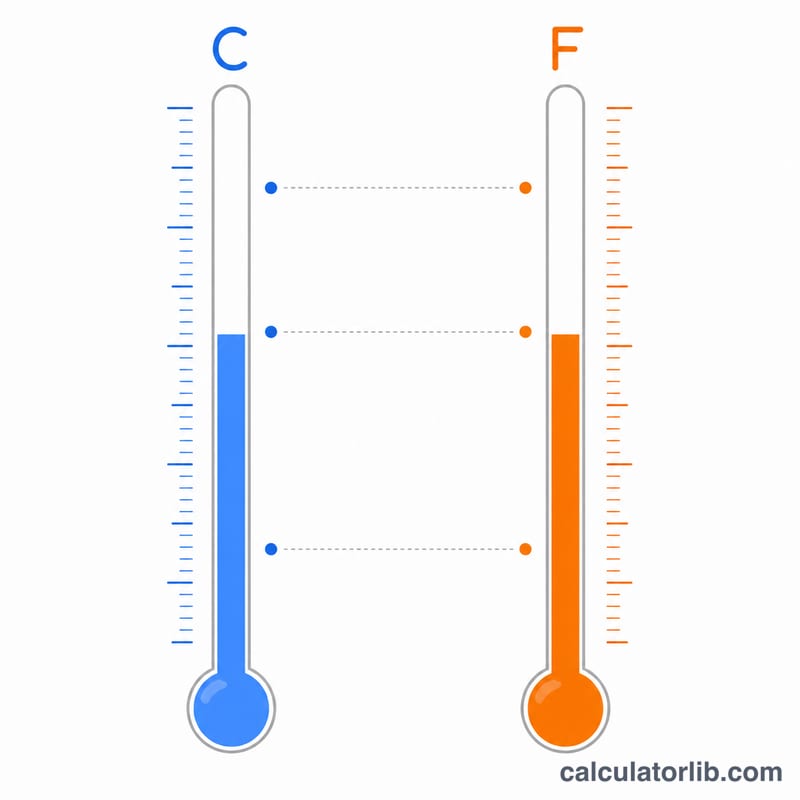
Pick whether you want to convert Celsius → Fahrenheit or Fahrenheit → Celsius, enter the temperature value (decimals and negatives are allowed), and the result appears immediately. For example, a comfortable home thermostat setting of 21°C equals about 70°F.
The Formula Explained
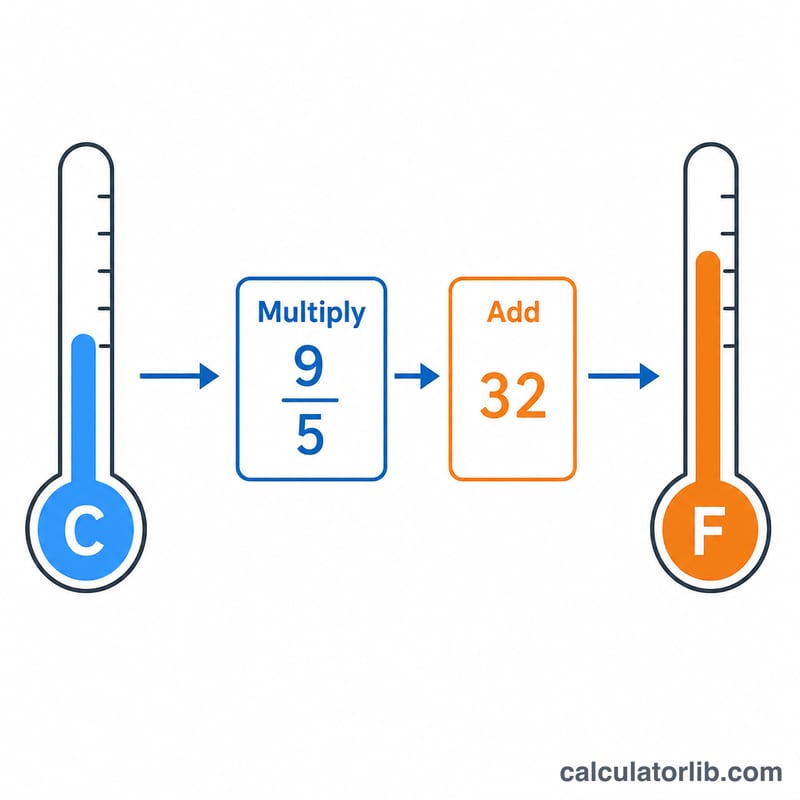
To go from Celsius to Fahrenheit, multiply by 9/5 (which is 1.8) and add 32: $$\text{°C} \times \frac{9}{5} + 32 = \text{°F}$$. The factor \(\frac{9}{5}\) stretches the degree size because a Celsius degree is larger than a Fahrenheit degree, and the +32 shifts the zero point, since water freezes at 0°C but 32°F. To reverse the process, subtract 32 first and then multiply by 5/9: $$\left(\text{°F} - 32\right) \times \frac{5}{9} = \text{°C}$$.
Worked Example
Suppose your oven recipe calls for 200°C. Multiply: $$200 \times \frac{9}{5} = 360.$$ Add 32: $$360 + 32 = \textbf{392°F}.$$ Going the other way, 98.6°F body temperature converts as $$\left(98.6 - 32\right) \times \frac{5}{9} = 66.6 \times \frac{5}{9} = \textbf{37°C}.$$
Celsius to Fahrenheit Conversion Chart
Every value in this chart comes from the standard formula \(F = C \times \tfrac{9}{5} + 32\). Where the result is not a whole number, it is rounded to 0.1 °F. Each 1 °C step equals 1.8 °F. That is why the thermostat rows below go up by 1.8 °F each time. For example, \(21 \times \tfrac{9}{5} + 32 = 37.8 + 32 = 69.8\), so 21 °C is 69.8 °F.
Cold weather (−40 to 0 °C)
| °C | °F |
|---|---|
| −40 | −40 (the two scales read the same here) |
| −35 | −31 |
| −30 | −22 |
| −25 | −13 |
| −20 | −4 |
| −15 | 5 |
| −10 | 14 |
| −5 | 23 |
| 0 | 32 (water freezes) |
Everyday thermostat settings (16 to 26 °C)
| °C | °F |
|---|---|
| 16 | 60.8 |
| 17 | 62.6 |
| 18 | 64.4 |
| 19 | 66.2 |
| 20 | 68 |
| 21 | 69.8 |
| 22 | 71.6 |
| 23 | 73.4 |
| 24 | 75.2 |
| 25 | 77 |
| 26 | 78.8 |
Warm weather and body temperature
| °C | °F |
|---|---|
| 30 | 86 |
| 35 | 95 |
| 37 | 98.6 (normal body temperature) |
| 40 | 104 |
| 100 | 212 (water boils at sea level) |
Common oven settings
| °C | °F |
|---|---|
| 150 | 302 |
| 160 | 320 |
| 180 | 356 |
| 200 | 392 |
| 220 | 428 |
| 230 | 446 |
Key reference points
- Water freezes: 0 °C = 32 °F.
- Water boils: 100 °C = 212 °F at sea level, which means standard atmospheric pressure. At higher altitudes water boils at a lower temperature.
- Normal body temperature: 37 °C = 98.6 °F. This is the traditional reference value. A healthy person's temperature varies a little during the day and from person to person.
- Where the scales meet: −40 °C = −40 °F.
Recipes and oven dials often round these numbers. A recipe may say 180 °C where the dial shows 350 °F, which is close to the exact 356 °F.
FAQ
At what temperature are Celsius and Fahrenheit equal? At \(-40°\), where \(-40\text{°C} = -40\text{°F}\).
What is room temperature in Fahrenheit? A typical room temperature of 20–22°C is roughly 68–72°F.
Does this work for negative temperatures? Yes. For example, \(-10\text{°C} = 14\text{°F}\), and the formula handles any value you enter.