
What This Calculator Does
This tool estimates the carbon dioxide (CO2) emissions produced by your electricity consumption. You enter the amount of electricity used in kilowatt-hours (kWh) and the emission factor of your electricity grid, and it returns the equivalent CO2 in kilograms and metric tonnes. It is useful for carbon footprint tracking, sustainability reporting, and understanding the climate impact of energy use.
How to Use It
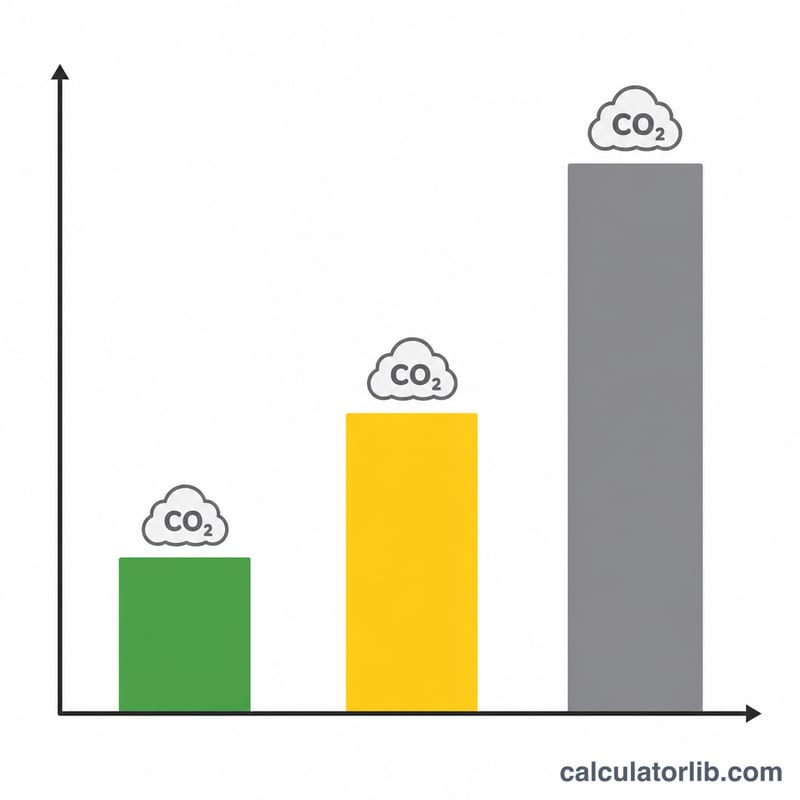
Enter the total electricity used in kWh (for example, from a monthly utility bill). Then enter your grid's emission factor in kg CO2 per kWh. This factor varies by country and energy mix — a coal-heavy grid may exceed 0.8 kg/kWh, while a grid rich in hydro, nuclear, or renewables can be below 0.1 kg/kWh. A global average of roughly 0.4 kg/kWh is a reasonable default. Check your local utility or national energy agency for an exact figure.
The Formula Explained
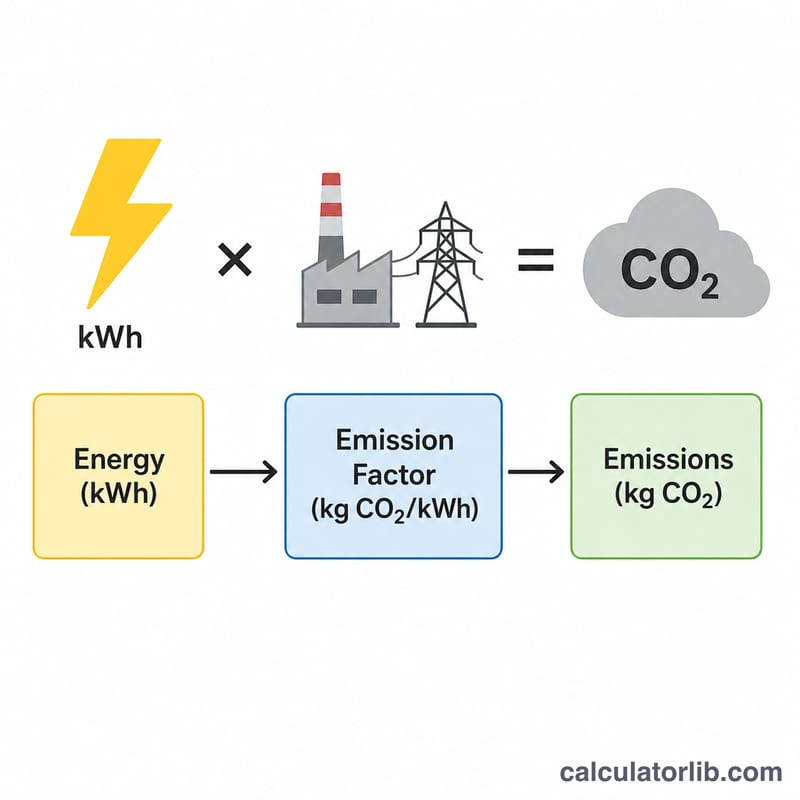
The calculation is straightforward: $$\text{CO}_2\,(\text{kg}) = \text{kWh} \times \text{Emission Factor (kg/kWh)}$$ The emission factor represents how much CO2 is released to generate one kWh of electricity on your grid. Multiplying it by your consumption gives total emissions. Dividing by 1000 converts kilograms to metric tonnes.
Worked Example
Suppose your household used 1,000 kWh last month and your grid emission factor is 0.4 kg CO2 per kWh. Then: $$1{,}000 \times 0.4 = 400 \text{ kg CO}_2$$ which is 0.4 metric tonnes. Over a year at the same rate, that's about 4,800 kg (4.8 tonnes) of CO2 from electricity alone.
FAQ
What emission factor should I use? Use your country's published grid factor if available. As a fallback, \(0.4\) kg/kWh approximates a global average.
Does this include transmission losses? No — this is a simple direct estimate. Some official factors already bake in grid losses; check your source.
Is renewable electricity zero emissions? At the point of use, renewables emit near zero, so a low or zero emission factor reflects a clean grid.