
What is the Power Station Runtime Calculator?
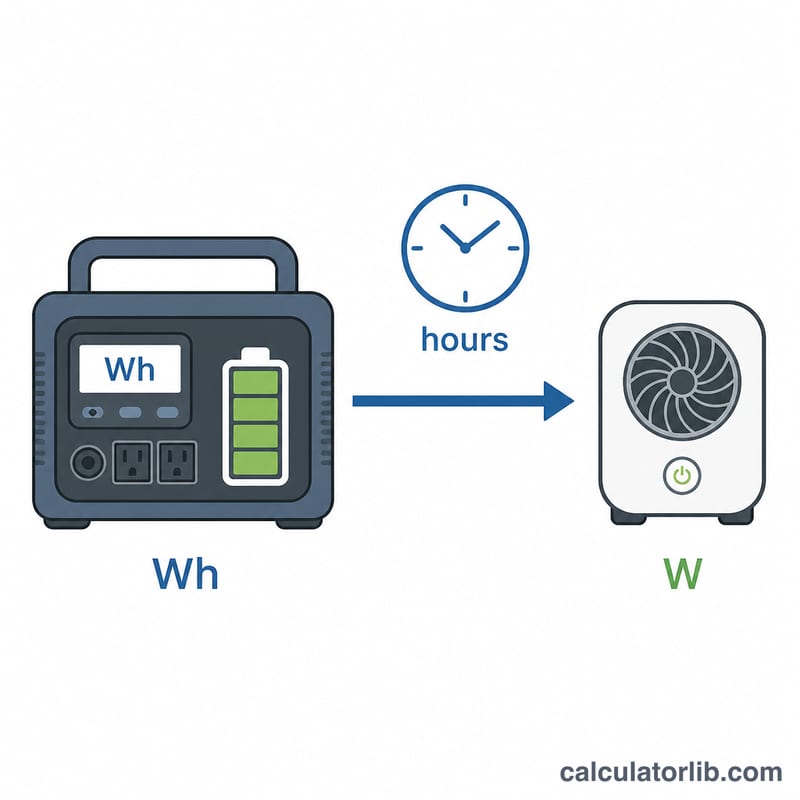
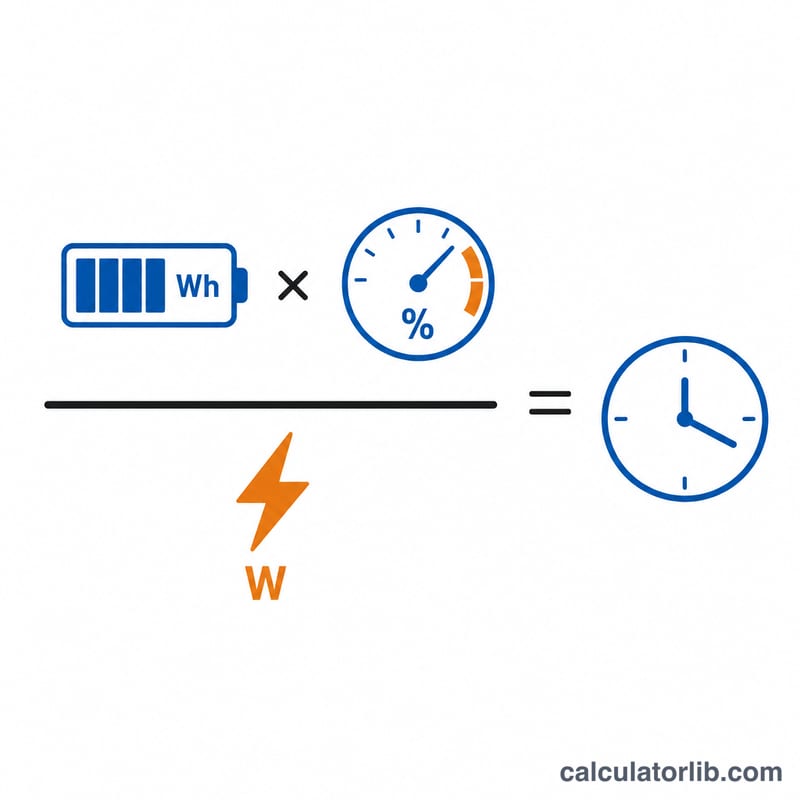
This tool estimates how long a portable power station, solar generator, or battery pack will power a device. Battery capacity is given in watt-hours (Wh), the appliance draws a certain number of watts (W), and an efficiency factor accounts for inverter and conversion losses. The result is the approximate runtime in hours.
How to use it
Enter three values: the battery capacity in watt-hours (often printed on the unit, e.g. 1000 Wh), the continuous power draw of your device in watts, and an efficiency percentage. A typical AC inverter is 80–90% efficient; DC outputs are higher. The calculator returns total runtime plus a friendly hours-and-minutes breakdown and the usable energy after losses.
The formula explained
$$\text{Runtime (hours)} = \frac{\text{Battery (Wh)} \times \dfrac{\text{Efficiency (\%)}}{100}}{\text{Load (W)}}$$ Efficiency is entered as a percentage and converted to a fraction. Multiplying capacity by efficiency gives the usable energy; dividing by the load gives time. The units cancel cleanly: watt-hours divided by watts equals hours.
Worked example
Suppose you have a 1000 Wh power station running a 100 W mini-fridge at 85% efficiency. Usable energy = \(1000 \times 0.85 = 850\) Wh. Runtime = \(850 \div 100 = 8.5\) hours, or about 8 h 30 min. Lowering the load to 50 W would roughly double the runtime to 17 hours.
FAQ
What efficiency should I use? For AC devices through an inverter, 85% is a reasonable default. For direct DC (USB, car ports) use 90–95%.
Why is my real runtime shorter? Batteries are rarely discharged to 0%, temperature reduces capacity, and startup surges and varying loads all reduce real-world runtime.
How do I convert amp-hours to watt-hours? Multiply amp-hours by the battery voltage: \(\text{Wh} = \text{Ah} \times \text{V}\). A 100 Ah, 12 V battery is 1200 Wh.