What Is the Wh to Ah Calculator?
This calculator converts a battery's energy rating in watt-hours (Wh) into its capacity in amp-hours (Ah). Watt-hours measure total energy, while amp-hours measure charge at a given voltage. Because the two depend on each other, you need the battery's nominal voltage to switch between them. The tool also shows the result in milliamp-hours (mAh) for smaller cells.
How to Use It
Enter the energy in watt-hours and the battery's nominal voltage. Click calculate to see the capacity in amp-hours and milliamp-hours. For a typical lead-acid or LiFePO₄ system use 12 V, 24 V, or 48 V; for a single lithium-ion cell use about 3.7 V.
The Formula Explained
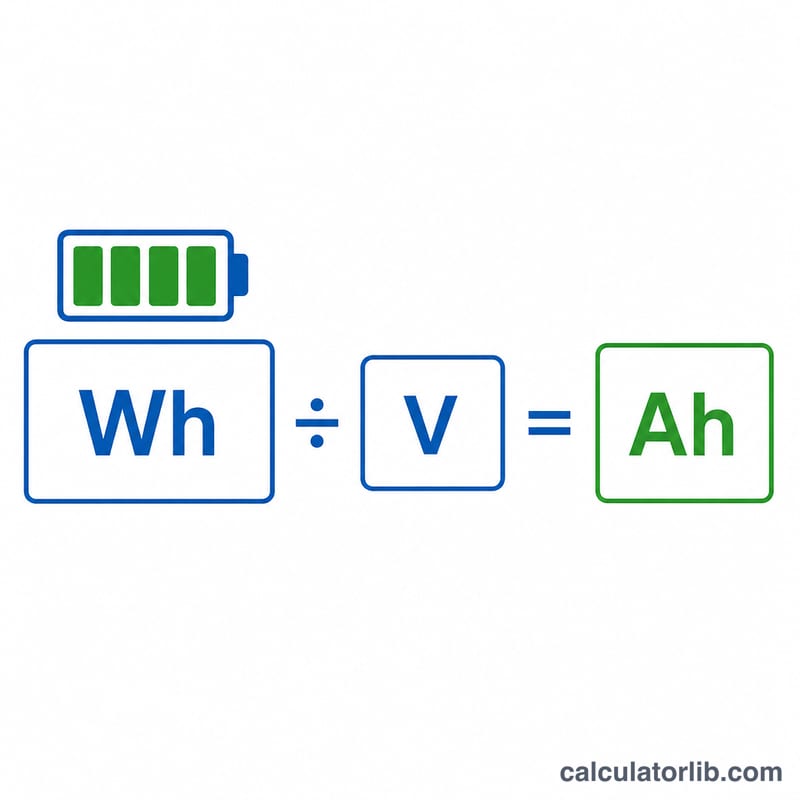
The relationship is simply $$\text{Ah} = \frac{\text{Wh}}{\text{V}}$$ Energy (in watt-hours) is power multiplied by time, and power equals voltage times current. Dividing energy by voltage removes the voltage term and leaves charge over time — amp-hours. Note the result depends entirely on the voltage you choose, so always use the battery's nominal voltage.
Worked Example
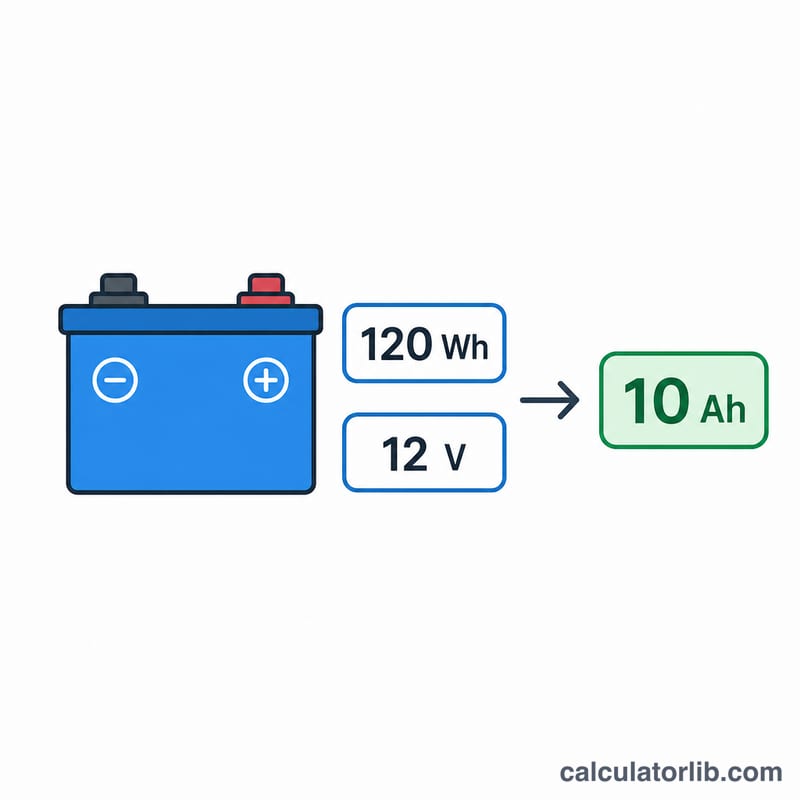
A solar battery is rated at 1200 Wh and runs at 12 V. Capacity $$= 1200 \div 12 = \textbf{100 Ah},$$ equal to 100,000 mAh. If the same energy were stored at 24 V, the capacity would be only 50 Ah, since higher voltage stores the same energy with less charge.
Wh to Ah Across Common Battery Voltages
Capacity in amp-hours depends entirely on the voltage you divide by. The same stored energy can be labelled 100 Ah or 50 Ah depending on whether the pack is wired as a 12 V or a 24 V system, so always read the nominal voltage printed alongside an Ah figure. All rows below use \( \text{Ah} = \text{Wh} \div \text{V} \), then \( \text{mAh} = \text{Ah} \times 1000 \).
| Energy (Wh) | Nominal voltage (V) | Capacity (Ah) | Capacity (mAh) | Typical application |
|---|---|---|---|---|
| 18.5 | 3.7 | 5.00 | 5,000 | Single Li-ion cell / small USB power bank |
| 100 | 11.1 | 9.01 | 9,009 | Laptop / 3S Li-ion pack — at the 100 Wh airline carry-on threshold |
| 1200 | 12 | 100.00 | 100,000 | 12 V lead-acid or LiFePO4 solar / RV battery bank |
| 1200 | 24 | 50.00 | 50,000 | Identical energy rewired as a 24 V system |
| 5120 | 51.2 | 100.00 | 100,000 | 48 V-class (16S) LiFePO4 home storage rack |
| 75 | 3.6 | 20.83 | 20,833 | Parallel cell string inside an e-bike pack |
Worked substitution for the laptop row:
$$\text{Ah} = \frac{100\ \text{Wh}}{11.1\ \text{V}} = 9.009\ \text{Ah} \approx 9{,}009\ \text{mAh}$$Key Terms and Units Explained
- Watt-hour (Wh) — a unit of energy: one watt drawn for one hour. \( 1\ \text{Wh} = 3600\ \text{J} \). It already accounts for voltage, which is why it is the honest way to compare batteries.
- Amp-hour (Ah) — a unit of electric charge: one ampere flowing for one hour. \( 1\ \text{Ah} = 3600\ \text{C} \). It says nothing about energy on its own.
- Milliamp-hour (mAh) — one thousandth of an amp-hour: \( 1\ \text{Ah} = 1000\ \text{mAh} \). Used for phone, tool and single-cell ratings.
- Nominal voltage — the manufacturer's representative average voltage over a discharge, and the value you should divide by. Typical nominal values: about 3.6–3.7 V for a Li-ion (NMC/LCO) cell, 3.2 V for a LiFePO4 cell, 2.0 V for a lead-acid cell, and 12.8 V for a 4S LiFePO4 pack. These differ from fully-charged voltage, roughly 4.2 V for Li-ion and 3.65 V for LiFePO4 — using the charged voltage understates the Ah figure.
- Rated vs. usable capacity — rated capacity is the full nameplate value measured under the datasheet's test conditions; usable capacity is the portion you may actually draw without harming cycle life.
- Depth of discharge (DoD) — the percentage of rated capacity removed. \( \text{Usable Ah} = \text{Rated Ah} \times \text{DoD} \).
- C-rate — discharge or charge current expressed as a multiple of capacity. For a 100 Ah battery, 1C = 100 A, C/20 = 5 A. Ratings are only valid at the stated C-rate.
- Series (S) vs. parallel (P) — cells in series add voltage and keep Ah the same; cells in parallel add Ah and keep voltage the same. Either way the Wh total is the sum, which is why \( \text{Wh} = \text{Ah} \times \text{V} \) holds for the whole pack. A "4S2P" LiFePO4 pack of 100 Ah cells is 12.8 V, 200 Ah, 2560 Wh.
What Your Ah Result Actually Means
The number this calculator returns is rated capacity at the nominal voltage you entered — a charge figure, not a promise of runtime. Read it with these limits in mind.
- Ah is only comparable at equal voltage. A 50 Ah 24 V pack and a 100 Ah 12 V pack store the same 1200 Wh. Comparing amp-hours across different voltages is meaningless; compare watt-hours instead.
- Rated is not usable. Manufacturer datasheets generally recommend limiting lead-acid batteries to roughly 50% depth of discharge for reasonable cycle life, while LiFePO4 is commonly specified for about 80–100% DoD. A 100 Ah lead-acid bank realistically offers around 50 Ah; check your own cell datasheet, since these are typical industry figures rather than a universal rule.
- Capacity is quoted at a specific discharge rate. Lead-acid capacity is usually rated at C/20 (a 20-hour discharge); lithium is often rated at C/5 or 1C. Draw harder and you get less out — for lead-acid this drop is described by the Peukert effect, and a 100 Ah C/20 battery may deliver noticeably less than 100 Ah at a 1-hour rate. Lithium chemistries are far less sensitive but not immune.
- System losses come off the top. Inverter conversion, wiring resistance, connectors and controller overhead typically consume on the order of 5–15% of stored energy in a real installation, so plan runtime from usable energy after losses, not from nameplate Wh.
- Air travel limits are written in Wh, not Ah. The IATA Dangerous Goods Regulations (adopted by most airlines worldwide, with national variations) set lithium battery carry-on thresholds at 100 Wh and 160 Wh — spare batteries up to 100 Wh are generally allowed, 100–160 Wh usually needs operator approval, and above 160 Wh is normally forbidden in passenger baggage. Because the rule is energy-based, manufacturers print the Wh rating on the pack; an Ah figure alone cannot answer the question. Always confirm current rules with your airline and national authority before flying.
Reverse-checking a pack label is a useful sanity test. A battery marked 12.8 V, 100 Ah should read:
$$\text{Wh} = 100\ \text{Ah} \times 12.8\ \text{V} = 1280\ \text{Wh}$$Converting back gives 100 Ah, confirming the label is internally consistent. If the printed Wh and Ah do not agree at the nominal voltage, one of the two numbers is being quoted at a different voltage or a different test condition.
This section is general technical information; follow your battery manufacturer's datasheet, your installer, and the applicable local electrical and transport regulations for any specific decision.
FAQ
Why do I need voltage? Watt-hours and amp-hours are different quantities; voltage is the bridge that converts between energy and charge.
What voltage should I use? Use the battery's nominal (rated) voltage, not its fully charged peak voltage, for the most accurate everyday capacity.
Can I convert back? Yes — multiply amp-hours by voltage to return to watt-hours: \(\text{Wh} = \text{Ah} \times \text{V}\).