
What This Calculator Does
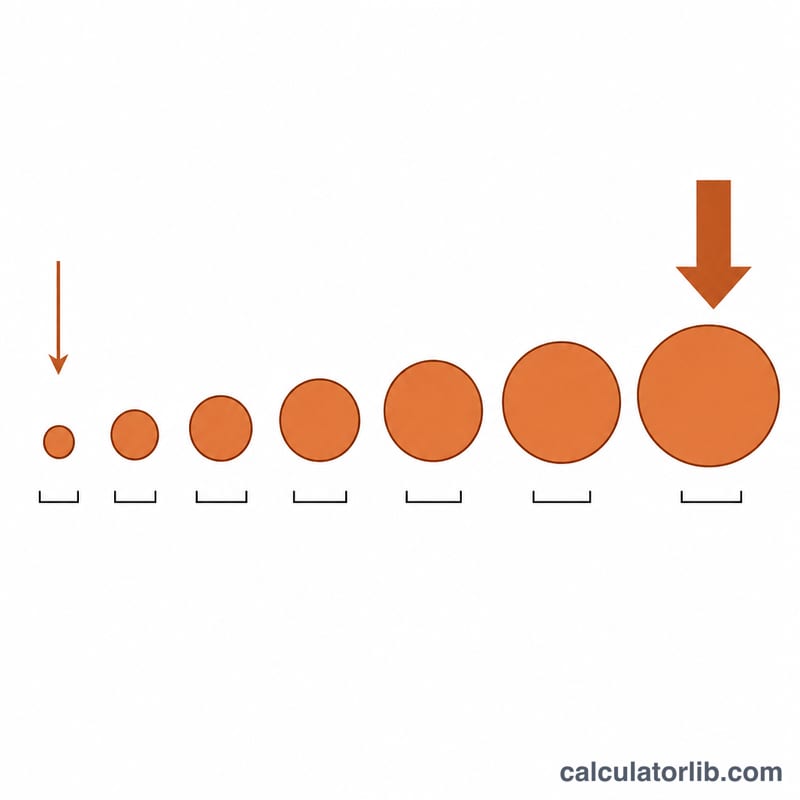
This tool sizes electrical wire (American Wire Gauge, AWG) for a given load by limiting voltage drop. It applies common US/NEC practice, where a maximum voltage drop of about 3% on a branch circuit is recommended. It checks standard copper or aluminum conductors from 14 AWG up to 4/0 and returns the smallest size that keeps the drop within your chosen limit.
How To Use It
Select DC/single-phase or three-phase, then enter your system voltage, the load current in amps, the one-way distance to the load in feet, and your acceptable voltage-drop percentage (3% is typical). Pick copper or aluminum. The calculator returns the recommended gauge plus the actual voltage drop at that size.
The Formula Explained
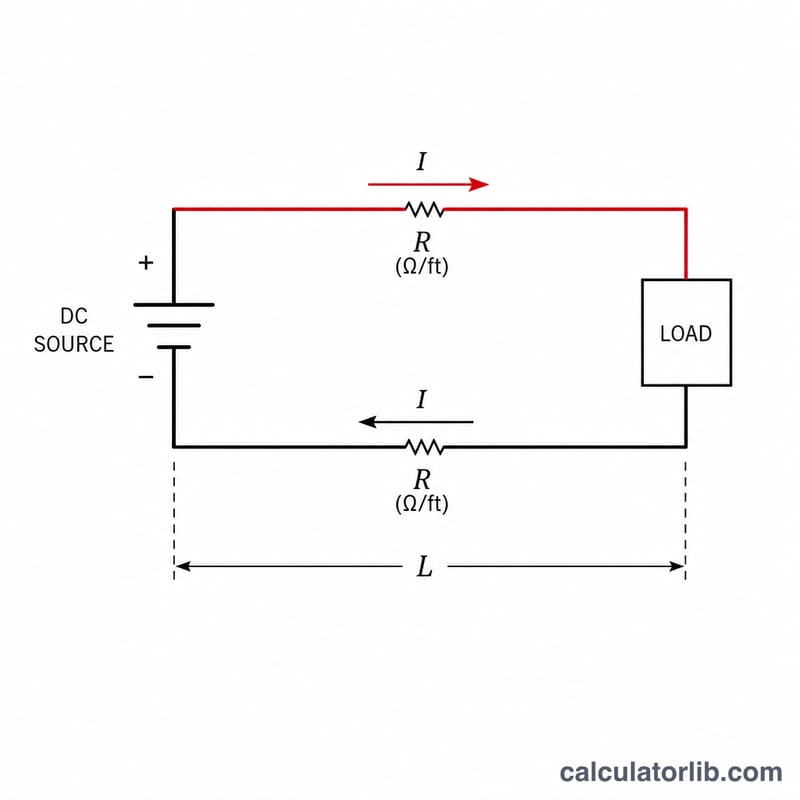
Voltage drop is $$V_{drop} = k \cdot L \cdot I \cdot R_{ft}.$$ Because current flows out and back, single-phase and DC use \(k = 2\) (the distance is doubled). Three-phase uses \(k = \sqrt{3} \approx 1.732\). \(L\) is the one-way run length, \(I\) is the current, and \(R_{ft}\) is the conductor's resistance per foot. Aluminum resistance is roughly \(1.61\times\) that of copper.
Worked Example
A 120 V single-phase circuit carries 20 A over 100 ft of copper, with a 3% limit (3.6 V allowed). For 12 AWG (\(R = 1.93\ \Omega/1000\ \text{ft} = 0.00193\ \Omega/\text{ft}\)): $$V_{drop} = 2 \times 100 \times 20 \times 0.00193 = 7.72\ \text{V}$$ — too high. For 8 AWG (\(0.000764\ \Omega/\text{ft}\)): $$2 \times 100 \times 20 \times 0.000764 = 3.056\ \text{V} \le 3.6\ \text{V}.$$ So 8 AWG is selected (10 AWG would give 4.84 V, still too high).
FAQ
Why is distance doubled? Current travels to the load and returns, so the conductor length the current sees is twice the one-way run.
Should I size for ampacity too? Yes — this tool sizes for voltage drop only. Always verify the conductor also meets NEC ampacity and breaker requirements.
Why does aluminum need a bigger gauge? Aluminum has higher resistance per unit area, so a larger cross-section is needed for the same voltage drop.