What is the Crypto DCA Calculator?
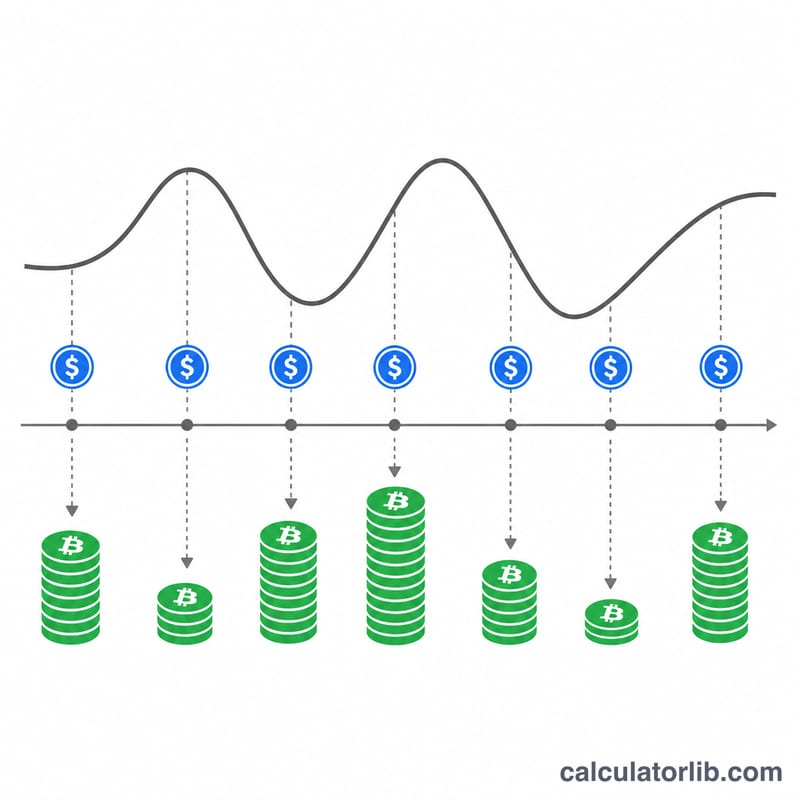
Dollar-cost averaging (DCA) is an investing strategy where you buy a fixed dollar amount of an asset at regular intervals, regardless of price. This calculator models a crypto DCA plan: it accumulates coins period by period at the prevailing price, then values your holdings at a current price so you can see total coins, average cost, profit and return on investment.
How to use it
Enter the amount you invest each period, the number of periods, the asset price at the start and end of your buying window, and the current price you want to value the portfolio at. The tool assumes the price moves linearly between the start and end price across your periods, buying more coins when prices are low and fewer when prices are high — the core benefit of DCA.
The formula explained
For each period i you receive \(\text{Invest} / P_i\) coins. Summing across all periods gives total coins. Your average cost per coin equals total invested divided by total coins. Portfolio value is total coins multiplied by the current price, and ROI is profit divided by total invested.
$$\begin{gathered} \text{ROI} = \frac{N \cdot C - I}{I} \times 100\% \\[1.5em] \text{where}\quad \left\{ \begin{aligned} N &= \sum_{i=0}^{n-1} \frac{\text{Contribution}}{P_i} \\ P_i &= \text{Start Price} + \left(\text{End Price} - \text{Start Price}\right)\frac{i}{n-1} \\ C &= \text{Current Price} \\ I &= \text{Contribution} \cdot \text{Periods} \\ n &= \text{Periods} \end{aligned} \right. \end{gathered}$$
Worked example
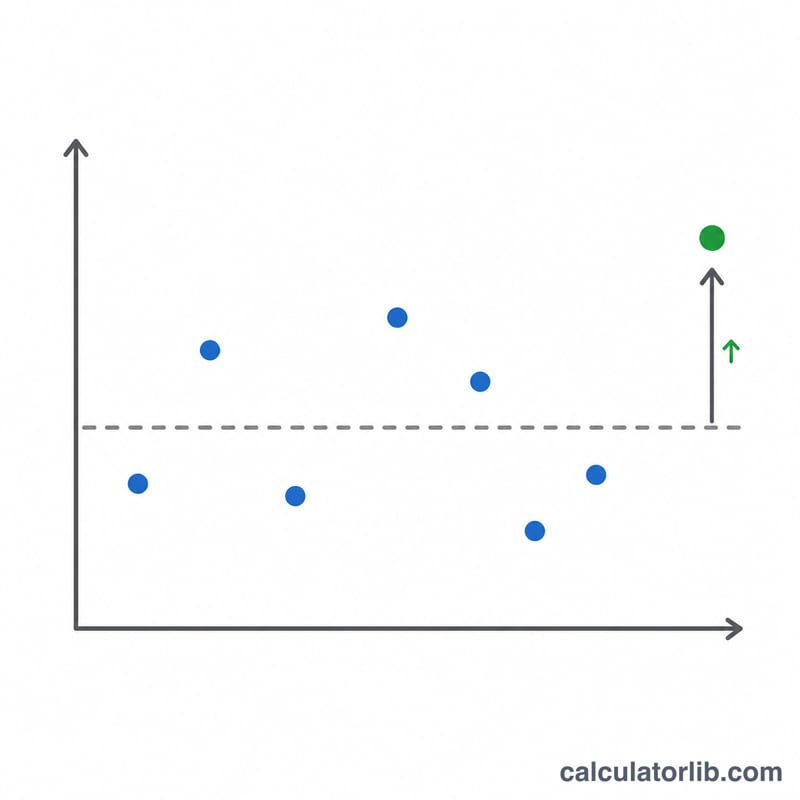
Suppose you invest $100 per period for 12 periods while the price rises from $20,000 to $40,000. Because each period buys a different number of coins, your average cost lands below the simple midpoint. If the current price is $40,000, the calculator shows your accumulated coins, the $1,200 invested, your average cost, and the resulting profit and ROI.
DCA Scenarios: Rising, Falling and Flat Price Paths
All four scenarios invest $100 per period for 12 periods ($1,200 total). Purchase prices follow the calculator's linear path \(P_i = \text{Start} + (\text{End} - \text{Start})\frac{i}{n-1}\) for \(i = 0,\dots,11\), and coins are \(N = \sum 100/P_i\). These figures are illustrative examples, not predictions of any real market. Fees, spreads and taxes are excluded.
| Scenario | Start price | End price | Current price | Total coins | Average cost | Portfolio value | Profit | ROI |
|---|---|---|---|---|---|---|---|---|
| Rising | $20,000 | $40,000 | $40,000 | 0.041901 | $28,639 | $1,676.06 | +$476.06 | +39.67% |
| Falling | $40,000 | $20,000 | $20,000 | 0.041901 | $28,639 | $838.03 | -$361.97 | -30.16% |
| Flat | $30,000 | $30,000 | $30,000 | 0.040000 | $30,000 | $1,200.00 | $0.00 | 0.00% |
| Dip, then recover (current differs from end) | $30,000 | $20,000 | $35,000 | 0.048778 | $24,601 | $1,707.24 | +$507.24 | +42.27% |
How the numbers arise
Rising case: prices are \(P_i = 20{,}000\cdot\frac{11+i}{11}\), so \(N = \frac{100\cdot 11}{20{,}000}\sum_{k=11}^{22}\frac{1}{k} = 0.055 \times 0.761845 = 0.041901\) coins. Average cost is \(1{,}200 / 0.041901 \approx \$28{,}639\). Value at $40,000 is \(0.041901 \times 40{,}000 = \$1{,}676.06\), so ROI is \((1{,}676.06 - 1{,}200)/1{,}200 = 39.67\%\).
Falling case: the same twelve prices are bought in reverse order, so the coin count and average cost are identical. Only the current price differs, and $20,000 gives \(0.041901 \times 20{,}000 = \$838.03\).
Dip-then-recover case: the buying path falls from $30,000 to $20,000, giving 0.048778 coins at an average of about $24,601. The current price is then set to $35,000, above the last purchase price, to mimic a recovery after buying. Value is \(0.048778 \times 35{,}000 = \$1{,}707.24\).
Interpreting Your DCA Results
- Average cost vs current price: if your average cost per coin is below the current price, the position shows an unrealized gain. If it is above, the position shows an unrealized loss.
- ROI is gross and unrealized: the ROI \(\frac{N\cdot C - I}{I}\times 100\%\) compares current value with total invested. It becomes a realized result only if you sell, and it ignores fees, spreads and taxes.
- Average cost vs the simple mean of prices: because a fixed amount buys more coins when the price is low, average cost is the harmonic mean of the purchase prices. It is always at or below their simple average unless all prices are equal. In the rising example the simple mean is $30,000 but the average cost is about $28,639. In the dip-then-recover example the simple mean is $25,000 and the average cost about $24,601.
- Order of prices matters for the result only through the current price: the rising and falling paths use the same prices in reverse order and give the same coin count and average cost. Their ROI differs only because of where the price ends up.
- No guarantee: DCA does not ensure a profit or prevent losses. In the falling scenario the position is down about 30% even though buying continued throughout.
- Model limits: the calculator assumes prices move in a straight line between the start and end price. Real crypto prices are irregular, so actual outcomes will differ. Exchange fees, bid-ask spreads and taxes would lower the net result.
This is general information to help you read the output, not financial advice.
Key Terms and Glossary
- Dollar-cost averaging (DCA)
- Investing a fixed amount at regular intervals regardless of price, so more coins are bought when the price is low and fewer when it is high.
- Contribution (periodic investment)
- The fixed amount of money invested in each period, such as $100 per week or month.
- Period
- One purchase interval. The calculator spreads the number of periods you enter across the price path from start to end.
- Average cost per coin
- Total invested divided by total coins accumulated, \(I / N\).
- Total invested
- Contribution multiplied by the number of periods, \(I = \text{Contribution}\times n\).
- Portfolio value
- Total coins multiplied by the current price, \(N \cdot C\).
- Unrealized vs realized profit
- Unrealized profit is a paper gain or loss on coins you still hold. Realized profit is locked in once the coins are sold.
- ROI (return on investment)
- Profit divided by total invested, expressed as a percentage: \(\frac{N\cdot C - I}{I}\times 100\%\).
- Lump-sum investing
- Investing the whole amount at once instead of spreading it over several periods. Its result depends on the single entry price.
- Volatility
- How strongly and quickly an asset's price moves up and down. Crypto assets are generally more volatile than most traditional assets, which makes entry timing matter and is why simplified linear paths are only rough approximations.
FAQ
Does this account for fees or taxes? No — results are gross of trading fees, spreads and taxes, which vary by exchange and jurisdiction.
Why does it assume a linear price path? Real prices are volatile, but a linear path between start and end prices is a simple, transparent way to illustrate how DCA averages your entry. Actual results depend on the real price at each buy.
Can I use this for stocks or any asset? Yes. The math works for any asset you buy a fixed amount of on a schedule, not just crypto.