
What this calculator does
The Crypto Mining Electricity Cost Calculator estimates how much electricity your mining rig (or any always-on hardware) consumes and what it costs over a given period. Power is the single biggest ongoing expense in proof-of-work mining, so knowing your true energy cost is essential before you can judge whether a rig is profitable.
How to use it
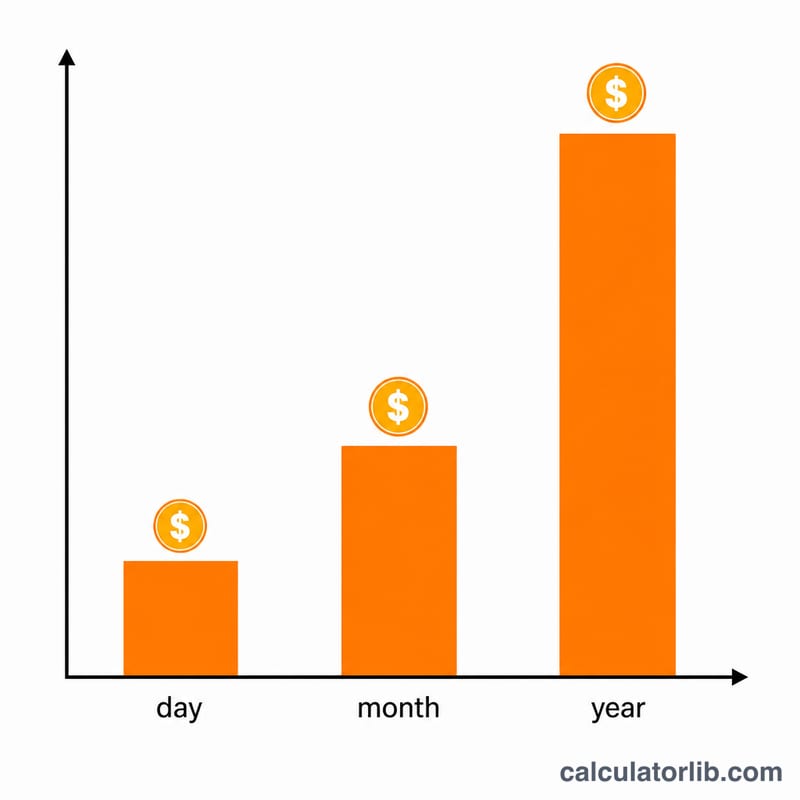
Enter three values: your rig's power draw in watts (check the PSU rating or a wall meter for the most accurate figure), your electricity price in dollars per kilowatt-hour (find this on your utility bill), and the number of days you want to evaluate. The calculator returns the daily, 30-day monthly, and total cost, plus the energy used in kilowatt-hours.
The formula explained
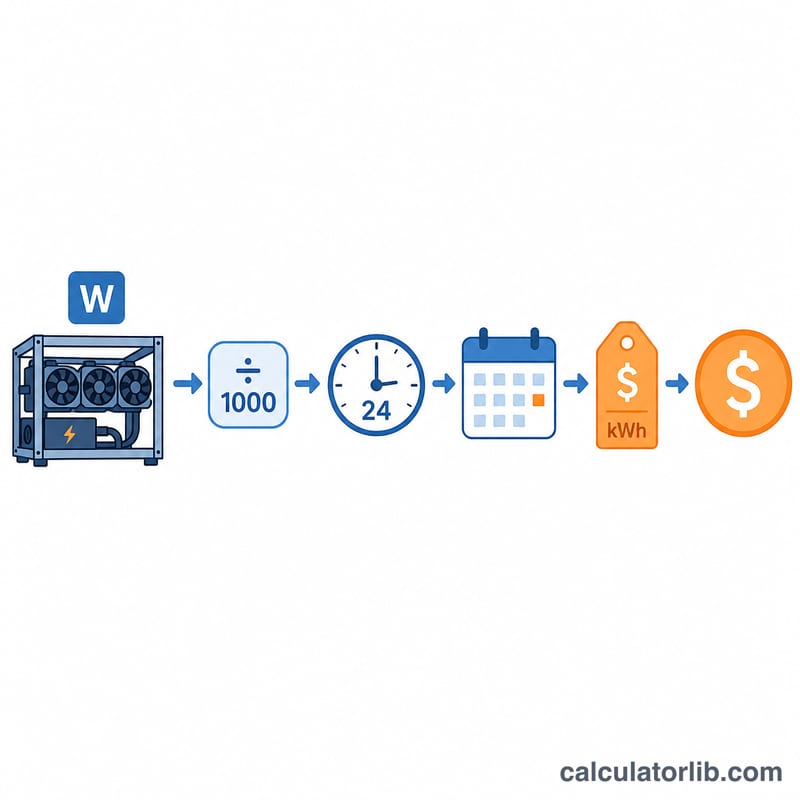
$$\text{Cost} = \frac{\text{Power}_{\text{W}}}{1000} \times 24 \times \text{days} \times \text{Price}_{\text{kWh}}$$ Dividing watts by 1000 converts to kilowatts. Multiplying by 24 assumes the rig runs around the clock, which is typical for mining. Multiplying by the number of days and your per-kWh rate gives the total bill for the period.
Worked example
A 3000 W rig at $0.12 per kWh for 30 days: \(\frac{3000}{1000} \times 24 = 72\) kWh per day. Over 30 days that is 2160 kWh. At $0.12/kWh the total cost is $$2160 \times \$0.12 = \mathbf{\$259.20}$$ or about $8.64 per day.
FAQ
Does this include the cost of the hardware? No. This tool covers electricity only. To assess profitability, subtract this electricity cost (and any pool fees) from your mining revenue.
Why assume 24 hours a day? Mining rigs are usually run continuously to maximise hash output. If you mine part-time, scale the days input by your actual duty cycle (e.g. 12 hours/day = half the days).
What power figure should I use? Wall-measured power is best because it includes PSU inefficiency. If you only know GPU/ASIC ratings, add roughly 10-15% for power supply losses and system overhead.