
What this calculator does
The Margin Cost Calculator turns two numbers you already know — your selling price and your cost price — into three figures that matter when pricing a product: the cash profit per unit, the profit margin as a percentage of revenue, and the markup as a percentage of cost. It works in any currency because it only deals with the relationship between the two amounts, so it suits retailers, freelancers, resellers and anyone setting prices.
The inputs you enter
- Selling Price — the amount the customer pays you for one unit.
- Cost Price — what that unit cost you to buy or make.
Both should be entered on the same basis (per single unit, or per batch — just keep them consistent).
The formulas it uses
The calculator runs three short steps:
- Profit = \(\text{Selling Price} - \text{Cost Price}\)
- Margin % = \((\text{Profit} \div \text{Selling Price}) \times 100\)
- Markup % = \((\text{Profit} \div \text{Cost Price}) \times 100\)
The key distinction is the denominator: margin is profit measured against the selling price, while markup is the same profit measured against the cost. That is why markup is always the larger of the two percentages for a given sale.
$$\begin{gathered} \text{Margin \%} = \frac{\text{Selling Price} - \text{Cost Price}}{\text{Selling Price}} \times 100 \\[1.5em] \text{Markup \%} = \frac{\text{Selling Price} - \text{Cost Price}}{\text{Cost Price}} \times 100 \end{gathered}$$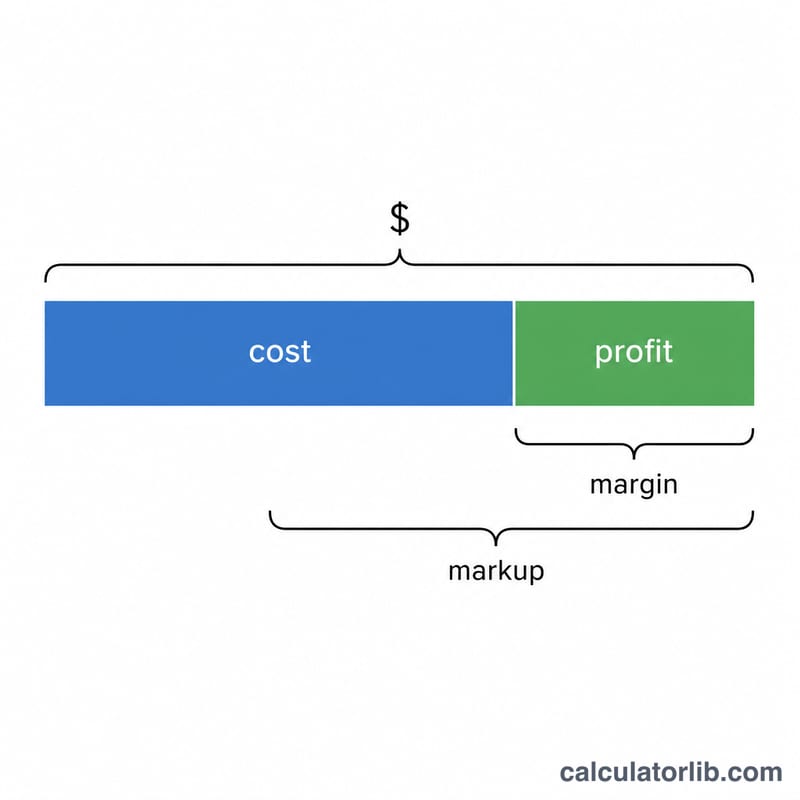
Worked example
Suppose you sell an item for 100 that cost you 60:
- Profit = \(100 - 60 = \mathbf{40}\)
- Margin = \((40 \div 100) \times 100 = \mathbf{40\%}\)
- Markup = \((40 \div 60) \times 100 = \mathbf{66.67\%}\)
So the same 40 of profit is a 40% margin but a 66.67% markup — handy to know when a supplier quotes "markup" and your accounts report "margin".
Frequently asked questions
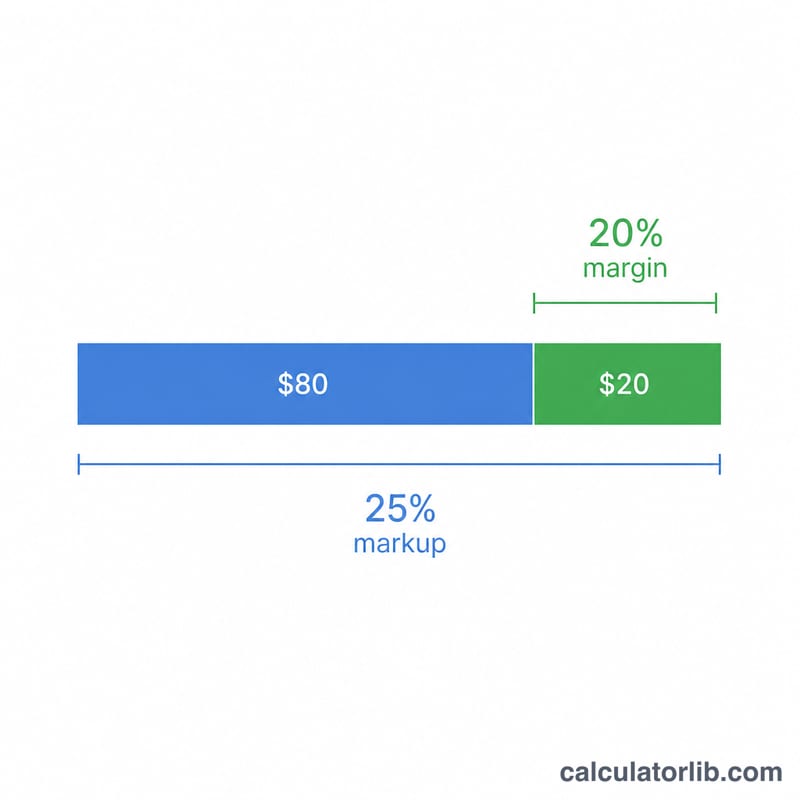
What's the difference between margin and markup? Margin shows what fraction of your revenue is profit; markup shows how much you've added on top of cost. Both come from the same profit figure but use different denominators.
Can the margin be negative? Yes. If your cost price is higher than your selling price, the profit is negative and so are the margin and markup — a signal you're selling at a loss.
Why can markup exceed 100% but margin can't? Margin is profit as a share of selling price, so it can never reach 100% unless cost is zero. Markup compares profit to cost, which can easily be exceeded — doubling your cost gives a 100% markup.