
What the Markup Calculator Does
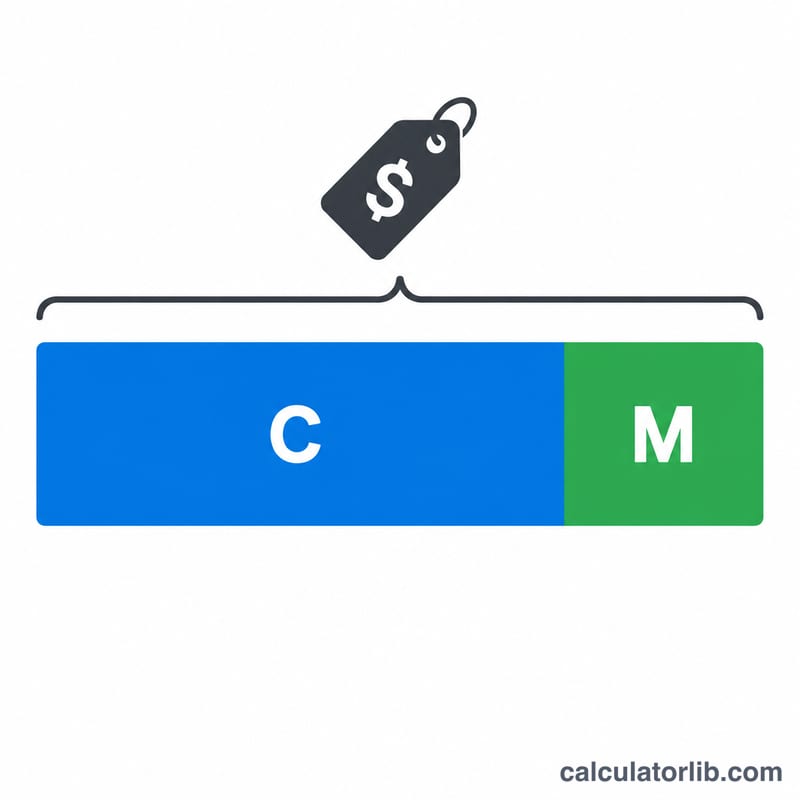
This Markup Calculator turns two simple numbers — your cost price and your markup percentage — into the three figures that matter most for pricing: the selling price, the profit per unit, and the profit margin. It also breaks the selling price down into the share that covers your cost and the share that becomes profit, so you can see at a glance how much of every sale is yours to keep.
The Inputs You Enter
- Cost Price — what it costs you to buy or make the item (in your own currency, the calculator is not country-specific).
- Markup Percentage — the percentage you add on top of the cost to set your price.
The Formula
The calculator applies these exact steps:
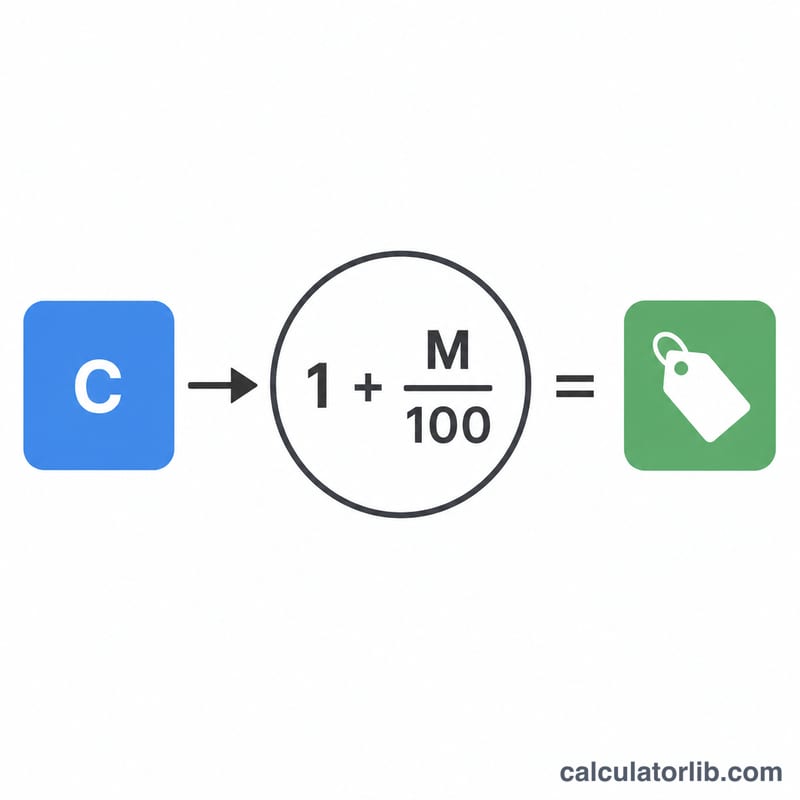
- Selling Price $$\text{Selling Price} = \text{Cost} \times \left(1 + \frac{\text{Markup \%}}{100}\right)$$
- Profit = Selling Price − Cost
- Profit Margin = (Profit ÷ Selling Price) × 100
- Cost Percentage = (Cost ÷ Selling Price) × 100
- Profit Percentage = (Profit ÷ Selling Price) × 100
Note the important distinction: markup is measured against your cost, while profit margin is measured against your selling price. They are never the same number unless your markup is zero.
Worked Example
Suppose your cost price is 100 and your markup is 50%:
- Selling Price $$100 \times \left(1 + \frac{50}{100}\right) = 150$$
- Profit $$150 - 100 = 50$$
- Profit Margin $$\left(\frac{50}{150}\right) \times 100 = 33.33\%$$
- Cost Percentage $$\left(\frac{100}{150}\right) \times 100 = 66.67\%$$
So a 50% markup produces only a 33.33% margin — a useful reminder that the two metrics differ.
Frequently Asked Questions
What is the difference between markup and margin? Markup is the extra amount added to cost expressed as a percentage of cost. Margin is profit expressed as a percentage of the selling price. Margin is always smaller than markup.
Can I use any currency? Yes. The calculator works on plain numbers, so the cost and resulting selling price are in whatever currency you enter.
What does 100% markup mean? It means you double your cost — a cost of 80 becomes a selling price of 160, giving a 50% profit margin.