
What Is the Cost of Equity?
The cost of equity is the rate of return investors require for holding a company's stock, compensating them for the risk taken. It is a key input in valuation, discounted cash flow (DCF) models, and the weighted average cost of capital (WACC). This calculator uses the Capital Asset Pricing Model (CAPM), the most widely used approach.
How to Use This Calculator
Enter three values: the risk-free rate (typically the yield on a long-term government bond), the stock's beta (its sensitivity to overall market movements), and the expected market return. The calculator returns the required cost of equity as a percentage and shows the equity risk premium.
The CAPM Formula Explained
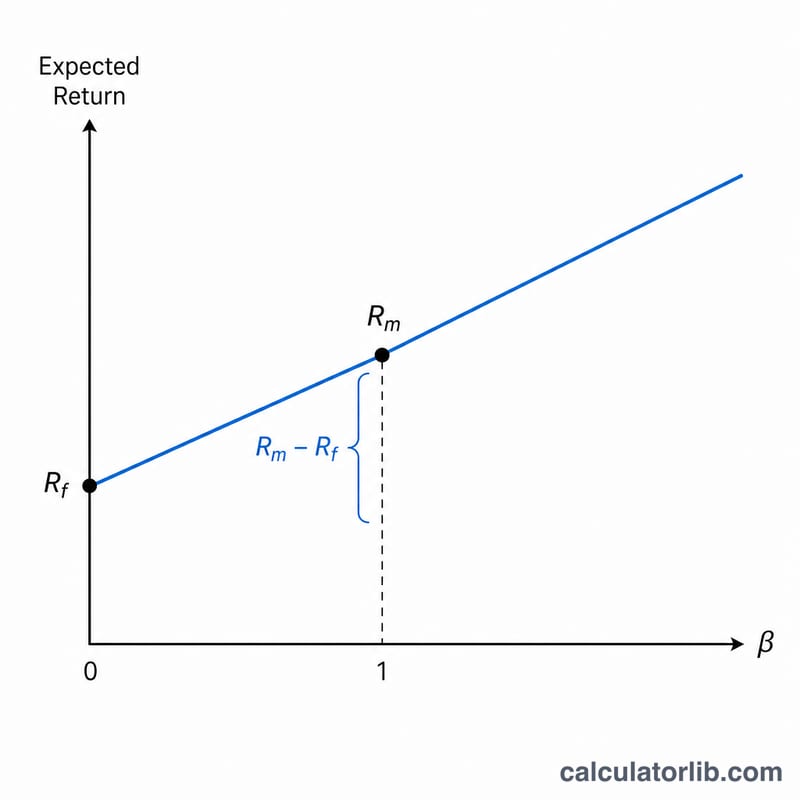
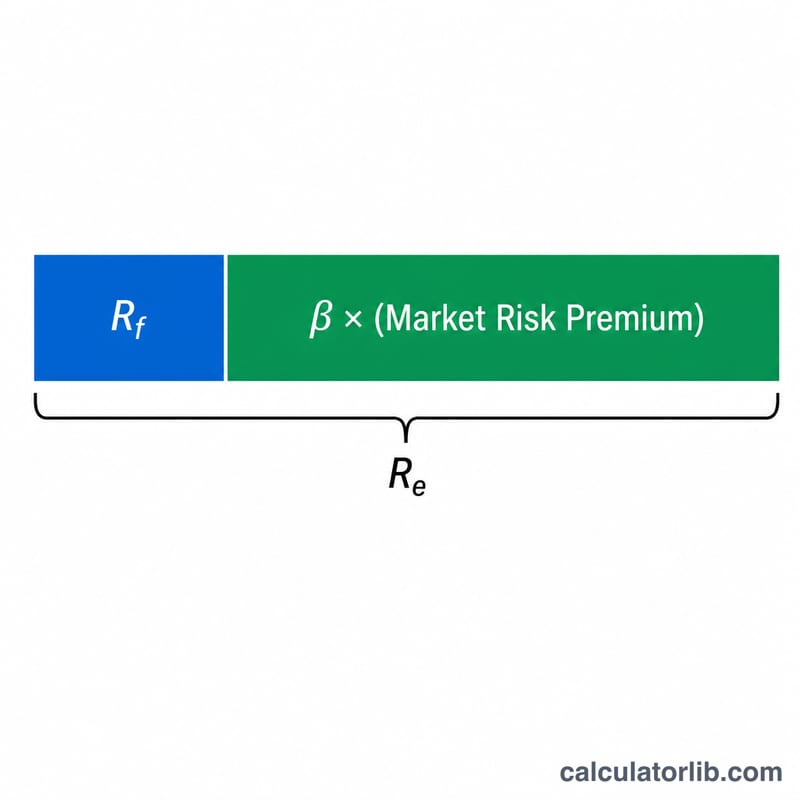
The formula is $$R_e = \text{Risk-Free Rate} + \text{Beta} \times \left( \text{Market Return} - \text{Risk-Free Rate} \right)$$ Here, Rf is the risk-free rate, \(\beta\) measures systematic risk relative to the market (\(\beta = 1\) means the stock moves with the market), and (Rm − Rf) is the equity risk premium — the extra return demanded for investing in equities over a risk-free asset.
Worked Example
Suppose the risk-free rate is 3%, beta is 1.2, and the expected market return is 9%. The equity risk premium is \(9\% - 3\% = 6\%\). The cost of equity is $$3\% + 1.2 \times 6\% = 3\% + 7.2\% = 10.2\%$$ Investors would require a 10.2% annual return to justify holding this stock.
FAQ
What beta should I use? Use the stock's historical beta from a financial data provider, or an industry average (unlevered then relevered) for private firms.
Why is a higher beta riskier? A beta above 1 means the stock amplifies market movements, so investors demand a higher return as compensation.
Can cost of equity be negative? Rarely. It can be low or even negative if beta is negative (the asset moves opposite the market), which acts as a hedge.