

What is MAGI?
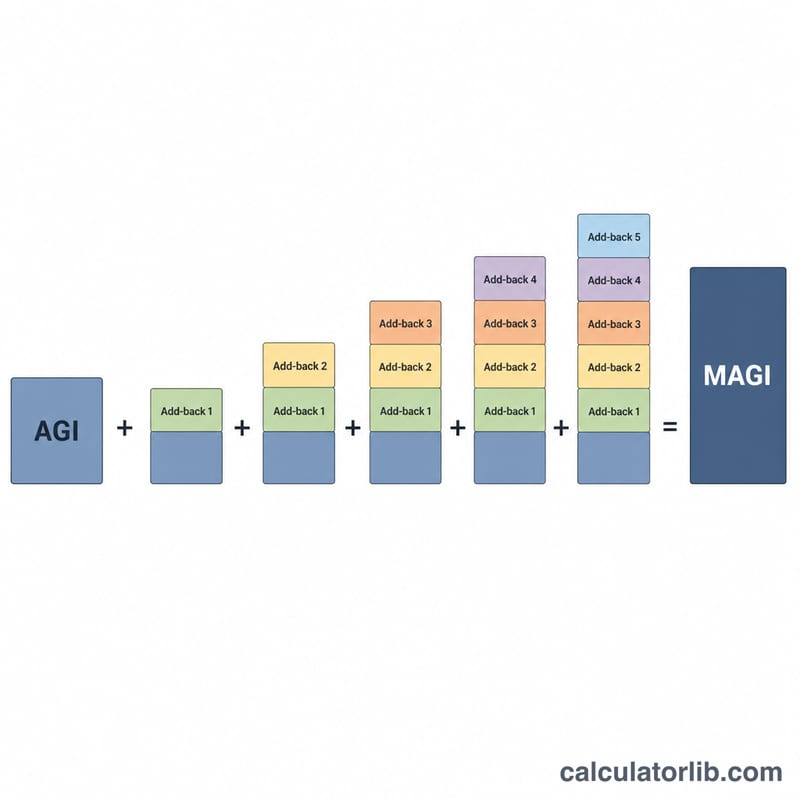
This calculator applies to the United States federal tax system. Modified Adjusted Gross Income (MAGI) is your Adjusted Gross Income (AGI) with certain deductions and excluded income added back. The IRS uses MAGI to determine eligibility for many benefits, including Roth IRA contributions, the deductibility of traditional IRA contributions, the Premium Tax Credit, and education credits. Note that the exact add-backs differ slightly by program; this tool uses the most common items and provides a general estimate, not tax advice.
How to use it
Start with your AGI from your Form 1040. Then enter any tax-exempt interest, foreign earned income you excluded, and the IRA, student loan interest, and tuition/fees deductions you claimed. The calculator adds these back to your AGI to estimate your MAGI.
The formula explained
$$\text{MAGI} = \text{AGI} + \text{Tax-exempt int.} + \text{Foreign income} + \text{IRA ded.} + \text{Student loan int.} + \text{Tuition \& fees}$$ Many add-backs are zero for a typical filer, which is why MAGI often equals AGI.
Worked example
Suppose your AGI is $80,000, with $2,000 of tax-exempt interest, a $3,000 IRA deduction, and $1,000 of student loan interest. Total add-backs = $6,000, so $$\text{MAGI} = \$80{,}000 + \$6{,}000 = \mathbf{\$86{,}000}$$
FAQ
Is MAGI the same as AGI? Often yes — if you have no tax-exempt interest, foreign income exclusions, or the listed deductions, your MAGI equals your AGI.
Does every program use the same MAGI? No. The IRS defines MAGI differently for different purposes; check the specific rules for your situation.
Where do I find my AGI? It appears on your Form 1040, line 11.