
What Is the Overtime Pay Calculator?
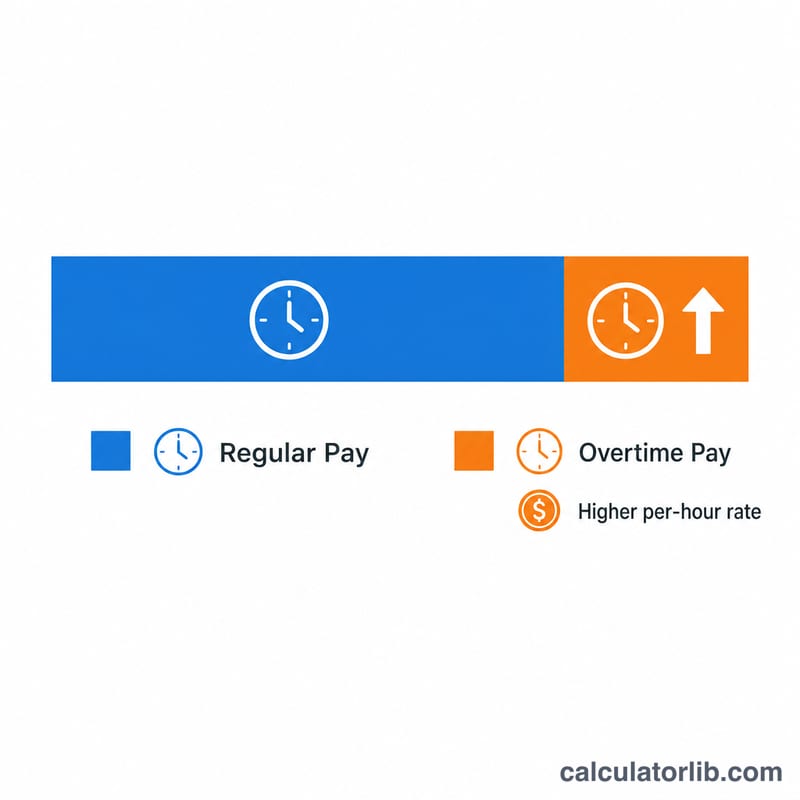
This calculator works out how much you earn when you work beyond your standard hours. Many jurisdictions require employers to pay a premium rate (commonly 1.5× or "time-and-a-half") for overtime, though the exact multiplier depends on your country, contract, or union agreement. Enter your figures to see your regular pay, overtime pay, and total earnings for the period.
How to Use It
Enter your normal hourly rate, the number of regular hours you worked, your overtime hours, and the overtime multiplier that applies to you (1.5 for time-and-a-half, 2 for double-time). The tool instantly shows the breakdown of your wages.
The Formula Explained
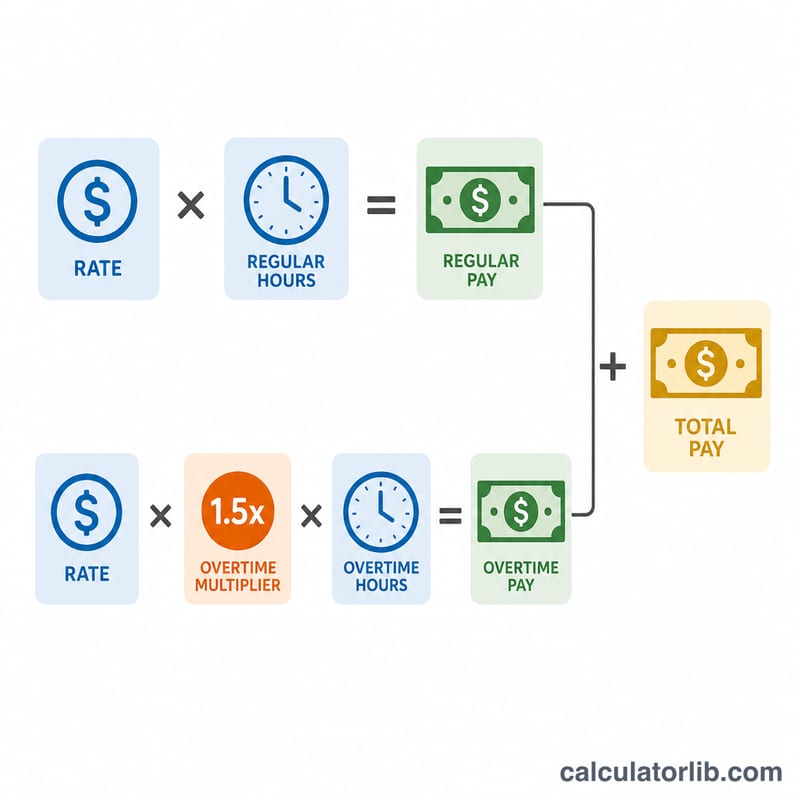
Overtime pay is calculated as hourly rate × multiplier × overtime hours. Your regular pay is simply hourly rate × regular hours. Adding the two together gives your total pay for the period. The effective overtime hourly rate is your base rate multiplied by the chosen factor.
$$\text{Total Pay} = \text{Rate} \times \text{Regular Hours} + \text{Rate} \times \text{Multiplier} \times \text{Overtime Hours}$$
Worked Example
Suppose you earn $20/hour, work 40 regular hours and 5 overtime hours at a 1.5× multiplier. Regular pay = \(20 \times 40 = \$800\). Overtime pay = \(20 \times 1.5 \times 5 = \$150\). Total pay = \(800 + 150 = \$950\), with an effective overtime rate of $30/hour.
FAQ
What multiplier should I use? Time-and-a-half (1.5) is the most common standard, but double-time (2.0) may apply on holidays or after a certain number of hours. Check your local labor laws or contract.
Does this handle taxes? No — this shows gross pay before any tax or deductions.
Can I use a weekly or biweekly period? Yes, just enter the total hours for whatever period you are calculating.