

What This Calculator Does
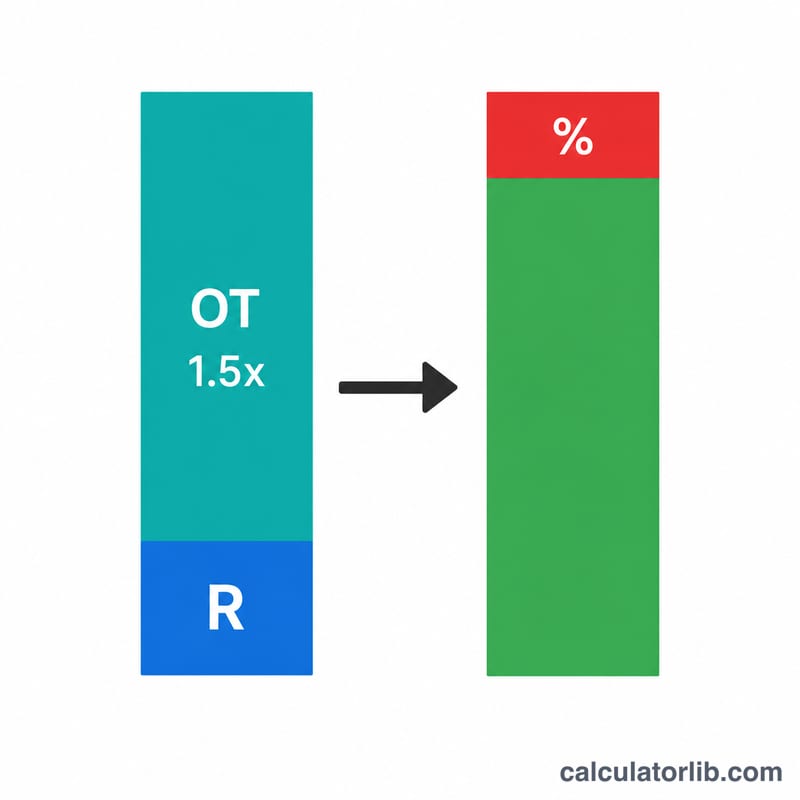
The Overtime Pay After Tax Calculator shows your estimated take-home pay when overtime is included. It adds your regular pay to overtime earnings (paid at the common time-and-a-half rate of 1.5×) and then subtracts an estimated tax to give a net figure. It's a quick way to see how much of that extra overtime you actually keep.
How To Use It
Enter four values: your regular pay for the period, your normal hourly rate, the number of overtime hours worked, and your effective tax rate as a percentage. Click calculate to see your net pay, plus a breakdown of overtime pay, gross pay, and tax deducted. The tax rate is a single flat percentage you supply (for example, your combined effective income-and-payroll rate), so the tool stays usable in any country.
The Formula Explained
Overtime pay is calculated as overtime hours × hourly rate × 1.5. This is added to your regular pay to get gross pay. The net result is gross pay multiplied by (1 − tax rate ÷ 100). In symbols:
$$\text{Net Pay} = G - G \times \frac{\text{Tax Rate (\%)}}{100}$$
$$\text{where}\quad \left\{ \begin{aligned} G &= \text{Regular Pay} + \text{OT} \\ \text{OT} &= \text{OT Hours} \times \text{Rate} \times 1.5 \end{aligned} \right.$$
Worked Example
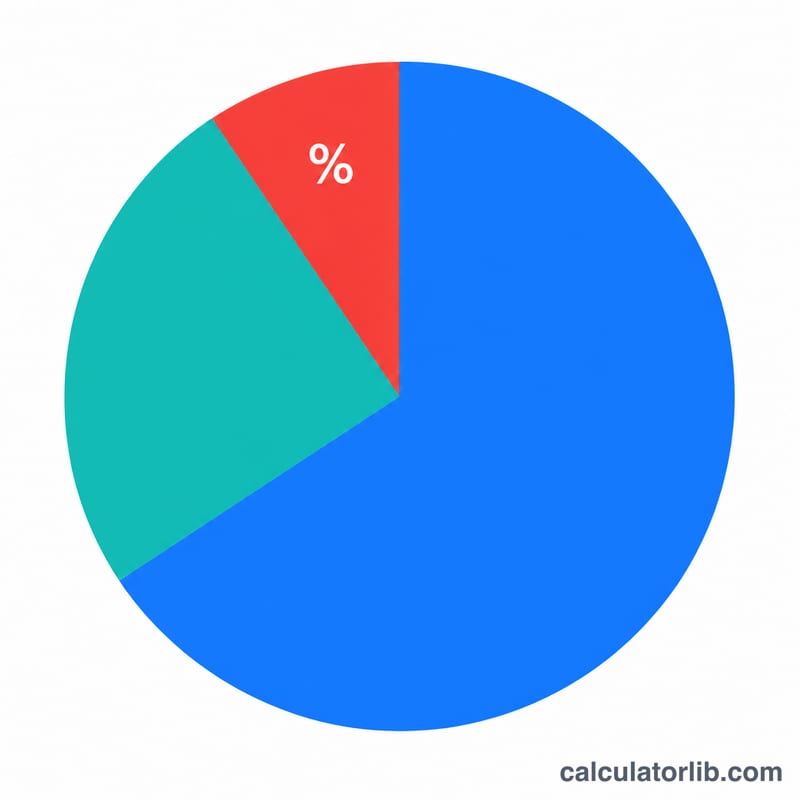
Suppose your regular pay is $800, your hourly rate is $20, you worked 10 overtime hours, and your tax rate is 25%. Overtime pay = \(10 \times 20 \times 1.5 = \$300\). Gross pay = \(800 + 300 = \$1{,}100\). Tax = \(1{,}100 \times 0.25 = \$275\). Net pay =
$$1{,}100 - 275 = \mathbf{\$825}$$
FAQ
Is overtime always 1.5×? This calculator assumes the standard time-and-a-half multiplier. Some jurisdictions or contracts use double time (2×) for certain hours.
What tax rate should I enter? Use your effective (blended) tax rate, not your top marginal bracket, for a realistic take-home estimate.
Is overtime taxed more? Overtime isn't taxed at a special rate, but the extra income can push part of your pay into a higher bracket. Adjust the tax rate to reflect that if needed.