

What This Calculator Does
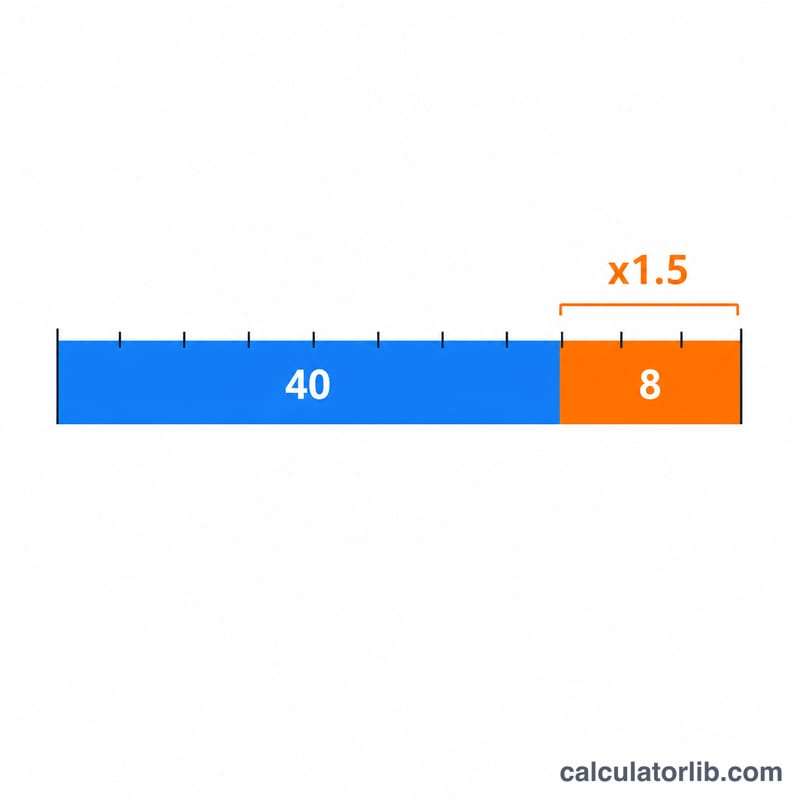
This tool estimates your gross weekly pay when you work overtime. Under the US Fair Labor Standards Act (FLSA), non-exempt employees are entitled to time-and-a-half (1.5×) for hours worked beyond 40 in a workweek. This calculator splits your hours into regular and overtime portions and totals the pay. The default 1.5× multiplier reflects US federal rules; some states or contracts use different rules, so adjust the multiplier as needed.
How to Use It
Enter the total hours you worked this week, your standard hourly rate in dollars, and the overtime multiplier (1.5 is the standard "time-and-a-half"). The calculator instantly shows your total gross pay along with a breakdown of regular hours, overtime hours, and the pay for each.
The Formula Explained
The math is straightforward:
$$\text{Pay} = \min(\text{hours}, 40)\cdot \text{rate} + \max(0,\, \text{hours} - 40)\cdot \text{rate} \cdot \text{multiplier}$$
The first term pays your normal rate for up to 40 hours. The second term applies the overtime multiplier only to hours above 40. If you work 40 hours or fewer, the overtime term is zero.

Worked Example
Suppose you worked 45 hours at $20/hour with a 1.5× multiplier. The first 40 hours pay \(40 \times \$20 = \$800\). The 5 overtime hours pay \(5 \times \$20 \times 1.5 = \$150\). Your total gross pay is $950.
FAQ
Is overtime always 1.5×? Federal US law sets 1.5× for hours over 40 per week, but some states (e.g., daily overtime in California) or union contracts differ. Adjust the multiplier to match your situation.
Is this take-home pay? No — this is gross pay before taxes, insurance, and other deductions.
Does it count over 40 hours only? Yes. Overtime here is based purely on weekly hours exceeding 40; it does not model daily overtime rules.