

What Is the Hours Pay Calculator?
The Hours Pay Calculator works out how much you earn for a given number of hours at a set hourly rate. It is ideal for hourly employees, freelancers, part-time workers, and anyone who wants a quick estimate of gross pay before deductions. Enter the hours you worked and your rate, and the calculator returns your total pay instantly.
How to Use It
Type the total number of hours worked into the first field. You can use decimals for partial hours — for example, 7.5 hours for seven and a half hours. Then enter your hourly rate in dollars (or your own currency, since the math is the same). The result shows your total gross pay for those hours.
The Formula Explained
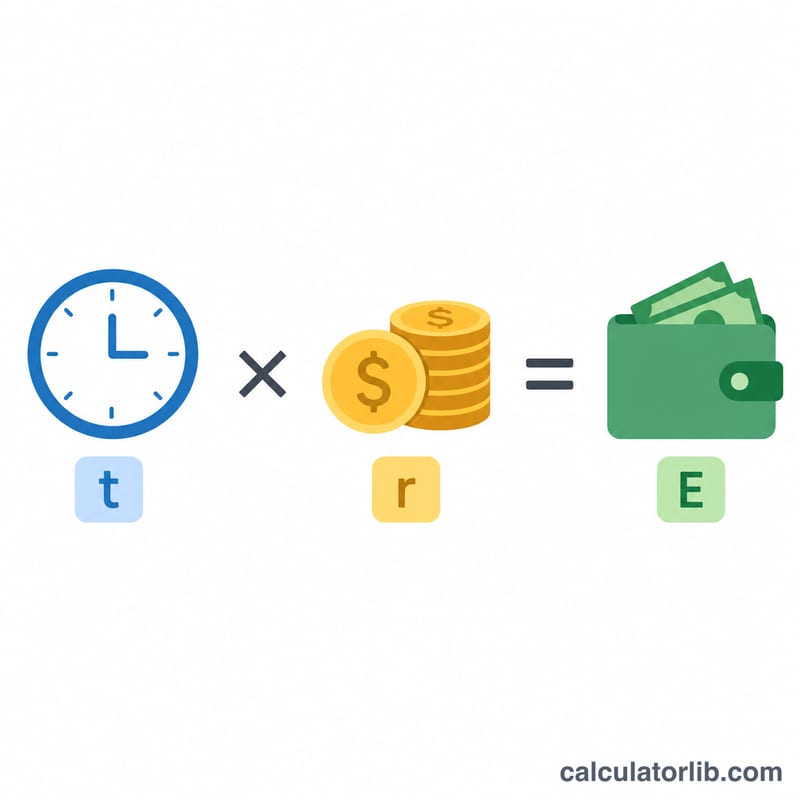
The calculation is straightforward multiplication:
$$\text{Pay} = \text{Hours Worked} \times \text{Hourly Rate}$$
Because it is gross pay, the figure does not subtract taxes, benefits, or other withholdings. For overtime, enter the overtime hours separately at the higher rate and add the results, or run the calculator twice.
Worked Example
Suppose you worked 37.5 hours in a week and earn $18.50 per hour. Your pay is $$37.5 \times 18.50 = \$693.75.$$ If you also picked up 5 overtime hours at $27.75, that adds $$5 \times 27.75 = \$138.75,$$ bringing the week to \(\$832.50\).

FAQ
Does this include taxes? No. It calculates gross pay only. Net (take-home) pay will be lower after tax and deductions.
Can I use it for any currency? Yes. The multiplication works the same regardless of currency; just read the dollar sign as your own.
How do I handle overtime? Calculate regular hours at your normal rate and overtime hours at the overtime rate, then add the two totals together.