
What Is the Graduation Year Calculator?
The Graduation Year Calculator estimates the year you can expect to graduate based on three simple inputs: the current year, the total length of your program, and how many years you have already completed. It works for high school, college, university, and graduate programs of any length, and supports half-year (semester) steps for more precise planning.
How to Use It
Enter the current calendar year, the total number of years your program is designed to take, and the number of years you have finished so far. The calculator subtracts completed years from the total to find your remaining study time, then adds that to the current year to project your graduation year.
The Formula Explained
The core equation is straightforward:
$$\text{Grad Year} = \text{Current Year} + \left(\text{Total Years} - \text{Years Completed}\right)$$The term in parentheses is your years remaining. If you have completed more years than the program length (negative remaining), the calculator clamps the remaining time to zero, meaning you are eligible to graduate in the current year.
Worked Example
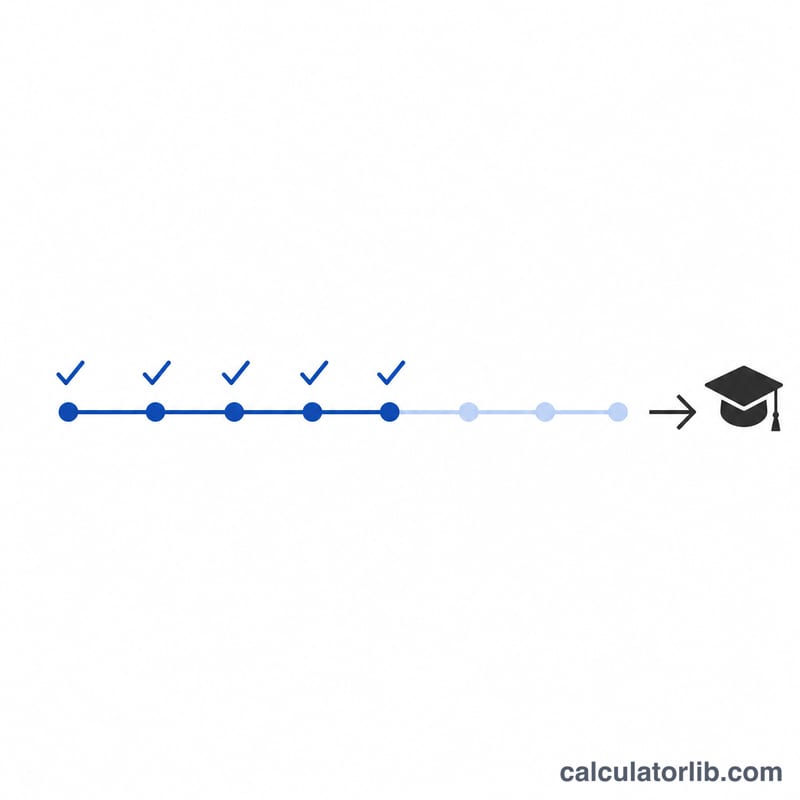
Suppose it is 2024, you are enrolled in a 4-year bachelor's degree, and you have completed 1 year. Years remaining = \(4 - 1 = 3\). Graduation year = \(2024 + 3 =\) 2027. If instead you had completed 2.5 years, remaining = 1.5 years, and your projected graduation would be mid-2025.
FAQ
Can I use half years? Yes — the inputs accept 0.5 steps, so you can model semester progress. A result like 2025.5 means roughly mid-2025.
What if I've already finished my program? If years completed equals or exceeds the total, remaining is zero and the calculator returns the current year.
Does it account for breaks or part-time study? No. It assumes continuous enrollment. For gap years or part-time study, increase the "total years" value to reflect your real timeline.