
What is the School Starting Age Calculator?
This calculator determines how old a child will be on a school's enrollment cutoff date and whether they meet the minimum age required to start school. Cutoff dates and required ages vary by country, state, and district — common cutoffs include September 1, August 1, or December 31, and typical required ages are 4, 5, or 6 years. Enter your own values to match your local rules.
How to use it
Enter the child's date of birth, the school's cutoff date, and the minimum age (in years) the child must reach by that cutoff. The tool reports the child's exact age in years, months, and days on the cutoff date, the age as a decimal, and a likely-eligible verdict.
The formula
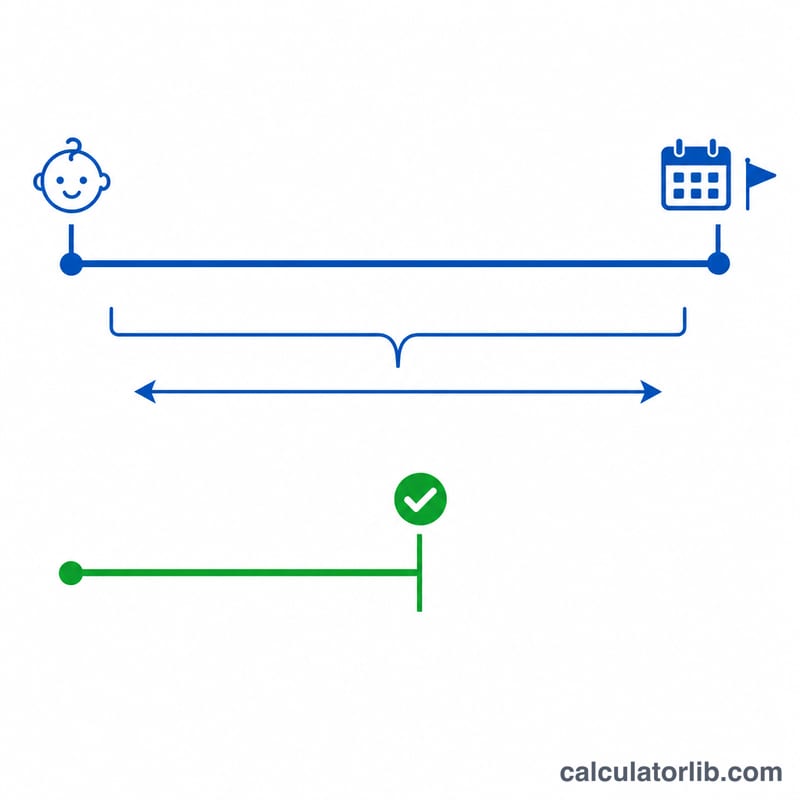
Age on cutoff = cutoff date − birth date, counted in years, months, and days on the calendar. The child reaches the required age on the birth date plus the required number of calendar years (a half year adds 6 months; a 29 February birthday falls on 28 February in a common year). The child is considered eligible when that date is on or before the cutoff date. The decimal age (total days divided by 365.25) is still shown, but for information only — it does not decide the verdict.
$$\text{Birth Date} + \text{Required Years} \leq \text{Cutoff Date} \;\Rightarrow\; \text{Eligible}$$
Worked example
A child born September 15, 2020 with a cutoff of September 1, 2025 and a 5-year requirement: from Sep 15 2020 to Sep 1 2025 is 4 years, 11 months, and 17 days — a decimal age of about \(4.96\) years, shown for information. The child's fifth birthday is September 15, 2025, which falls after the cutoff, so the child is not yet eligible and would typically wait for the next intake.
Interpreting Your Result
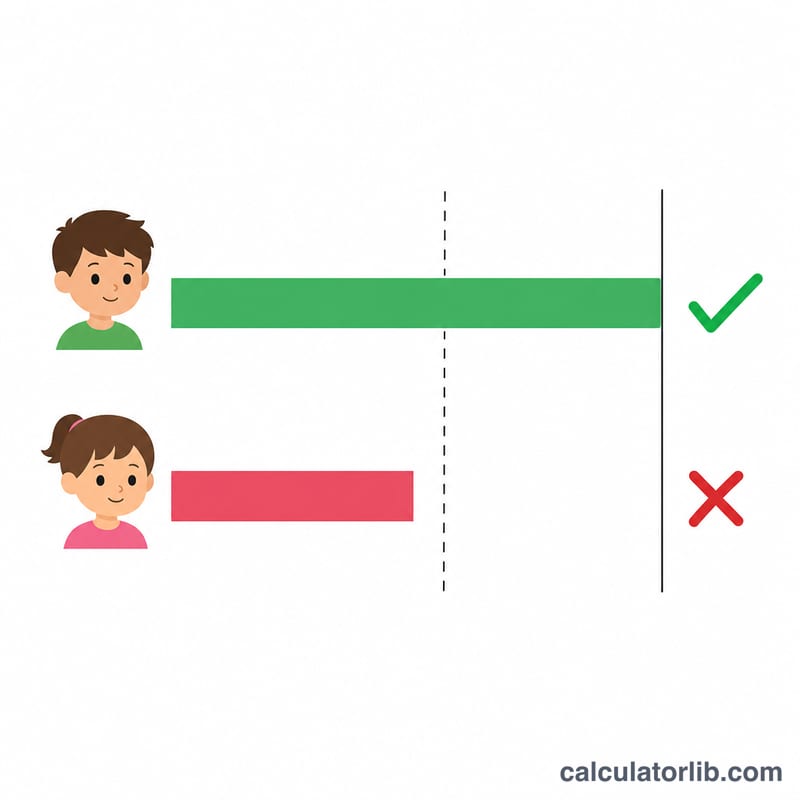
The calculator returns two ways of expressing the same thing: the child's exact age on the cutoff date, written as years, months and days (for example 4 years, 11 months, 17 days), and the child's decimal age, a single number such as 4.96. The exact age is what a registrar reads off a birth certificate; the decimal age is shown for information only and does not decide the verdict:
$$\text{Age}_{\text{years}} = \frac{\text{Cutoff Date} - \text{Birth Date}}{365.25}$$
A verdict of likely eligible means only this: the date the child reaches the required age — birth date plus the required number of calendar years — falls on or before the cutoff date, for the cutoff date and required age you entered. The tool does not know your country, state, district or school — it applies your own rule to your own dates. If you typed a cutoff of 1 September and 5 years, a "likely eligible" answer says the child is at least 5 on 1 September, nothing more.
Two details matter at the margins. First, the divisor 365.25 is the average length of a calendar year including leap years, so a child standing exactly on their fifth birthday can display a decimal age of about 4.999 rather than a clean 5.000; this does not affect the verdict, which is based on calendar dates. Second, admissions offices apply rules in words, not decimals, and the wording varies: "turns 5 on or before the cutoff" includes a child who turns 5 exactly on the cutoff date, while "turns 5 before the cutoff" excludes them. The calculator uses the "on or before" reading, so a child who turns 5 on the cutoff day is reported as eligible. If the date the child reaches the required age lands within a few days or weeks of the cutoff in either direction, confirm with the school or education authority, who will also tell you which proof-of-age document they accept.
An ineligible result usually means nothing more dramatic than enrolment in the next intake year — the child starts one year later with a slightly older cohort. It is rarely the end of the conversation. Many jurisdictions offer some combination of: early-entry or acceleration assessment for children who miss the cutoff narrowly but show readiness; voluntary deferral or "redshirting", where a family holds an eligible child back a year; and a separate compulsory school age that is often a year older than the minimum entry age, so a child may be permitted to start before they are legally required to. Which of these exist, and whether they are discretionary or guaranteed, depends entirely on the country and often on the state, province or local authority — cutoff dates differ widely between and within countries, and none of them is universal.
This tool is informational and is not legal advice, official enrolment guidance, or a placement decision. Only the admitting school, district or education ministry can confirm eligibility.
Cutoff Scenarios Compared
The rows below use two fixed birth dates plus one leap-day birth date, run against different cutoff dates and minimum ages. They show how the same child can be eligible under one rule and not under another — the child does not change, the rule does.
| Birth date | Cutoff date | Required age | Exact age at cutoff | Decimal age | Verdict |
|---|---|---|---|---|---|
| 2020-09-15 | 2025-09-01 | 5 years | 4 y, 11 m, 17 d | 4.96 | Not eligible — misses by 14 days |
| 2020-09-15 | 2025-12-31 | 5 years | 5 y, 3 m, 16 d | 5.29 | Eligible — later cutoff clears it |
| 2020-09-15 | 2025-09-01 | 4 years | 4 y, 11 m, 17 d | 4.96 | Eligible — lower minimum age |
| 2020-09-15 | 2025-09-15 | 5 years | 5 y, 0 m, 0 d | 4.999 | Eligible — turns 5 on the cutoff day itself |
| 2020-02-10 | 2025-09-01 | 5 years | 5 y, 6 m, 22 d | 5.56 | Eligible — clearly, an early-in-year birth |
| 2020-02-29 (leap day) | 2025-09-01 | 5 years | 5 y, 6 m, 4 d | 5.51 | Eligible — turned 5 on 28 Feb 2025 |
Row 1 versus row 2 is the whole point of a cutoff: a birthday in mid-September is 14 days short of a 1 September cutoff but comfortably clear of a 31 December one. The same child would be in the youngest slice of the cohort under the December rule and the oldest slice under the September rule a year later.
The leap-day row is worth a note. Since 2025 is not a leap year, the tool takes the anniversary of 29 February as 28 February (some systems use 1 March), so the child born 29 February 2020 turns 5 on 28 February 2025 and is 5 y, 6 m, 4 d old on 1 September 2025. The decimal age, shown for information only, is based on elapsed days: \(2011 \div 365.25 = 5.506\). For eligibility decisions, a system using 1 March would give a different verdict only when the cutoff is 28 February of the year the child reaches the required age.
Key Terms Explained
Terminology in this field is strongly country-specific — the same idea carries different names in the United States, the United Kingdom, Australia, Canada and elsewhere. The definitions below are generic.
- Cutoff date (eligibility date) — the fixed calendar date on which a child's age is measured to decide which intake year they belong to. Common cutoffs sit anywhere from mid-year to 31 December depending on the jurisdiction.
- Minimum starting age (required years) — the age a child must have reached on the cutoff date to enrol in a given grade or year level. It is set by the education authority, not by the school in most systems.
- Exact age — age expressed as completed years, months and days (for example 5 y, 6 m, 22 d), matching how a calendar counts anniversaries.
- Decimal age — the same age as one number, obtained by dividing elapsed days by the average year length of 365.25 days. Shown for information only; it does not decide the verdict, and it can read fractionally under a whole number on the exact birthday.
- Intake / school year — the annual cohort a child joins and the calendar period it covers. School years start in late summer or early autumn in much of the northern hemisphere and in January or February in much of the southern hemisphere.
- Kindergarten, preschool, Reception, Year 1 — names for the earliest year levels, which do not map onto each other across countries. "Kindergarten" is the first year of formal school in the United States and Canada but a pre-school stage in Germany and elsewhere; England uses Reception followed by Year 1, and Australia uses Kindergarten, Prep, Reception or Transition depending on the state.
- Academic redshirting — voluntarily holding back an age-eligible child for one year so they start with the next cohort, usually on maturity or readiness grounds. The term is chiefly North American.
- Early entry / acceleration assessment — a formal process, available in some jurisdictions only, by which a child who misses the cutoff may be admitted early after an evaluation of academic and social readiness.
- Compulsory school age — the age at which attendance becomes legally required. It is frequently a year or more above the minimum entry age, so there can be a window in which a child may attend but is not obliged to.
- Deferral — formally postponing an eligible child's start to a later term or the following year, typically with the school's or authority's agreement, and sometimes while the place is held.
Which formula do you need?
The verdict comes from comparing two calendar dates: the birth date plus the required number of years, against the cutoff. It does not come from the decimal age. The reason is that a decimal age built from days can fall just below a whole number for a child who has turned that age exactly.
Take a child born 1 September 2020 with a cutoff of 1 September 2025 and a required age of 5. The span contains one leap day, 29 February 2024, so it is \(5 \times 365 + 1 = 1826\) days. The decimal age is:
$$\frac{1826}{365.25} \approx 4.9993$$That is slightly under 5, yet the fifth birthday falls on the cutoff day, so the child counts as eligible. If your school or district publishes its rule in terms of birthdays, the calendar comparison is the one that matches it. Treat the decimal figure as a rough guide only, and never compare it to the required age yourself.
If your authority states its rule differently, for example as a birth-date range for each intake, follow the wording of the official rule and confirm with the school.
Conventions and edge cases
Each case below was run through this calculator; the result column is what it actually returns.
| Case | Input | Result | Note |
|---|---|---|---|
| Turns 5 the day after the cutoff | 2020-09-02 → 2025-09-01 → 5 | Not yet eligible | Age on the cutoff date: 4 y 11 m 30 d. |
| Turned 5 the day before the cutoff | 2020-08-31 → 2025-09-01 → 5 | Likely eligible | Age on the cutoff date: 5 y 0 m 1 d. |
| Turns 5 on the cutoff day | 2020-09-01 → 2025-09-01 → 5 | Likely eligible | Age on the cutoff date: 5 y 0 m 0 d. |
| Born 29 February, cutoff 28 February (common year) | 2020-02-29 → 2025-02-28 → 5 | Likely eligible | Age on the cutoff date: 5 y 0 m 0 d. |
Checked on 2026-11-08
FAQ
Why 365.25 days per year? It averages in leap years so the decimal age is accurate over multi-year spans. The decimal age is shown for information only; the verdict is based on calendar birthdays.
Is this legal advice? No. Cutoff dates and age rules differ by jurisdiction and can include exemptions or early-entry assessments. Always confirm with your local school authority.
What required age should I use? Use whatever your district specifies on its cutoff date — commonly 5 years for kindergarten in the US, or your local equivalent.