

What is the Baby Age Calculator?
This tool tells you exactly how old a baby is, expressed in total days, total weeks, weeks-plus-days, and calendar months-plus-days. Pediatricians, parents, and milestone trackers often need age in several formats at once — newborn feeding guides use weeks, vaccination schedules use months, and developmental charts use weeks-plus-days. This universal calculator works for any date and any region.
How to use it
Enter the baby's birth date (year, month, day) and the "as-of" date you want to measure to (it defaults to today). The calculator returns the elapsed time in every common unit so you can match whichever chart you are reading.
The formula
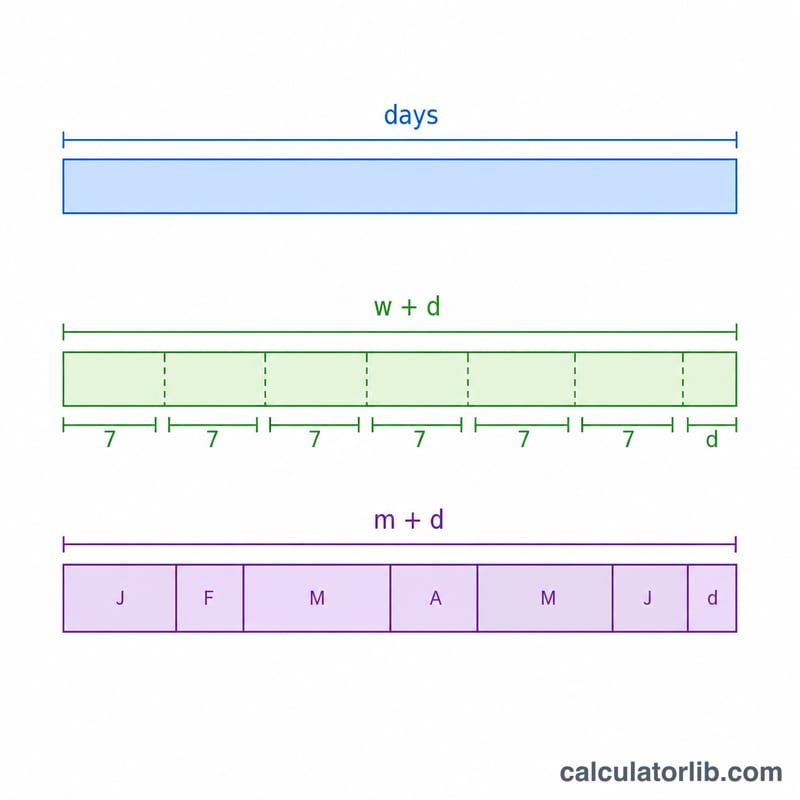
The core calculation is simply Age = as-of date − birth date. The difference in milliseconds is divided by 86,400,000 to get total days. Total weeks = total days ÷ 7. Weeks-plus-days splits that into whole weeks and a 0–6 day remainder. Calendar months are counted by month boundaries with a leftover-day adjustment, which is why "months and days" can differ slightly from "weeks".
$$\text{Total Days} = \left(\text{As-of Year},\ \text{As-of Month},\ \text{As-of Day}\right) - \left(\text{Birth Year},\ \text{Birth Month},\ \text{Birth Day}\right)$$$$\begin{gathered} \text{Total Days} = D_{\text{today}} - D_{\text{birth}} \qquad \text{Total Weeks} = \frac{\text{Total Days}}{7} \\[1.5em] \text{where}\quad \left\{ \begin{aligned} D_{\text{birth}} &= \left(\text{Birth Year},\ \text{Birth Month},\ \text{Birth Day}\right) \\ D_{\text{today}} &= \left(\text{As-of Year},\ \text{As-of Month},\ \text{As-of Day}\right) \\ \text{Months} &= \left(\text{As-of Year} - \text{Birth Year}\right)\times 12 + \left(\text{As-of Month} - \text{Birth Month}\right) \end{aligned} \right. \end{gathered}$$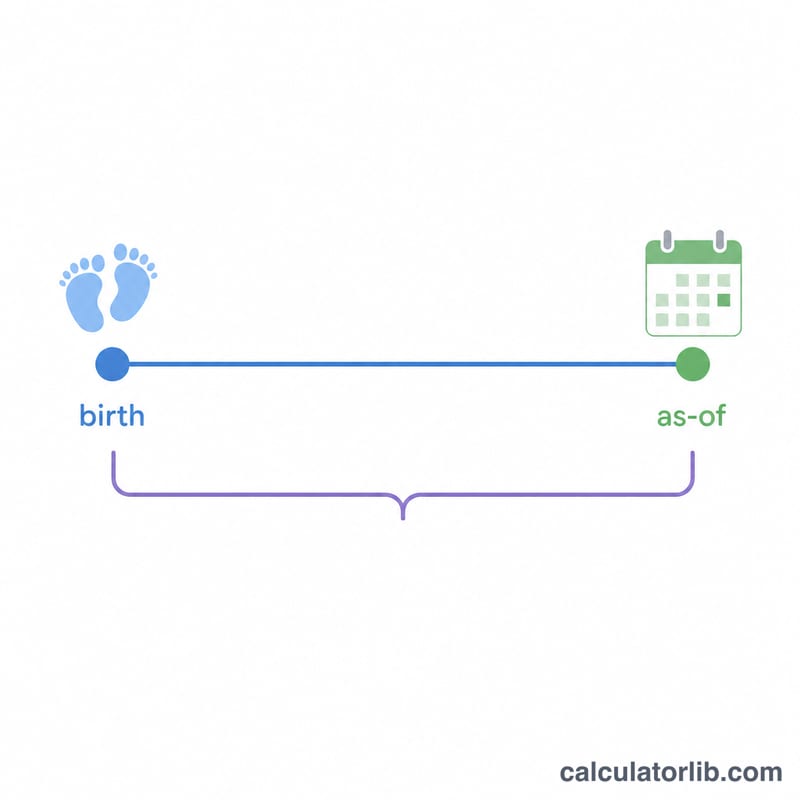
Worked example
Born 2024-01-01, measured on 2024-03-15. January has 31 days and February 2024 has 29 days (leap year), so \(31 + 29 + 14 = 74\) days elapsed from Jan 1 to Mar 14, plus 1 = 75 total days. That is \(75 \div 7 = \mathbf{10.714}\) weeks, or 10 weeks and 5 days. In calendar terms the baby is 2 months and 14 days old.
Understanding Your Baby's Age Result
This calculator returns a baby's age in several units at once because different settings use different conventions. Knowing which one applies helps you read schedules and milestone charts correctly.
Weeks-plus-days for newborns and early development. In the first few months, growth and developmental change happen quickly, so clinicians and milestone trackers often count age in completed weeks and leftover days (for example, “6 weeks 2 days”). This fine resolution matters when comparing feeding, sleep, and motor milestones, and it mirrors how gestational age is counted before birth, giving a continuous timeline. The completed weeks are what is normally quoted — a baby is “6 weeks old” from day 42 until day 49.
Months for vaccination and well-child schedules. Standard immunization schedules (such as those published by national pediatric bodies) and routine well-child visits are organized by calendar months — commonly 2, 4, 6, 12, and 15 months. Because calendar months differ in length, the “months” figure is anchored to the day-of-month of birth rather than to a fixed number of days, so a baby born on the 10th turns a month older on the 10th of each following month.
Corrected (adjusted) age for premature babies. For an infant born preterm, pediatric convention often uses corrected age (also called adjusted age): the age the baby would be if born on the original due date. It is calculated by subtracting the number of weeks of prematurity from the chronological age. Corrected age is commonly applied to developmental milestone and growth assessment, typically up to about 2 years of age, because a baby born several weeks early should be compared developmentally to babies of the same post-due-date maturity. This calculator reports chronological age from the actual birth date; to estimate corrected age, subtract the weeks born early.
This section explains standard conventions for general understanding only and is not medical advice. For questions about your child's development, immunizations, or prematurity adjustment, consult a qualified pediatric clinician.
Definitions & Glossary
- Birth date
- The calendar date the baby was born. It is the starting point of every age calculation and corresponds to day 0.
- As-of date
- The date you are measuring the age on (often today). The age is the span from the birth date up to and including this date.
- Total days
- The exact count of whole days elapsed from the birth date to the as-of date. This is the most precise unit and the basis from which weeks and months are derived.
- Total weeks
- The number of completed 7-day periods since birth, found by dividing total days by 7 and discarding any remainder.
- Weeks-plus-days
- Age expressed as completed weeks and the leftover days (the remainder after dividing total days by 7), e.g. 45 days = 6 weeks 3 days.
- Calendar months-plus-days
- Age counted by whole calendar months from the birth day-of-month, plus the extra days into the current month. Because months vary in length, this is not a fixed number of days.
- Day 0
- The day of birth itself. Under this convention the baby is 0 days old on the birth date and becomes 1 day old the following day, matching how newborn age is usually stated.
- Leap year adjustment
- The handling of 29 February in date arithmetic. A span that crosses a leap day includes that extra day in the total-day count, so a full year may be 365 or 366 days depending on whether a 29 February falls within it.
FAQ
Why do "weeks" and "months" not match exactly? A month is not exactly 4 weeks, so the two views diverge — both are correct.
Does it count the birth day? Age is the elapsed time since birth, so the birth day itself is day 0.
Does it handle leap years? Yes — it uses actual calendar dates, so February 29 is counted correctly.