What Is the Money Weight Calculator?
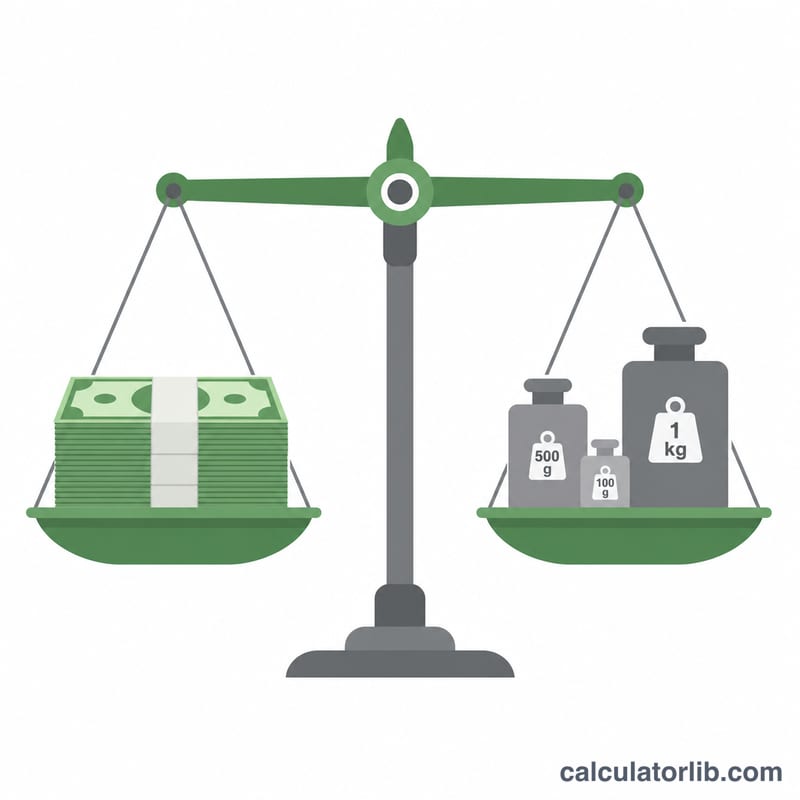
The Money Weight Calculator tells you how heavy a quantity of cash is. Whether you're curious how much a million dollars in $100 bills weighs, planning to move a large amount of physical currency, or simply satisfying a "how heavy is a briefcase of cash" question, this tool converts a money amount into a physical weight in grams, kilograms and pounds.
How to Use It
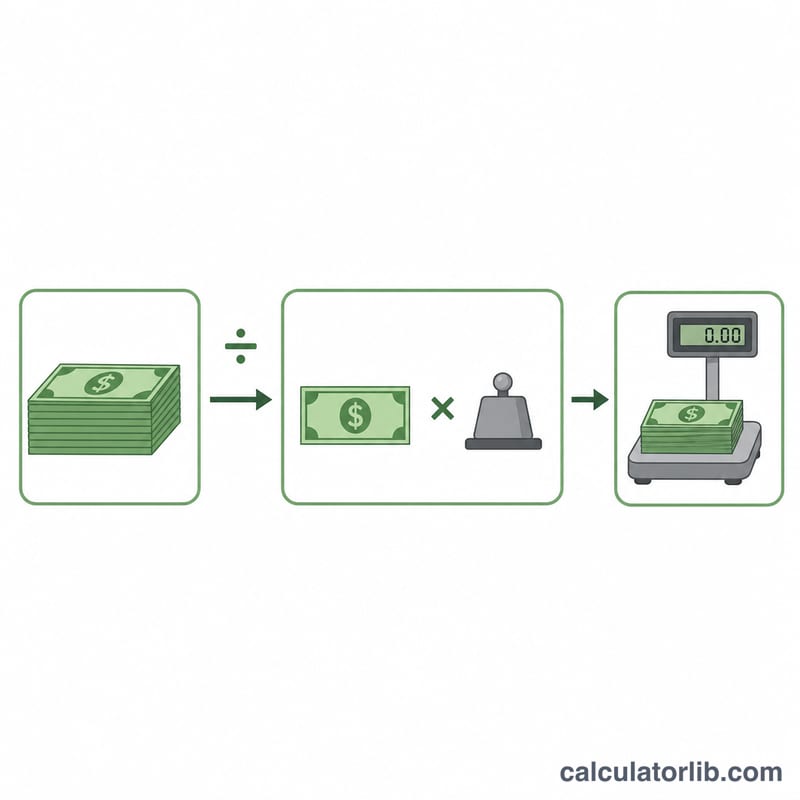
Enter three values: the total money amount you want to weigh, the denomination (the face value of each note or coin, e.g. 100 for a $100 bill), and the weight per note or coin in grams. The calculator divides the amount by the denomination to find how many notes/coins are needed, then multiplies by the unit weight. For reference, a US banknote of any denomination weighs about 1 gram.
The Formula Explained
The calculation is straightforward: $$\text{Total weight} = \left( \frac{\text{Amount}}{\text{Denomination}} \right) \times \text{Weight per note or coin}$$ First we divide the amount by the denomination to get the number of physical pieces, then multiply that count by the weight of one piece. Grams are converted to kilograms by dividing by 1,000 and to pounds by dividing by 453.59237.
Preset weights: US notes about 1 g each (Bureau of Engraving and Printing); coin weights are the official specifications of the US Mint, the European Central Bank and the Japan Mint. Worn coins and notes vary slightly.
Worked Example
Suppose you want to weigh $1,000,000 in $100 bills, with each bill weighing 1 gram. The number of bills is \(1{,}000{,}000 \div 100 = 10{,}000\) bills. $$\text{Total weight} = 10{,}000 \times 1\ \text{g} = 10{,}000\ \text{g} = 10\ \text{kg}$$ which is about 22.05 lb. So a million dollars in hundreds weighs roughly 10 kilograms.
Weights of Common Banknotes and Coins
The calculator needs two numbers you can look up once and reuse: the denomination (face value of a single note or coin) and the weight per unit in grams. The table below lists published specifications from each issuing authority, so any row can be pasted straight into the two input fields. Note that these are three different national/regional currency systems — the figures for one do not apply to another.
| Issuing authority | Item | Face value | Weight per unit (g) |
|---|---|---|---|
| US Bureau of Engraving and Printing (BEP) | Banknote, any denomination ($1, $2, $5, $10, $20, $50, $100) | $1 – $100 | 1.0 (nominal) |
| United States Mint | Cent (penny) | $0.01 | 2.500 |
| United States Mint | Nickel | $0.05 | 5.000 |
| United States Mint | Dime | $0.10 | 2.268 |
| United States Mint | Quarter dollar | $0.25 | 5.670 |
| United States Mint | Half dollar | $0.50 | 11.340 |
| United States Mint | Golden dollar (Sacagawea / Presidential) | $1.00 | 8.100 |
| European Central Bank | Euro banknotes (mass rises with note size) | €5 – €200 | ≈0.7 – 1.1 (approximate) |
| European Union / euro-area mints | 1 cent | €0.01 | 2.30 |
| European Union / euro-area mints | 2 cent | €0.02 | 3.06 |
| European Union / euro-area mints | 5 cent | €0.05 | 3.92 |
| European Union / euro-area mints | 10 cent | €0.10 | 4.10 |
| European Union / euro-area mints | 20 cent | €0.20 | 5.74 |
| European Union / euro-area mints | 50 cent | €0.50 | 7.80 |
| European Union / euro-area mints | 1 euro | €1.00 | 7.50 |
| European Union / euro-area mints | 2 euro | €2.00 | 8.50 |
| Bank of England | Polymer banknotes (£5, £10, £20, £50) | £5 – £50 | ≈0.7 – 1.0 (approximate) |
| The Royal Mint | One penny | £0.01 | 3.56 |
| The Royal Mint | Two pence | £0.02 | 7.12 |
| The Royal Mint | Five pence | £0.05 | 3.25 |
| The Royal Mint | Ten pence | £0.10 | 6.50 |
| The Royal Mint | Twenty pence | £0.20 | 5.00 |
| The Royal Mint | Fifty pence | £0.50 | 8.00 |
| The Royal Mint | One pound | £1.00 | 8.75 |
| The Royal Mint | Two pounds | £2.00 | 12.00 |
Coin masses are legal specifications and are tightly controlled at striking, so they are reliable to about ±1–2% on circulated coins (wear removes a little metal). Banknote masses are not published as a legal tolerance in the same way: the euro and sterling figures above are approximate typical values, and the US 1.0 g figure is a widely used nominal average. Enter the denomination in the same currency unit as the amount — for coins that means a fractional value such as 0.25 for a US quarter, not 25.
Constants Used in the Conversion
The calculator works internally in grams and then converts to kilograms and pounds using exact definitions. The pound conversion is the international avoirdupois pound as defined by NIST and used throughout the US customary and imperial systems.
| Constant | Value | Note |
|---|---|---|
| 1 kilogram | 1,000 g | Exact (SI prefix) |
| 1 pound (lb) | 453.59237 g | Exact by definition — international avoirdupois pound (NIST) |
| 1 ounce (oz) | 28.349523125 g | Exact; 1 lb ÷ 16 |
| US banknote nominal mass | ≈1.0 g | ≈1,000 notes per kilogram (BEP nominal figure) |
| US banknote dimensions | 156 × 66.3 mm | All denominations share one size |
| US banknote thickness | ≈0.109 mm | ≈100 notes per 10.9 mm — useful for stack-height and volume estimates |
Converting grams to pounds is a single division:
$$\text{Weight (lb)} = \frac{\text{Weight (g)}}{453.59237}$$Worked example — $250 in US quarters. The denomination is 0.25 and the US Mint unit weight is 5.670 g:
$$\frac{\$250}{\$0.25} \times 5.670\ \text{g} = 1{,}000 \times 5.670 = 5{,}670\ \text{g} = 5.67\ \text{kg}$$$$\frac{5{,}670}{453.59237} = 12.50\ \text{lb}$$So a $250 roll-box of quarters weighs 5.67 kg, or about 12.5 lb.
Accuracy caveat: the 1.0 g per banknote figure is a nominal average, not a legal tolerance. Real notes vary by a few percent with wear, accumulated dirt, ink coverage and — most of all — moisture content, since paper and polymer both absorb ambient humidity. Bands, straps, clips and packaging add weight that this calculation ignores. Treat note-based results as estimates good to roughly ±5%; coin-based results are far more precise because coin masses are struck to a legal standard.
FAQ
How much does a US dollar bill weigh? Every US banknote weighs approximately 1 gram regardless of denomination.
Can I use this for coins? Yes. Enter the coin's face value as the denomination and its actual weight in grams as the per-coin weight.
Does currency matter? The formula is universal — just supply the correct denomination value and the real weight of one note or coin for your currency.