
What Is the Fish Weight Calculator?
The Fish Weight Calculator estimates how much a fish weighs without a scale, using simple body measurements. Anglers practicing catch-and-release often release fish before weighing them, so a length-based estimate is the practical way to record a catch. This tool supports two well-known methods used worldwide and reports the result in pounds, ounces, and kilograms.
How to Use It
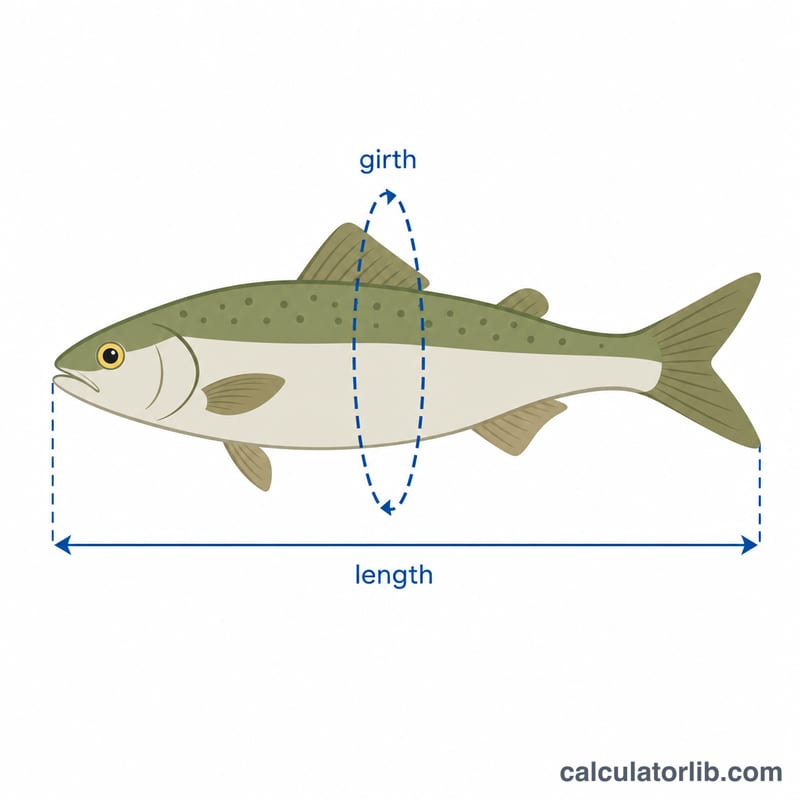
Pick a method. For the Length & Girth method, enter the fish's length and its girth (the distance around the fattest part of the body) in inches. For the Length Only method, enter just the length and a species shape factor. Click calculate to see the estimated weight.
The Formula Explained
The girth method uses $$\text{Weight} = \frac{\text{Length}^{2} \times \text{Girth}}{800}$$ Length is squared because the body cross-section roughly scales with length, and girth captures how stout the fish is. The constant 800 converts cubic inches into pounds for a typical fish density.
The length-only method uses $$\text{Weight} = \frac{\text{Length}^{3}}{\text{Shape Factor}}$$ Because girth is unknown, a species-specific shape factor stands in for body shape. Common values are about 800 for trout, 900 for bass, and 1200 for pike — slimmer fish use a larger factor.
Worked Example
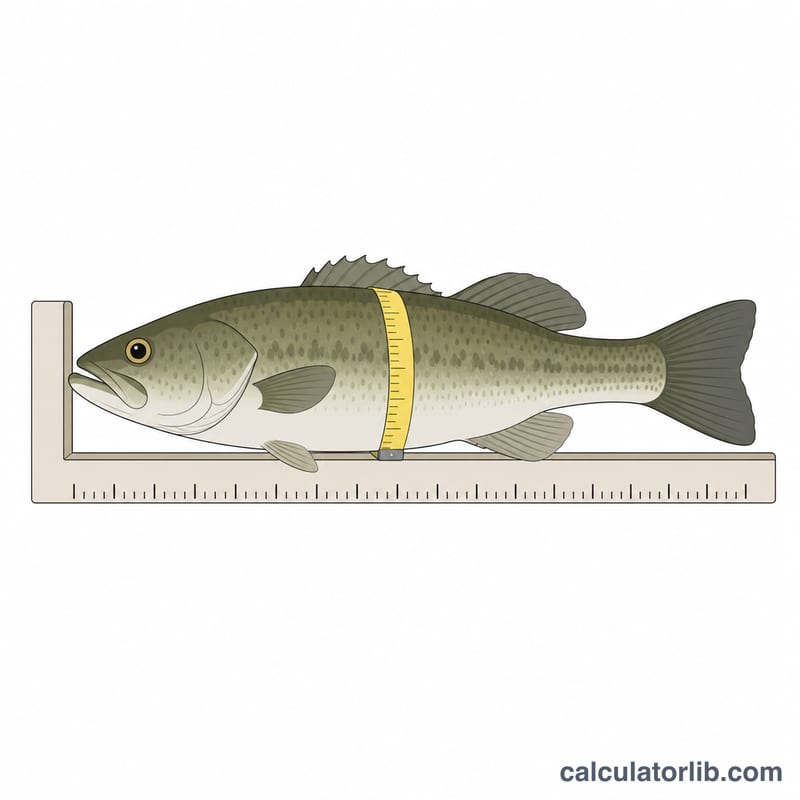
A bass measures 20 inches long with a 12-inch girth. Using the girth method:
$$\frac{20^{2} \times 12}{800} = \frac{400 \times 12}{800} = \frac{4800}{800} = \textbf{6 pounds}$$That is 96 ounces or about 2.72 kilograms.
FAQ
How accurate is it? The girth method is typically within 10% of actual weight. Length-only estimates vary more because they cannot account for an unusually fat or thin fish.
What units should I use? Enter length and girth in inches; the result is in pounds (with ounce and kilogram conversions shown).
Which shape factor should I pick? Use roughly 800 for trout/panfish, 900 for bass, and 1100–1200 for long slender fish like pike or musky.