
What Is a Bench Press Pyramid?
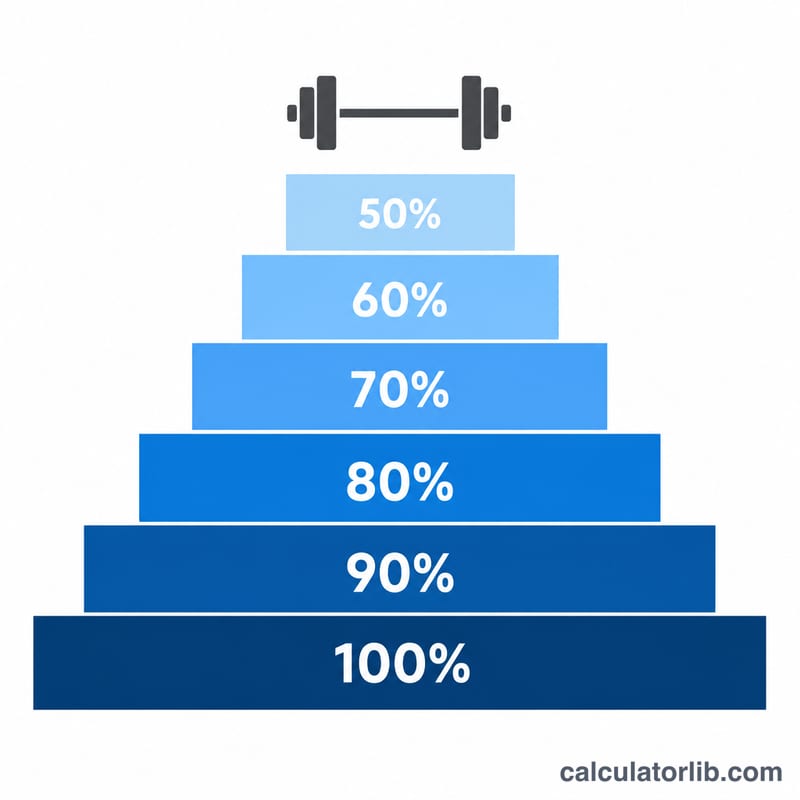
A pyramid set scheme has you progressively increase the weight on the bar each set, climbing toward a heavy top set. It's one of the most popular ways to structure a bench press workout because it builds in a natural warm-up, lets you grease the movement pattern, and brings you to your working weight safely. This calculator takes your one-rep max (1RM) and instantly maps out a classic ascending pyramid at 50%, 60%, 70%, 80%, 90%, and 100% of that max.
How to Use It
Enter your bench press 1RM, choose pounds or kilograms, and set the rounding increment to match the smallest plate jump you can make (5 lb or 2.5 kg are common). The calculator returns the weight for each pyramid step, rounded so you can actually load it on the bar without fiddling with fractional plates.
The Formula
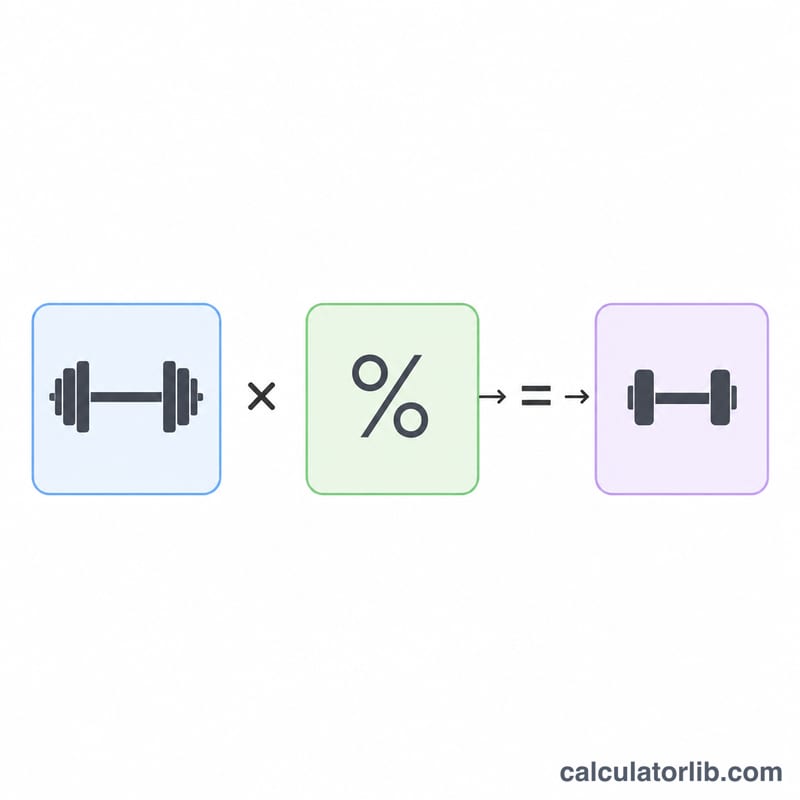
The math is simple: for each step, Set Weight = 1RM × Percent. So a lifter with a 200 lb max loads 100 lb at 50%, 120 lb at 60%, and so on. Each result is then rounded to the nearest increment you specify using round(W / r) × r.
$$W_{p} = \text{round}\!\left( \text{1RM} \times p \,,\; \text{Round To} \right), \quad p \in \{0.50,\,0.60,\,0.70,\,0.80,\,0.90,\,1.00\}$$
Worked Example
Suppose your 1RM is 200 lb and you round to the nearest 5 lb. The pyramid is: \(50\% \to 100\ \text{lb}\), \(60\% \to 120\ \text{lb}\), \(70\% \to 140\ \text{lb}\), \(80\% \to 160\ \text{lb}\), \(90\% \to 180\ \text{lb}\), \(100\% \to 200\ \text{lb}\). A reasonable rep scheme might be 10, 8, 6, 4, 2, 1 reps as you climb.
Percentage-to-Reps Reference
Strength-training percentage charts (commonly attributed to coaches such as those summarized in the NSCA literature) map each fraction of your 1RM to an approximate rep range and a training focus. Use this to decide how many reps to perform at each rung of your pyramid. Individual capacity varies, so treat these rep counts as typical estimates rather than guarantees.
| % of 1RM | Typical Reps | Primary Focus |
|---|---|---|
| 50% | 15–20+ | Warm-up / technique work |
| 60% | 12–15 | Muscular endurance & warm-up |
| 70% | 10–12 | Hypertrophy (muscle building) |
| 80% | 6–8 | Hypertrophy & strength crossover |
| 90% | 3–4 | Maximal strength |
| 100% | 1 | Peaking / true 1RM |
For a single working weight at any other intensity, you can compute a specific load directly with the bench-press-max-percentage-calculator. For example, a lifter with a 225 lb max training at 85% would use 191.25 lb before rounding to the nearest plate.
FAQ
How many reps per pyramid step? A common scheme is to drop reps as weight rises — for example 10/8/6/4/2/1. Adjust to your goal: more reps for hypertrophy, fewer for strength.
Do I need to do every step? No. Many lifters use the 50–70% sets purely as warm-ups and treat 80–90% as their real working sets.
What if I don't know my 1RM? Estimate it from a recent set using a one-rep max calculator, then plug that number in here.