
What Is a One-Rep Max (1RM)?
Your one-rep max is the maximum weight you can lift for a single repetition of an exercise such as the bench press, squat, or deadlift. Testing a true 1RM is risky and fatiguing, so lifters estimate it from a submaximal set instead. This calculator uses two of the most popular estimation models — the Epley and Brzycki formulas — and reports both alongside their average.
How to Use This Calculator
Enter the weight you lifted and the number of clean repetitions you completed (use any unit — kg or lb — the result comes back in the same unit). For best accuracy, use a set taken close to failure in the 2–10 rep range. The calculator instantly shows your estimated 1RM from each formula plus the average for a balanced figure.
The Formulas Explained
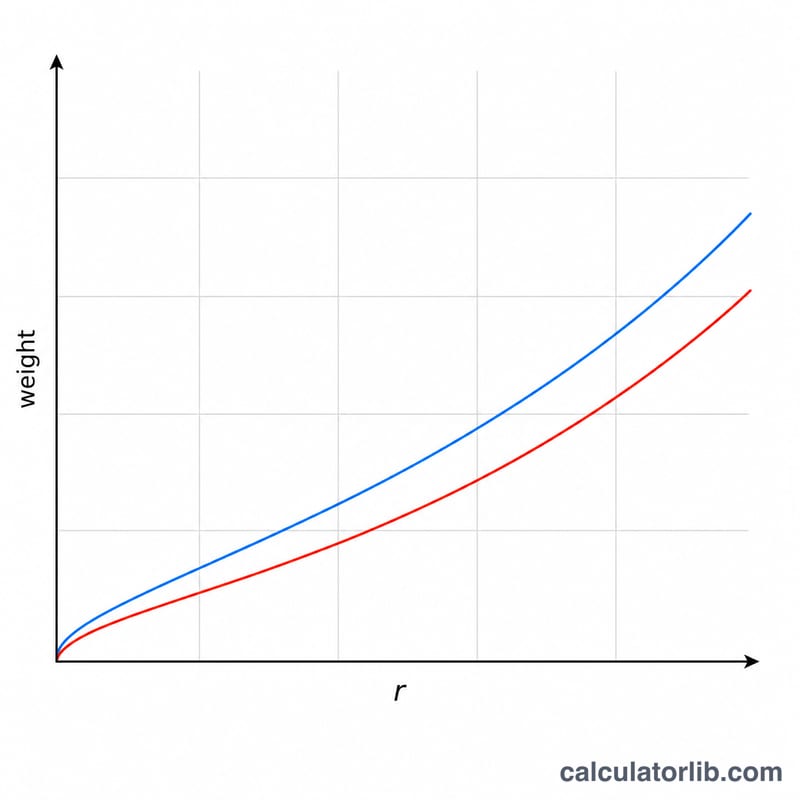
The Epley formula, $$\text{1RM} = w \times \left(1 + \frac{r}{30}\right)$$ scales your lift linearly with reps and tends to read slightly higher at high rep counts. The Brzycki formula, $$\text{1RM} = w \times \frac{36}{37 - r}$$ uses a percentage table and stays accurate at lower reps but becomes unstable as reps approach 37. Averaging the two smooths out their individual biases.
Worked Example
Suppose you bench press 100 kg for 5 reps. Epley gives $$100 \times \left(1 + \frac{5}{30}\right) = 100 \times 1.1667 = 116.67 \text{ kg}$$ Brzycki gives $$100 \times \frac{36}{37 - 5} = \frac{3600}{32} = 112.5 \text{ kg}$$ The average is $$\frac{116.67 + 112.5}{2} \approx 114.58 \text{ kg}$$
FAQ
Which formula is more accurate? Neither is universally best. Epley is slightly more forgiving at higher reps, Brzycki at lower reps. The average is a sensible default.
How many reps should I use? Estimates are most reliable with 2–10 reps. Above 10 reps, fatigue and form drift make all formulas less accurate.
Is this only for bench press? No. It works for any compound lift — squat, deadlift, overhead press — though larger muscle groups may produce slightly different rep-to-max relationships.