
What Is the Karvonen Heart Rate Calculator?
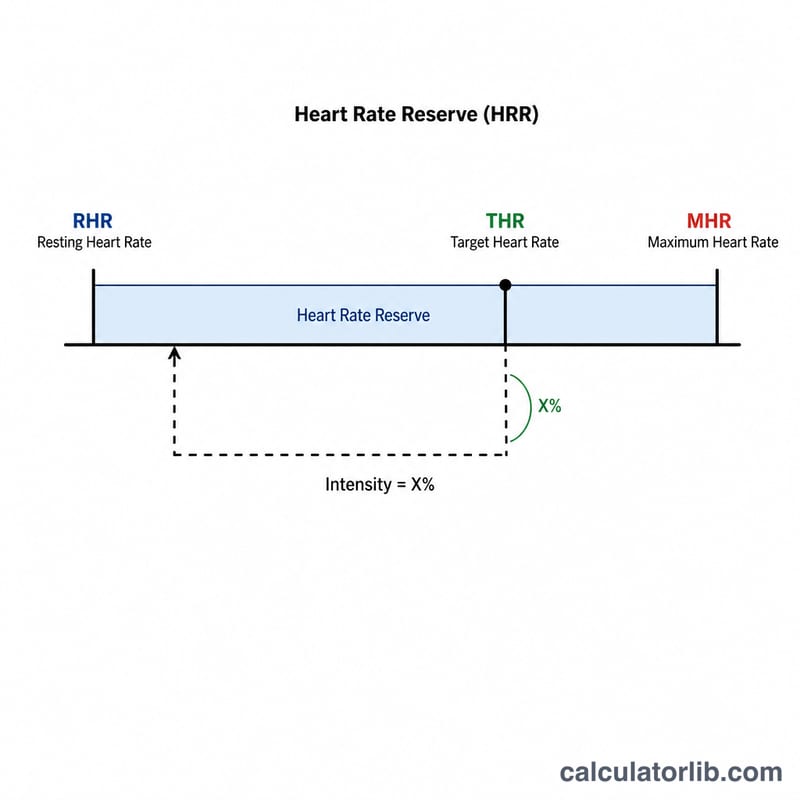
The Karvonen Heart Rate Calculator estimates your target heart rate (THR) for exercise using the heart rate reserve (HRR) method. Unlike a simple percentage of maximum heart rate, the Karvonen formula factors in your resting heart rate, giving a more personalized training zone. This makes it especially useful for runners, cyclists and anyone following structured cardio programs.
How to Use It
Enter your age, your resting heart rate (best measured first thing in the morning before getting up), and the intensity range you want to train in as percentages. Most aerobic training falls between 50% and 85% of heart rate reserve. The calculator returns your estimated maximum heart rate, your heart rate reserve, and the target beats-per-minute zone you should aim for.
The Formula Explained
The calculation works in three steps. First, maximum heart rate is estimated as \(\text{MHR} = 220 - \text{age}\). Second, heart rate reserve is the difference between your maximum and resting heart rate: \(\text{HRR} = \text{MHR} - \text{RHR}\). Finally, target heart rate is
$$\text{THR} = (\text{HRR} \times \text{intensity}) + \text{RHR}$$where intensity is expressed as a decimal (e.g. 70% = 0.70).
Worked Example
Consider a 30-year-old with a resting heart rate of 60 bpm training at 70% intensity.
$$\text{MHR} = 220 - 30 = 190 \text{ bpm}$$$$\text{HRR} = 190 - 60 = 130 \text{ bpm}$$$$\text{THR} = (130 \times 0.70) + 60 = 91 + 60 = \mathbf{151 \text{ bpm}}$$For a 50%–85% zone, the lower target is \((130 \times 0.50) + 60 = 125\) bpm and the upper target is \((130 \times 0.85) + 60 = 170.5\) bpm.
FAQ
Why is the Karvonen method better than percentage of max? Because it accounts for your resting heart rate, it adapts to your fitness level — fitter people with lower resting rates get more accurate zones.
How do I measure resting heart rate? Count your pulse for 60 seconds when you first wake up, before any activity or caffeine. Average several mornings for accuracy.
Is 220 − age accurate? It is a widely used estimate but can vary by ±10–12 bpm between individuals. For precise zones, a measured maximum heart rate from a stress test is ideal.