
What Is the Heart Rate from RR Interval Calculator?
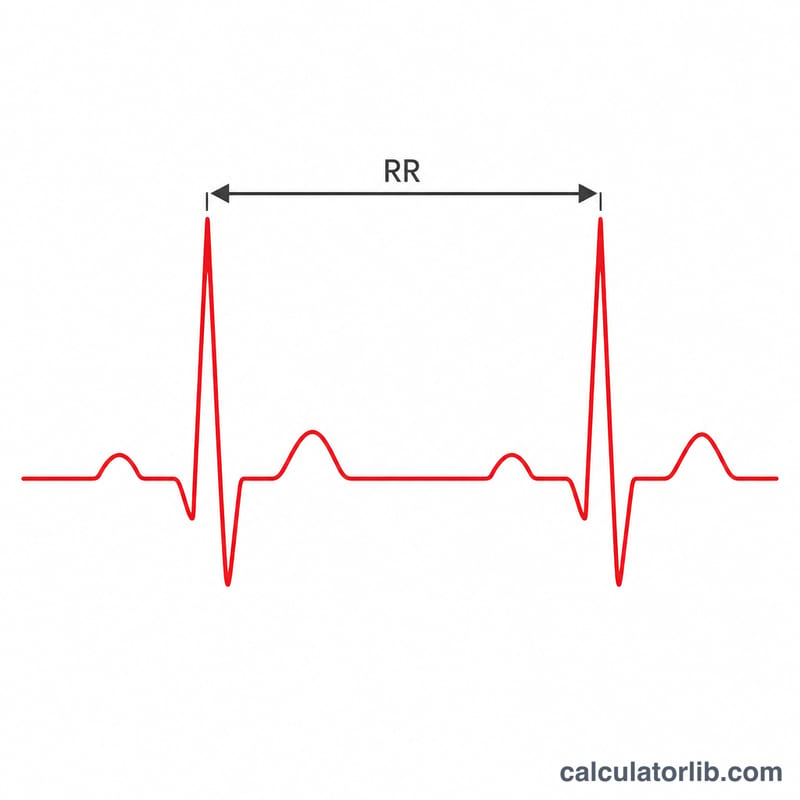
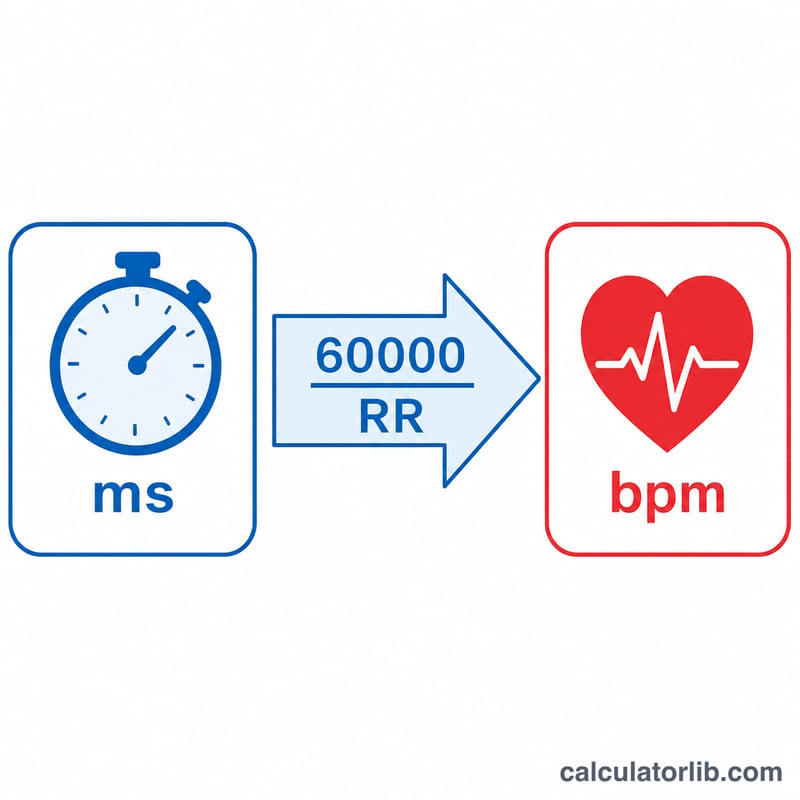
This calculator converts an RR interval — the time between two consecutive R-wave peaks on an electrocardiogram (ECG/EKG) — into a heart rate in beats per minute (bpm). The RR interval is measured in milliseconds (ms), and because one minute contains 60,000 milliseconds, the heart rate is simply 60,000 divided by the RR interval.
How to Use It
Enter the RR interval in milliseconds and the calculator returns the instantaneous heart rate. You can read the RR interval directly from an ECG strip, a Holter monitor, or many fitness and HRV devices. For a regular rhythm, a single RR interval gives a reliable rate; for irregular rhythms, average several intervals first.
The Formula Explained
The relationship is: $$\text{HR} = \frac{60000}{\text{RR Interval (ms)}}$$ The number 60,000 comes from converting one minute into milliseconds (60 seconds \(\times\) 1000 ms). A shorter RR interval means beats occur closer together, producing a higher heart rate; a longer interval means a slower rate.
Worked Example
Suppose the RR interval measured on an ECG is 800 ms. Then $$\text{HR} = \frac{60000}{800} = 75 \text{ bpm}$$ If the interval were 1000 ms (one full second between beats), the heart rate would be exactly 60 bpm.
FAQ
What is a normal RR interval? A resting adult heart rate of 60–100 bpm corresponds to an RR interval of roughly 600–1000 ms.
Why use the RR interval instead of counting beats? The RR interval gives an instantaneous rate from a single beat-to-beat measurement, which is useful for precise ECG analysis and heart-rate-variability studies.
Is this a medical diagnosis? No. This is an educational conversion tool. Always consult a qualified healthcare professional for interpretation of ECG data.