
What Is a Fetal Kick Count?
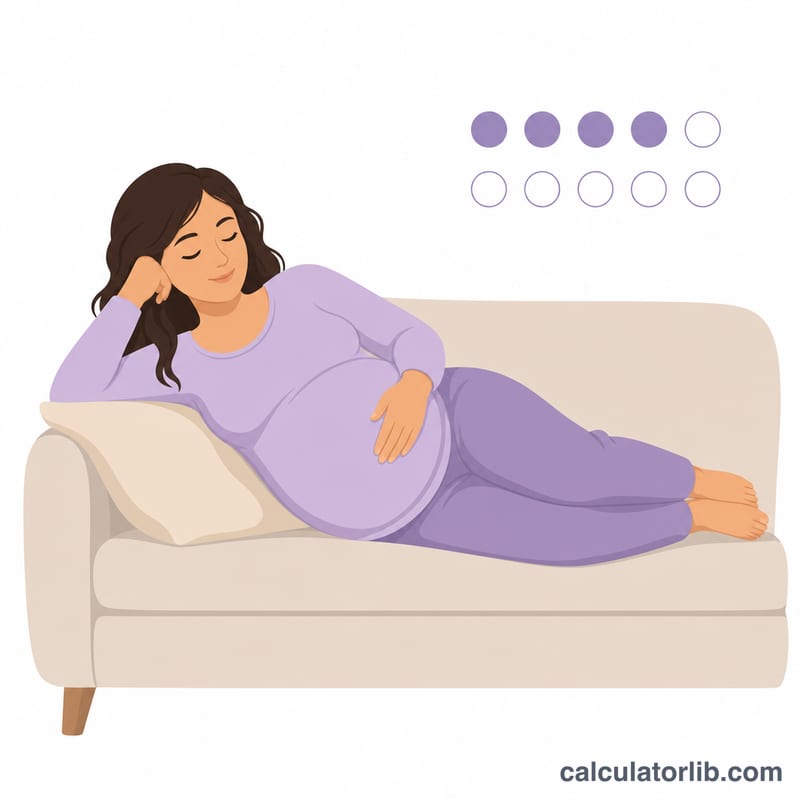
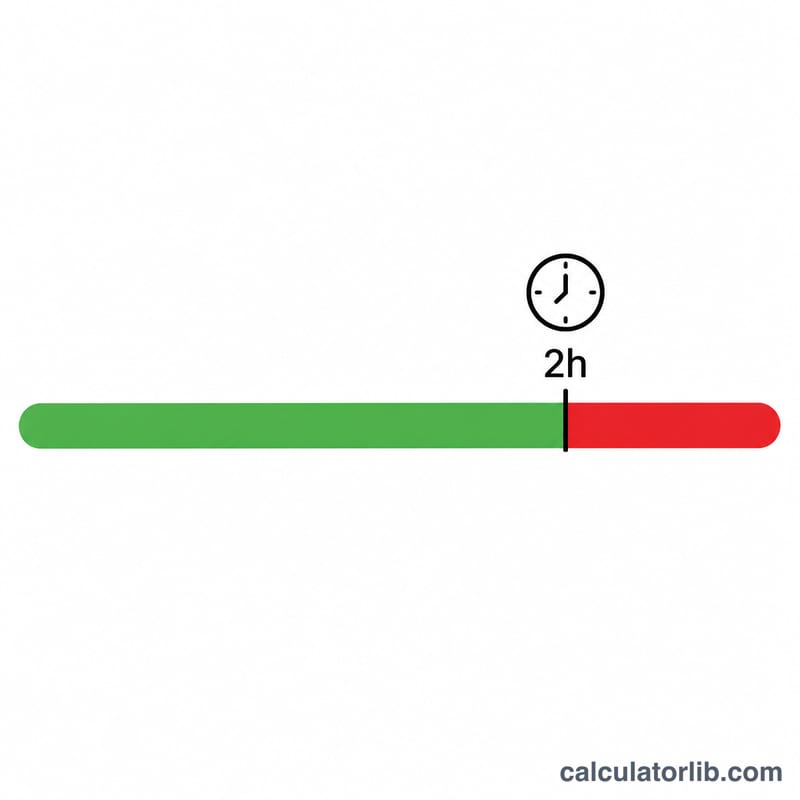
Counting fetal movements ("kick counting") is a simple way for expectant mothers, typically in the third trimester, to monitor their baby's wellbeing. A common method is to time how long it takes to feel 10 distinct movements. This calculator records the start time and the time the 10th movement was felt, then reports the elapsed minutes, the pace per movement, and whether the session fell within the widely used 2-hour guideline. This tool is educational and not a substitute for professional medical advice.
How to Use It
Choose a time when your baby is usually active. Note the clock time when you start, then count each distinct kick, roll, or flutter. When you reach 10 movements, enter the end time. The calculator subtracts start from end (handling sessions that cross midnight) and tells you the total minutes. Enter the number of movements actually counted to see your average pace.
The Formula Explained
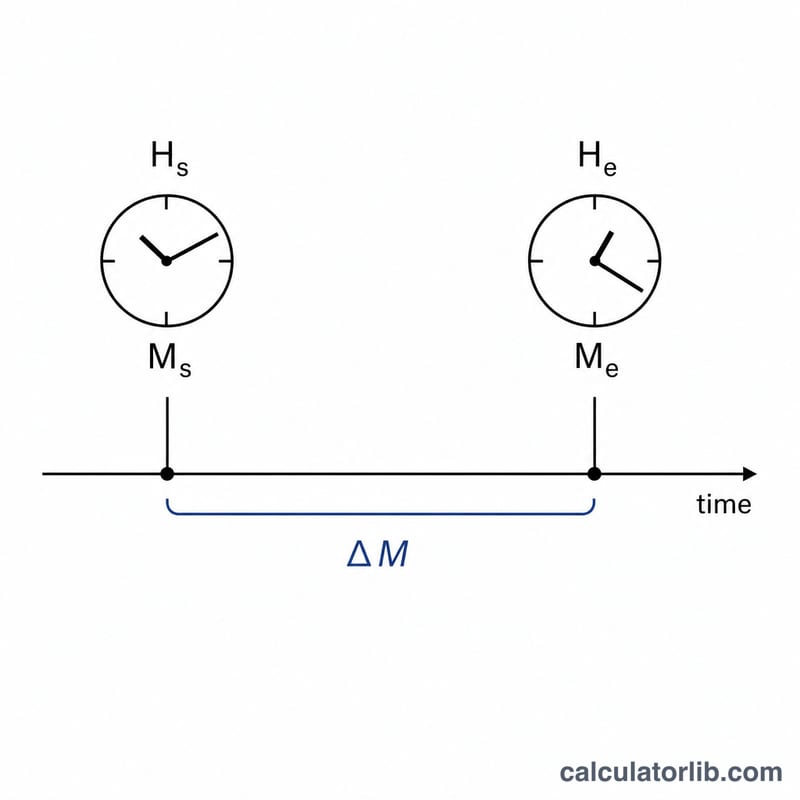
Times are converted to minutes-since-midnight: \(\text{start} = \text{startHour} \times 60 + \text{startMin}\) and \(\text{end} = \text{endHour} \times 60 + \text{endMin}\). Elapsed time is the difference; if the end is earlier (you crossed midnight), 1,440 minutes are added.
$$T_{\text{min}} = \left(60 \cdot \text{End Hr} + \text{End Min}\right) - \left(60 \cdot \text{Start Hr} + \text{Start Min}\right)$$$$\text{where}\quad \left\{ \begin{aligned} \text{Per Movement} &= \dfrac{T_{\text{min}}}{\text{Movements}} \\[0.4em] \text{Time to 10} &= 10 \cdot \dfrac{T_{\text{min}}}{\text{Movements}} \end{aligned} \right.$$Minutes per movement = elapsed ÷ movements, and the projected time to 10 movements scales that pace up to 10. If elapsed exceeds 120 minutes, an alert suggests contacting your care provider.
Worked Example
You start counting at 9:00 and feel your 10th movement at 9:35. Elapsed:
$$T_{\text{min}} = (9 \times 60 + 35) - (9 \times 60 + 0) = 575 - 540 = 35 \text{ minutes}$$With 10 movements, that's 3.5 minutes per movement, and the projected time to 10 movements is 35 minutes — comfortably within the 2-hour window, so the result is reassuring.
FAQ
How long is normal? Most babies reach 10 movements well within 2 hours. Reduced or slowing movement is a reason to seek advice.
What counts as a movement? Any kick, roll, flutter, or jab — but not hiccups.
Should I worry if it took 90 minutes? Anything under 2 hours is generally considered fine, but always trust your instincts and contact your midwife if something feels different from your baby's normal pattern.