
What Is the Corrected Reticulocyte Count?
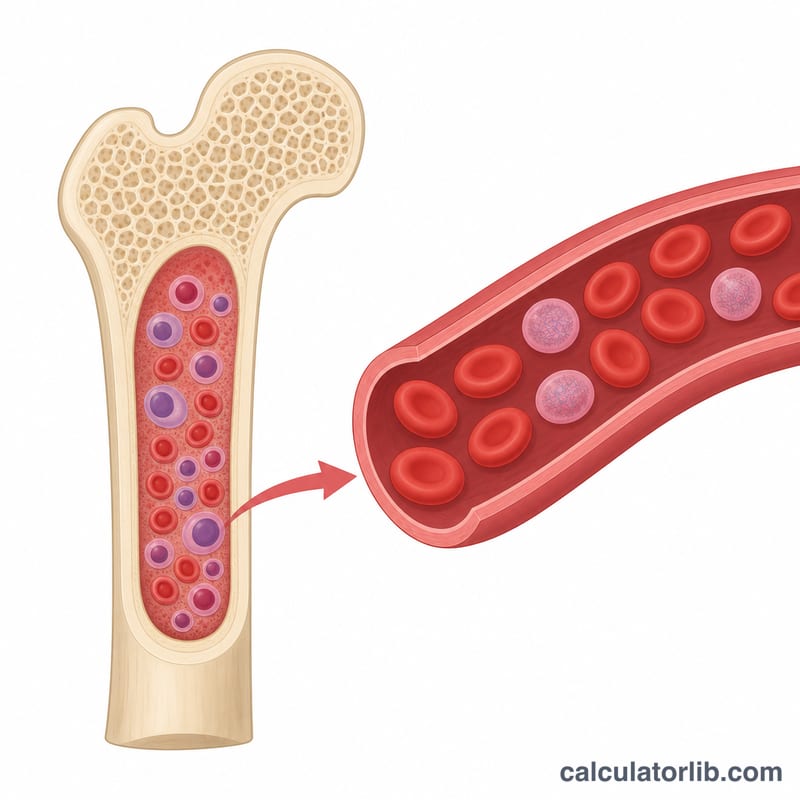
Reticulocytes are immature red blood cells. The raw reticulocyte percentage reported by a lab is expressed relative to the total red cell population, so in an anemic patient — who has fewer red cells — the percentage can appear falsely elevated. The corrected reticulocyte count (CRC) adjusts the reported percentage for the patient's degree of anemia, giving a more accurate picture of how well the bone marrow is responding.
How to Use This Calculator
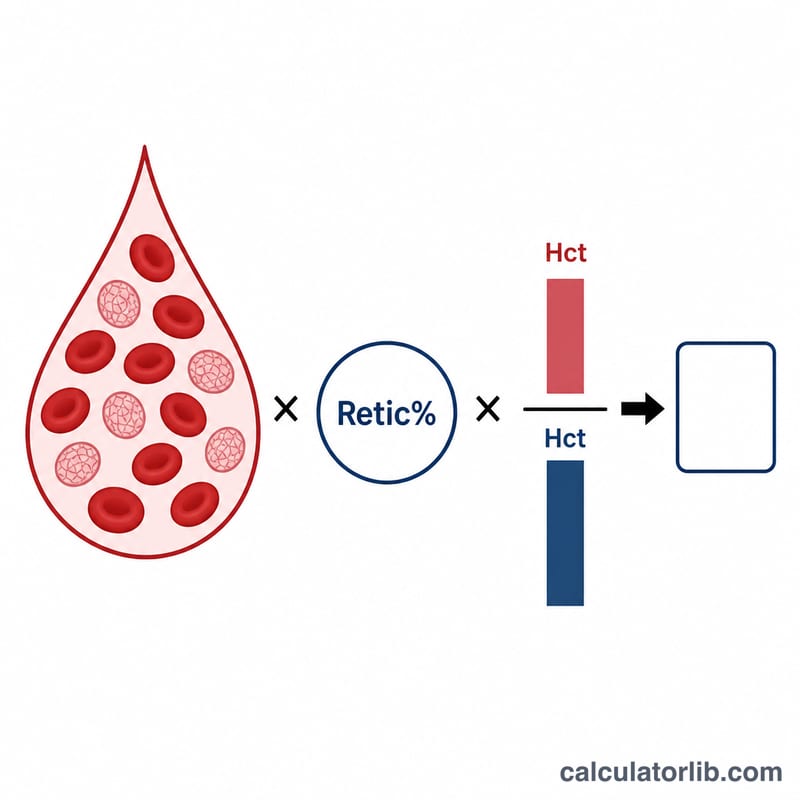
Enter the lab-reported reticulocyte percentage, the patient's measured hematocrit (Hct), and the reference normal hematocrit (commonly 45%). The calculator multiplies the reticulocyte percentage by the ratio of patient hematocrit to normal hematocrit and returns the corrected value.
The Formula Explained
$$\text{CRC} = \text{Reticulocyte (\%)} \times \frac{\text{Patient Hct (\%)}}{\text{Normal Hct (\%)}}$$ The normal hematocrit is conventionally 45%. A CRC under about 2% in an anemic patient suggests an inadequate (hypoproliferative) marrow response, while a higher CRC suggests the marrow is responding appropriately.
Worked Example
A patient has a reticulocyte count of 5% and a hematocrit of 25%, with a normal hematocrit of 45%. $$\text{CRC} = 5 \times \frac{25}{45} = 5 \times 0.5556 = 2.78\%$$ Although the raw value looked high at 5%, the corrected value of 2.78% shows a more modest marrow response after accounting for the anemia.
FAQ
Why use 45% as the normal hematocrit? 45% is a widely used reference midpoint; you can substitute a sex-specific normal value if preferred.
What is the reticulocyte production index (RPI)? The RPI takes the CRC one step further by dividing by a maturation correction factor, providing an even more refined measure of marrow activity.
Is this a diagnosis? No. The CRC is a screening calculation; interpret it alongside the full clinical picture and other lab results.