

What Is Corrected (Adjusted) Age?
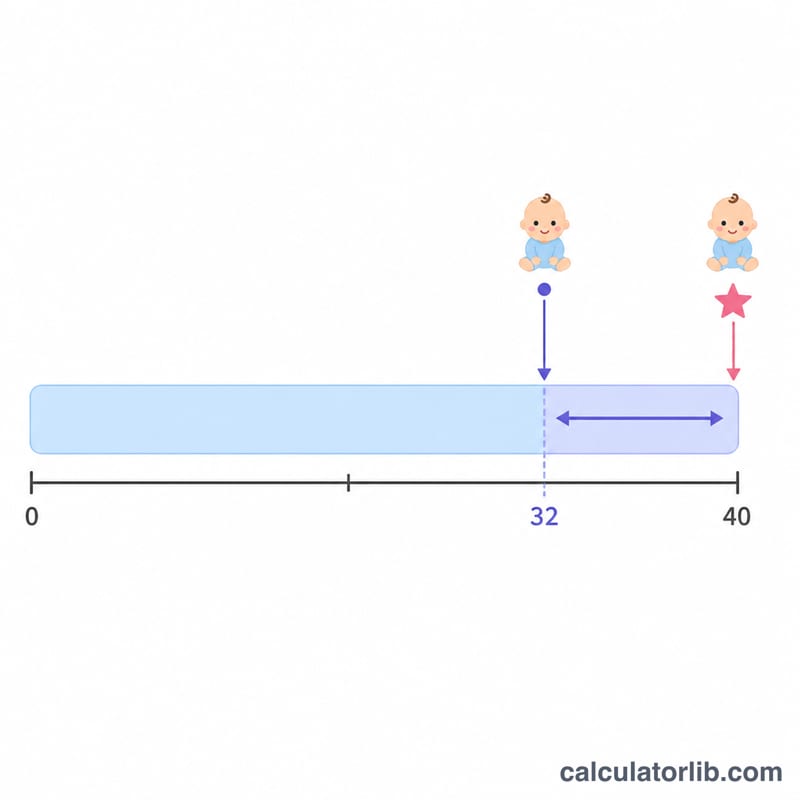
Corrected age — also called adjusted age — is the age a premature baby would be if they had been born on their due date. Because preemies arrive before completing the typical 40 weeks of gestation, their development is best compared against this adjusted timeline rather than their calendar (chronological) age. Pediatricians use corrected age when assessing growth, milestones, and feeding for babies born early, generally until around 2 years of age.
How to Use This Calculator
Enter two numbers: the baby's chronological age in weeks (weeks elapsed since the birth date) and the gestational age at birth in weeks (how many weeks pregnant the mother was at delivery). The calculator subtracts the weeks of prematurity and returns the corrected age in both weeks and approximate months.
The Formula Explained
A full-term pregnancy is treated as 40 weeks. The number of weeks a baby is premature equals \(40 - \text{gestational age at birth}\). The corrected age is then the chronological age minus that prematurity:
$$\text{Corrected age} = \text{chronological age} - (40 - \text{gestational age at birth})$$

Worked Example
Suppose a baby was born at 32 weeks gestation and is now 16 weeks old chronologically. Weeks of prematurity = \(40 - 32 = 8\). Corrected age = \(16 - 8 = 8\) weeks, which is roughly 1.84 months. So while the baby is 16 weeks old by the calendar, developmentally they are tracked as an 8-week-old.
FAQ
Until what age should I use corrected age? Most pediatricians use corrected age until about 24 months, after which the small gap becomes developmentally insignificant.
What if my baby was born after 40 weeks? Term and post-term babies do not need an age correction; this tool is intended for babies born before 40 weeks.
Is this a substitute for medical advice? No. This calculator is an educational aid. Always discuss your baby's development with your pediatrician.