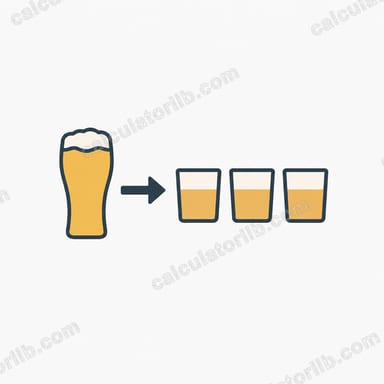
What Is a Standard Drink?
This calculator uses the United States definition of a standard drink: any beverage containing 14 grams (about 0.6 fluid ounces) of pure alcohol. Because beers, wines, and spirits differ wildly in strength, comparing them by container size is misleading. Converting to standard drinks lets you compare a can of beer, a glass of wine, and a shot of liquor on an equal footing. Note: other countries use different units (e.g., the UK uses 8 g units), so adjust if you are outside the US.

How to Use It
Enter the volume of the drink in milliliters and its alcohol by volume (ABV) as a percentage — both are usually printed on the label. The calculator returns the number of US standard drinks, plus the volume and mass of pure alcohol it contains.
The Formula Explained
First, multiply the volume by the alcohol fraction (ABV ÷ 100) to get the volume of pure ethanol. Multiply that by ethanol's density, 0.789 g/ml, to convert volume into grams. Finally divide by 14 g — the mass of alcohol in one US standard drink:
$$\text{Standard Drinks} = \frac{\text{Volume (ml)} \times \dfrac{\text{ABV (\%)}}{100} \times 0.789}{14}$$

Worked Example
A 355 ml can of beer at 5% ABV: pure alcohol volume = \(355 \times 0.05 = 17.75\) ml. Mass = \(17.75 \times 0.789 \approx 14.01\) g. Standard drinks = \(14.01 \div 14 \approx 1.0\) standard drink. That is exactly why a typical 12-oz beer is considered one drink.
Interpreting Your Result
The calculator reports how many US standard drinks a beverage contains, where one standard drink is 14 grams of pure alcohol. The figure comes from volume, ABV and the density of ethanol (0.789 g/ml). It is a measure of alcohol quantity only. Many drinks, such as craft beers, cocktails and generous wine pours, contain more than one standard drink even though they come in a single glass or bottle.
The reference points below come from the US National Institute on Alcohol Abuse and Alcoholism (NIAAA) and the Dietary Guidelines for Americans. They are US definitions and other countries use different thresholds.
- Dietary Guidelines for Americans (2025-2030): the current guidelines no longer give a numeric daily limit; they advise drinking less.
- Heavy drinking (NIAAA): for women, 4 or more drinks on any day or 8 or more per week; for men, 5 or more drinks on any day or 15 or more per week.
- Binge drinking: 4 or more drinks for women, or 5 or more for men, on a single occasion. This pattern typically brings blood alcohol concentration (BAC) to 0.08%, the US legal driving limit, in about 2 hours.
These are population-level definitions used for public health surveillance and guidance. They are not personal or medical advice. The calculator's result does not predict your BAC or level of impairment. Those depend on body weight, sex, how fast you drink, food, medications, health conditions and other factors. Some people, including those who are pregnant, are on certain medications, or have certain health conditions, are advised to avoid alcohol altogether. This is general information, not professional advice. Talk to a healthcare professional about your own situation.
US Standard Drinks vs. Other Countries' Units
Countries define a "standard drink" or "unit" differently, so the same glass counts differently depending on where you are. The table shows the grams of pure alcohol in each country's standard drink and what one US standard drink (14 g) equals in that country's units. The UK unit is rounded to 8 g (10 ml of ethanol is about 7.9 g).
| Country | Grams of pure alcohol per standard drink | 1 US standard drink (14 g) equals |
|---|---|---|
| United States | 14 g | 1 US standard drink |
| United Kingdom | 8 g (1 unit = 10 ml pure alcohol) | about 1.75 UK units |
How to convert
To convert US standard drinks into another country's units, multiply by 14 and divide by that country's grams per drink:
$$\text{Other units} = \frac{ \text{US drinks} \times 14}{\text{grams per other standard drink}}$$
To go the other way, multiply the other country's units by its grams per drink and divide by 14.
Example: A 750 ml bottle of wine at 12% ABV contains 750 × 0.12 × 0.789 = 71.01 g of alcohol, which is 71.01 ÷ 14 ≈ 5.07 US standard drinks.
Converting that to other systems:
- UK units: 5.07 × 14 ÷ 8 ≈ 8.9 units (about 9.0 using the exact 10 ml definition).
Each country's national guidelines are written in its own units, so compare guideline limits only after converting to grams.
FAQ
Why 0.789? That is the density of ethanol at room temperature in grams per milliliter, used to convert alcohol volume to alcohol mass.
How many standard drinks in a 750 ml bottle of 12% wine? \(750 \times 0.12 \times 0.789 \div 14 \approx 5.07\) standard drinks.
Is this a measure of how drunk I'll get? No. Standard drinks only count alcohol content. Blood alcohol concentration also depends on body weight, sex, food, and time. Always drink responsibly.