
What Is Standard Notation?
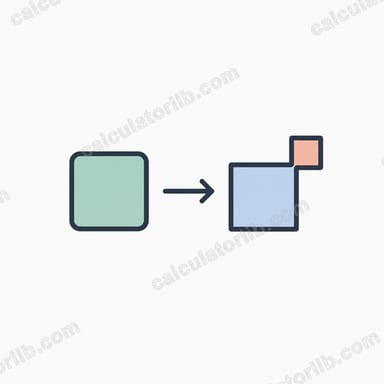
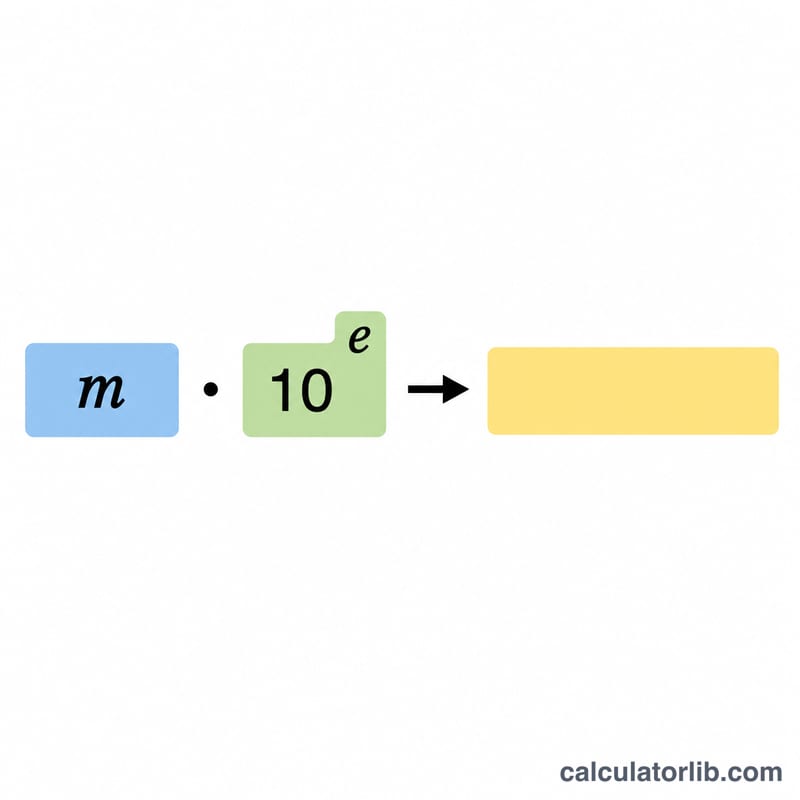
Standard notation (also called standard form or ordinary decimal notation) is the everyday way of writing numbers without exponents — for example, 60,200 instead of \(6.02 \times 10^{4}\). Scientific notation expresses a number as a mantissa (a coefficient) multiplied by a power of ten. This calculator reverses that compact form back into a familiar decimal number.
How to Use the Calculator
Enter the mantissa (the coefficient in front) and the exponent (the power of ten). The calculator multiplies the mantissa by 10 raised to the exponent and shows the resulting decimal value. A positive exponent produces a large number; a negative exponent produces a small fraction.
The Formula Explained
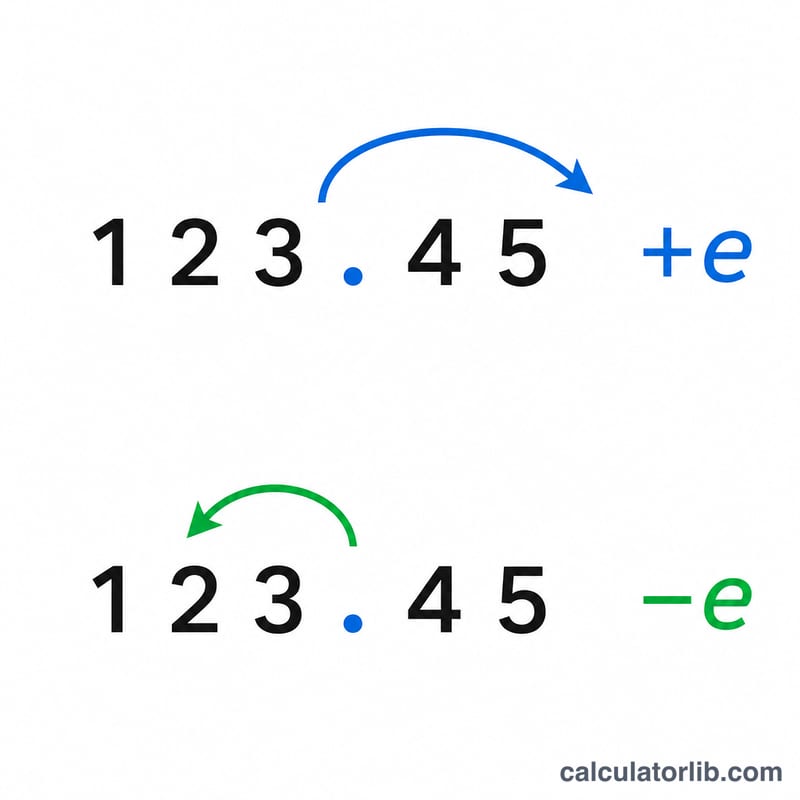
The conversion uses $$\text{Value} = \text{Mantissa} \times 10^{\text{Exponent}}$$ The exponent counts how many places the decimal point shifts: shift it right for a positive exponent and left for a negative one. For instance, \(10^{3} = 1{,}000\), so multiplying by it moves the decimal three places to the right.
Worked Example
Suppose the mantissa is 6.022 and the exponent is 23 (Avogadro's number). Then $$\text{value} = 6.022 \times 10^{23} = 602{,}200{,}000{,}000{,}000{,}000{,}000{,}000.$$ With a mantissa of 5 and exponent of 3, \(\text{value} = 5 \times 1{,}000 = 5{,}000\).
FAQ
What does a negative exponent mean? It represents a number smaller than one. For example, \(2 \times 10^{-3} = 0.002\).
Can the exponent be zero? Yes — any number times \(10^{0}\) equals itself, since \(10^{0} = 1\).
Does the mantissa have to be between 1 and 10? Proper scientific notation keeps the mantissa in that range, but this calculator accepts any value and still computes the correct result.