
What is engineering notation?
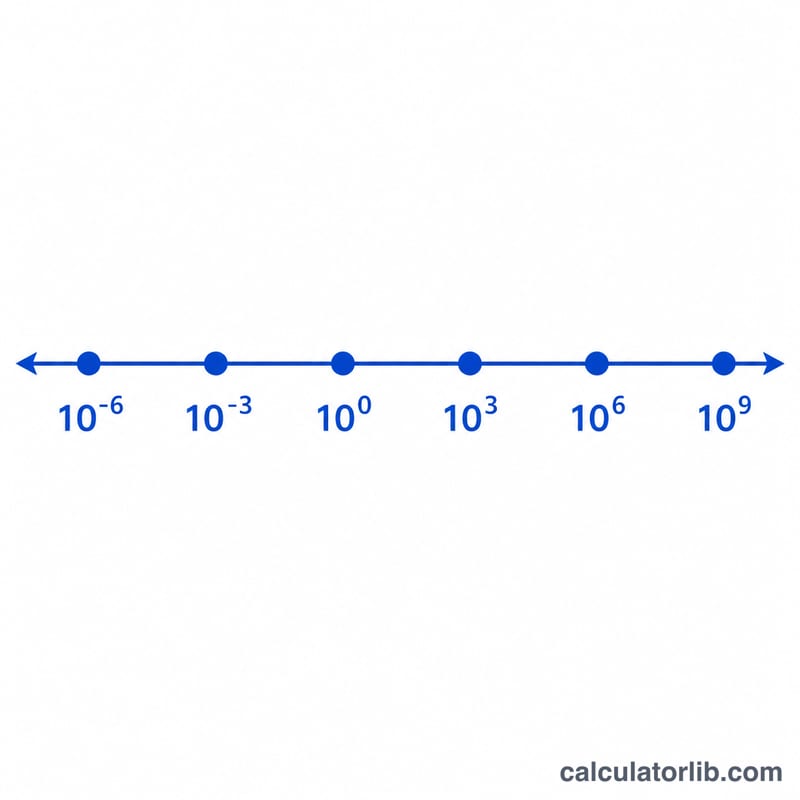
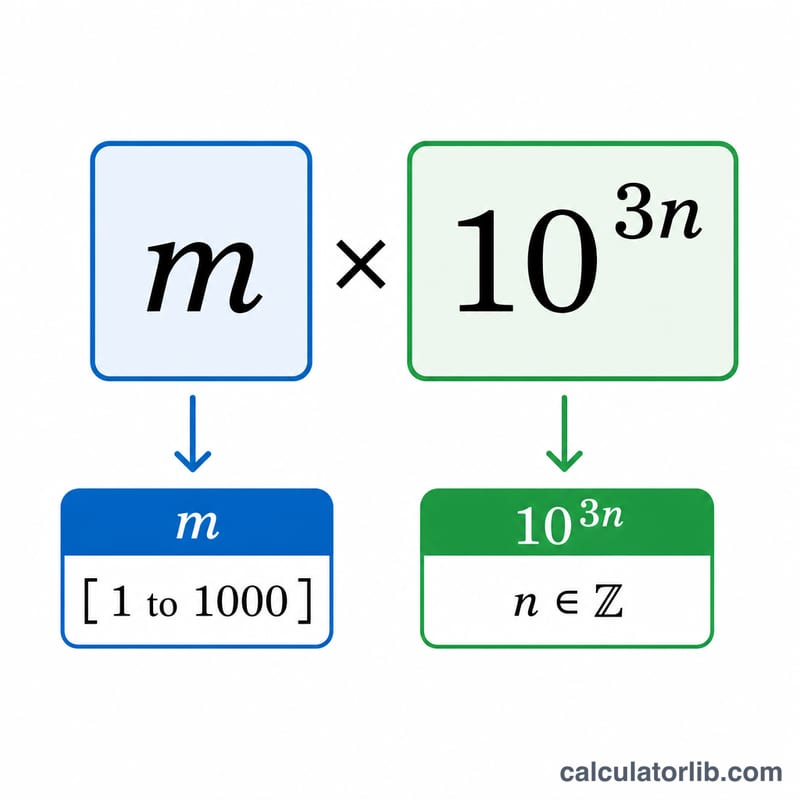
Engineering notation is a variant of scientific notation in which the exponent of ten is always restricted to a multiple of three. This makes it line up neatly with the metric prefixes engineers use every day — kilo (\(10^3\)), mega (\(10^6\)), giga (\(10^9\)), milli (\(10^{-3}\)), micro (\(10^{-6}\)) and so on. A number is written as \(m \times 10^{3n}\), where the mantissa m satisfies \(1 \le |m| < 1000\) and n is an integer.
How to use this calculator
Type any positive or negative number — for example 47000, 0.0034, or -1500000 — and the calculator returns the mantissa and the exponent. Because the exponent is forced to be a multiple of three, the mantissa always falls between 1 and 1000, ready to be paired with a metric prefix.
The formula explained
Starting from the base-ten logarithm of the absolute value, we choose the largest multiple of three exponent \(e = 3n\) such that dividing the original number by \(10^e\) leaves a mantissa whose magnitude is at least 1 but less than 1000. Symbolically:
$$x = m \times 10^{3n}.$$Zero is a special case and is returned as \(0 \times 10^0\).
Worked example
Take \(x = 47000\). The plain scientific form is \(4.7 \times 10^4\), but 4 is not a multiple of three. Rounding the exponent down to the nearest multiple of three gives \(10^3\), so we divide:
$$47000 \div 1000 = 47.$$The engineering notation is therefore \(47 \times 10^3\) — that is, 47 kilo-units.
FAQ
How is this different from scientific notation? Scientific notation keeps the mantissa between 1 and 10 with any integer exponent; engineering notation keeps the exponent a multiple of three and the mantissa between 1 and 1000.
Why use multiples of three? They match SI metric prefixes, so \(4.7 \times 10^4\) Hz becomes \(47 \times 10^3\) Hz = 47 kHz, which is easier to read.
Does it handle small numbers? Yes. 0.0034 becomes \(3.4 \times 10^{-3}\) (3.4 milli-units).