
What is scientific notation?
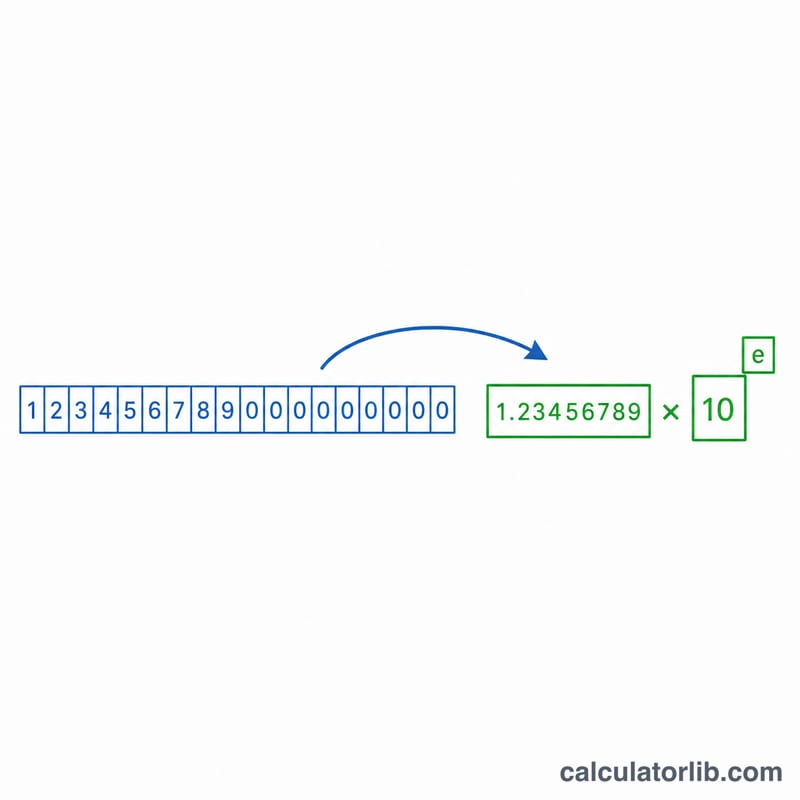
Scientific notation is a compact way of writing very large or very small numbers as a product of a mantissa (also called the coefficient or significand) and a power of ten. The standard form is \(m \times 10^{e}\), where the mantissa \(m\) satisfies \(1 \le |m| < 10\) and the exponent \(e\) is an integer. This format is used throughout science, engineering, and mathematics because it makes huge and tiny quantities easy to read, compare, and multiply.
How to use this calculator
Type any number into the input box. You can enter ordinary decimals such as 12345.678 or 0.00042, or numbers already in computer-style scientific form like 4.2e-3. The calculator returns the mantissa and the integer exponent so you can write the number in proper scientific notation. It works for positive numbers, negative numbers, and zero.
The formula explained
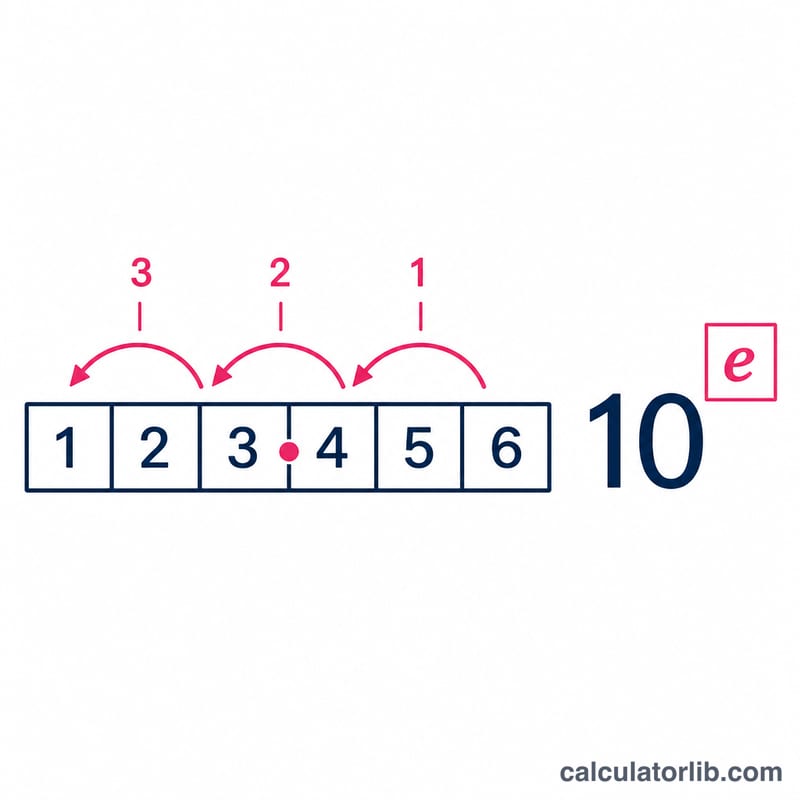
To convert a number \(x\) (with \(x \ne 0\)), the calculator finds the exponent as the floor of the base-10 logarithm of the absolute value:
$$e = \lfloor \log_{10}|x| \rfloor$$Dividing the original number by \(10^{e}\) gives the mantissa:
$$m = \frac{x}{10^{e}}$$Using the floor function guarantees the mantissa lands in the range \(1 \le |m| < 10\). A small adjustment handles floating-point rounding so the mantissa never displays as exactly 10.
Worked example
Convert 12,345.678. The base-10 log of 12,345.678 is about 4.0915, and its floor is 4, so \(e = 4\). Dividing gives
$$m = \frac{12{,}345.678}{10^{4}} = 1.2345678$$Therefore
$$12{,}345.678 = \mathbf{1.2345678 \times 10^{4}}$$FAQ
What about negative numbers? The sign stays with the mantissa, e.g. \(-540 = -5.4 \times 10^{2}\).
How is zero handled? Zero has no defined exponent, so it is returned as \(0 \times 10^{0}\).
Is this the same as engineering notation? No — engineering notation restricts the exponent to multiples of 3; scientific notation allows any integer exponent.