
What Is the Right Triangle Calculator?
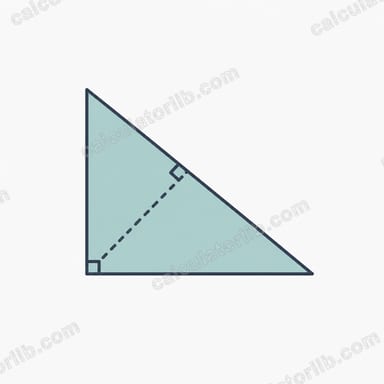
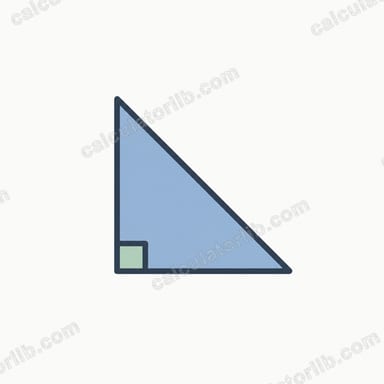
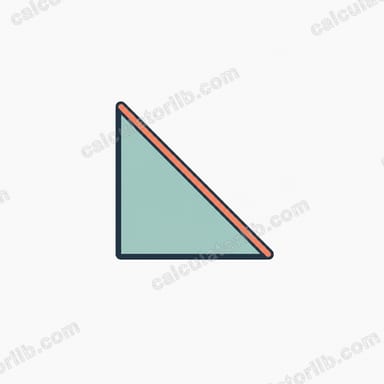
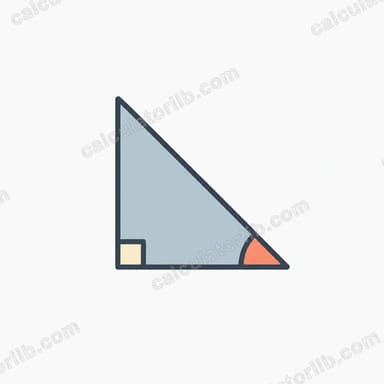
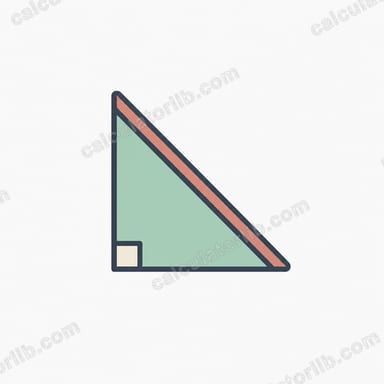
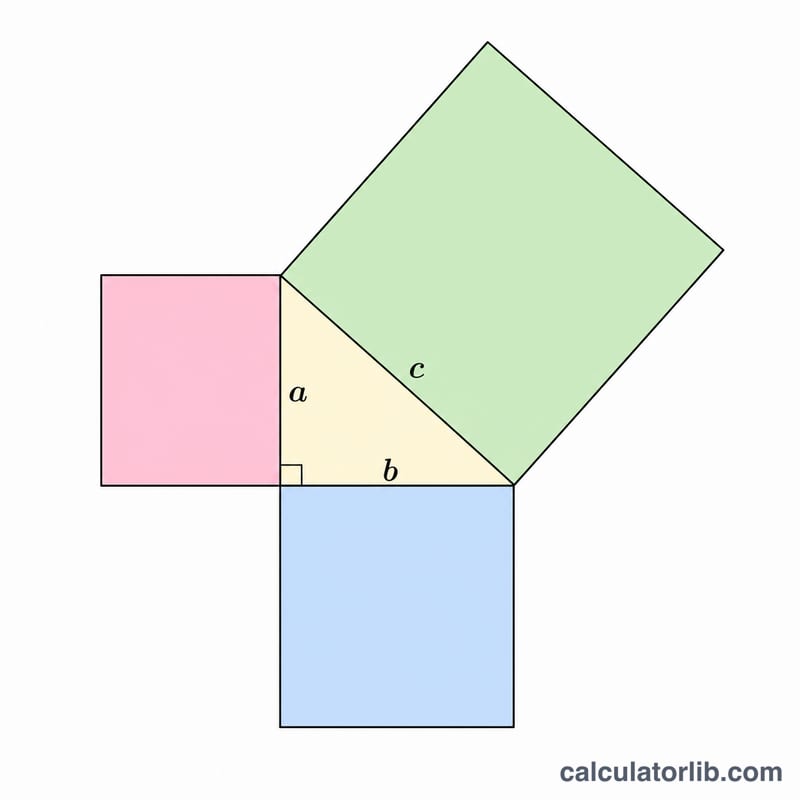
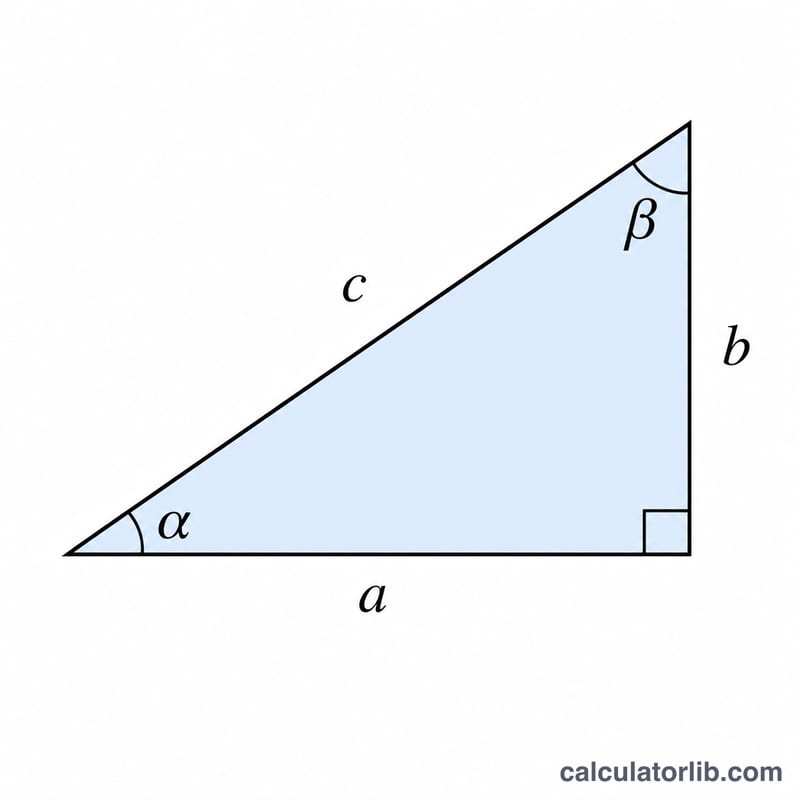
A right triangle has one 90° angle. The two sides that form the right angle are the legs (a and b), and the longest side opposite the right angle is the hypotenuse (c). This calculator takes the two leg lengths and instantly returns the hypotenuse, area, perimeter, and the two acute angles.
How to Use It
Enter the length of leg a and leg b in any consistent unit (cm, m, inches—just keep them the same). The results use the same units for lengths, square units for area, and degrees for angles. There is no need to know any angle in advance.
The Formulas Explained
The hypotenuse comes from the Pythagorean theorem: $$c = \sqrt{a^2 + b^2}$$ The area of a right triangle is simply half the product of its legs: $$A = \frac{a \cdot b}{2}$$ The perimeter is \(a + b + c\). The acute angle opposite leg a is found with $$A = \arctan\left(\frac{a}{b}\right)$$ and the angle opposite leg b is its complement, \(\arctan\left(\frac{b}{a}\right)\); together with the 90° angle they sum to 180°.
Worked Example
For legs \(a = 3\) and \(b = 4\): $$c = \sqrt{9 + 16} = \sqrt{25} = 5$$ $$A = \frac{3 \times 4}{2} = 6$$ Perimeter \(= 3 + 4 + 5 = 12\). Angle \(A = \arctan(3/4) \approx 36.87°\), and angle \(B = \arctan(4/3) \approx 53.13°\). This is the classic 3‑4‑5 right triangle.
FAQ
Can I enter the hypotenuse instead of a leg? No—this tool expects the two legs. To find a missing leg, rearrange: \(\text{leg} = \sqrt{c^2 - \text{other leg}^2}\).
Why are the angles in degrees? Degrees are the most common everyday unit; multiply by \(\pi/180\) to convert to radians.
What if one leg is zero? A triangle needs both legs greater than zero; a zero leg degenerates into a line.