
What Is Voltage Drop?
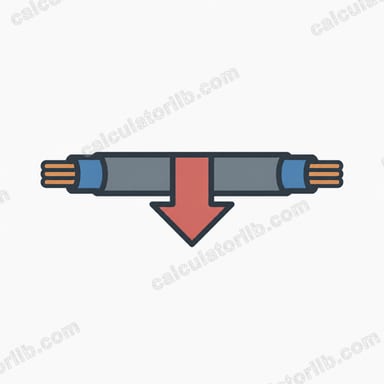
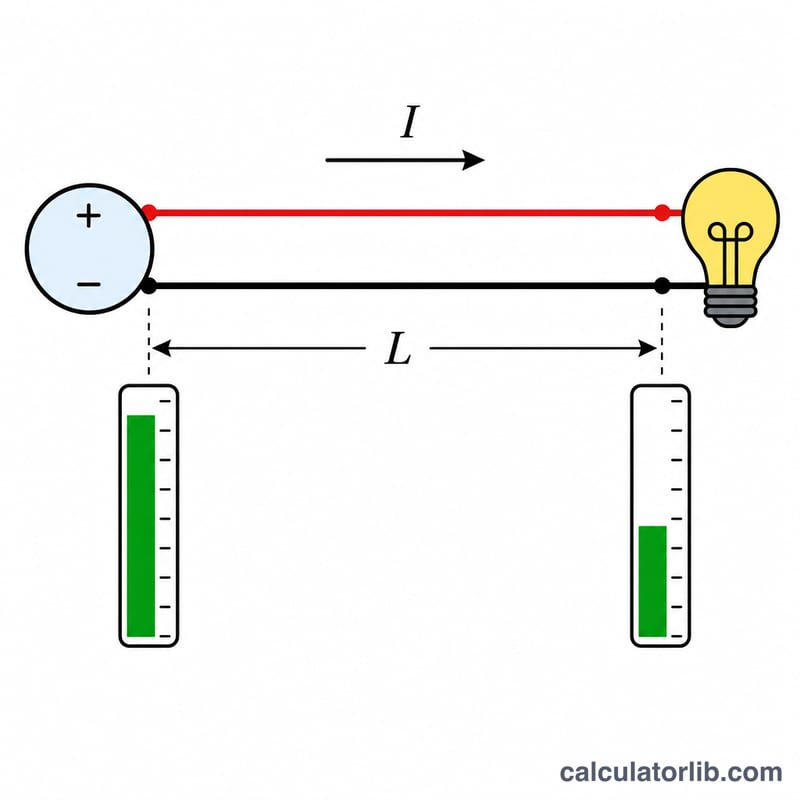
Voltage drop is the reduction in voltage along a cable caused by the conductor's electrical resistance. As current flows through a wire, some energy is lost as heat, so the voltage available at the load end is lower than at the source. Excessive voltage drop can cause dim lighting, motor overheating, and equipment malfunction. This calculator works in metric units and applies internationally; many codes recommend keeping drop below 3–5% of nominal voltage.
How to Use It
Choose the conductor material (copper or aluminum) and whether the circuit is single- or three-phase. Enter the load current in amps, the one-way run length in metres, the conductor cross-sectional area in mm², and the source voltage. The tool returns the absolute voltage drop, the drop as a percentage, and the resulting voltage at the load end.
The Formula Explained
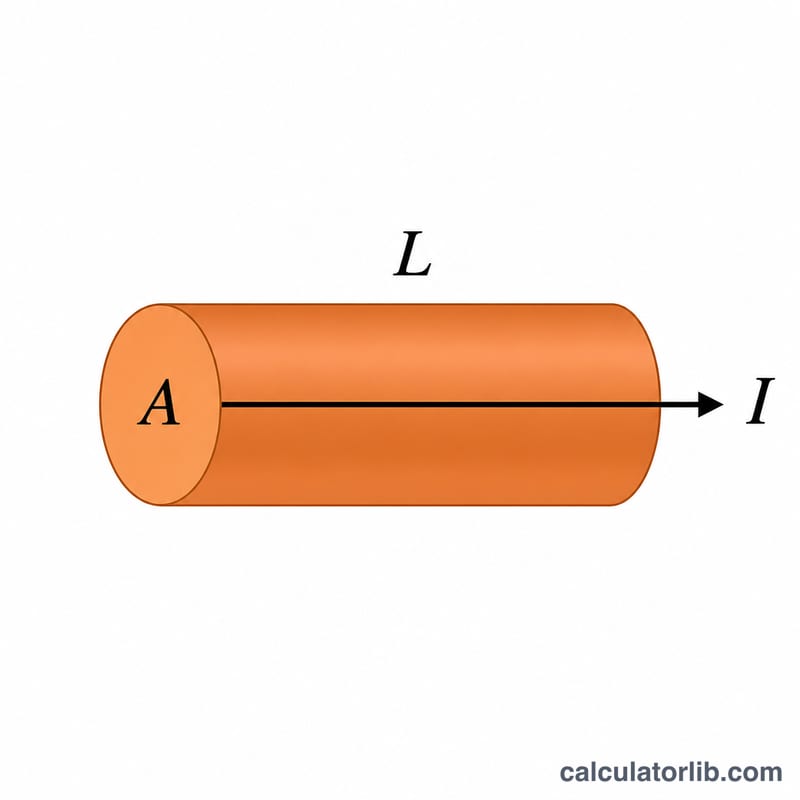
We use the resistivity form: $$V_{drop} = \dfrac{k \cdot \rho \cdot L \cdot I}{A}$$ Here \(\rho\) (rho) is the resistivity — about \(0.0172\ \Omega\cdot\text{mm}^2/\text{m}\) for copper and \(0.0282\ \Omega\cdot\text{mm}^2/\text{m}\) for aluminum at 20°C. The factor \(k\) accounts for circuit topology: 2 for a single-phase circuit (current travels out and back, doubling the conductor length) and \(\sqrt{3}\) (\(\approx 1.732\)) for a balanced three-phase line-to-line calculation.
Worked Example
A copper cable carries 20 A over a 30 m one-way run with a 4 mm² conductor on a 230 V single-phase supply. $$V_{drop} = \frac{2 \times 0.0172 \times 30 \times 20}{4} = 5.16\ \text{V}$$ That is \(\dfrac{5.16}{230} \times 100 = 2.24\%\), leaving 224.84 V at the load — within the typical 5% limit.
FAQ
Why multiply length by 2? Current must flow to the load and back, so a single-phase circuit's effective conductor length is twice the one-way run.
Copper vs aluminum? Aluminum has higher resistivity, so it drops more voltage for the same size; you typically need a larger cross-section.
Does temperature matter? Yes — resistivity rises with temperature. This tool uses standard 20°C values, so hot conductors will drop slightly more.