
What this calculator does
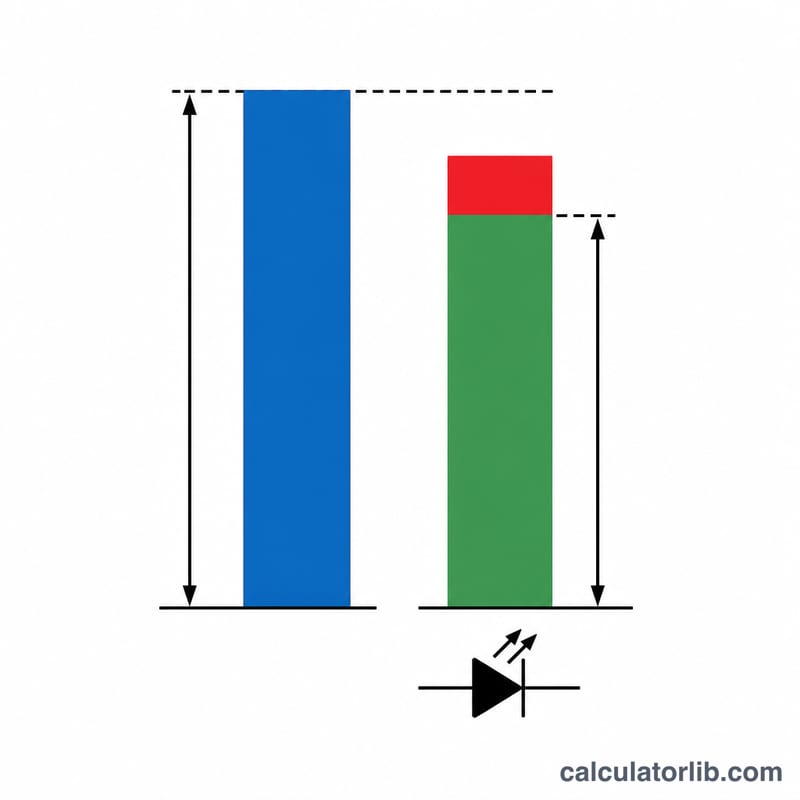
The LED Wire Voltage Drop Calculator estimates how much voltage is lost in the cable that connects your power supply to an LED, LED module or LED strip. Because LEDs are sensitive to small voltage changes, even a fraction of a volt lost in long or thin wires can leave the LED dim or running below spec. This tool is universal — it works for any conductor in any country since it is based on physics, not a regional wiring code.
How to use it
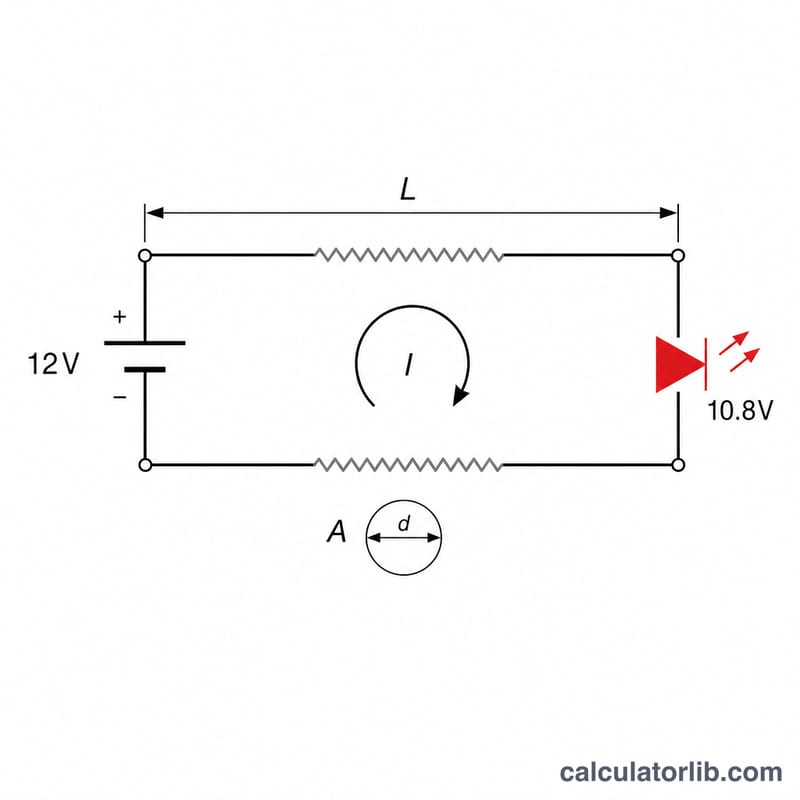
Enter the LED current in amps, the one-way length of the wire run (the calculator automatically doubles it for the return conductor), the cross-section area of the wire in mm², the supply voltage, and the conductor material (copper or aluminum). The result shows the voltage dropped in the wire, the voltage that actually reaches the LED, the drop as a percentage, the loop resistance and the power wasted as heat.
The formula explained
A wire's resistance is \(R = \rho L / A\), where \(\rho\) is the material resistivity (\(1.68\times10^{-8}\ \Omega\cdot\text{m}\) for copper), \(L\) the length and \(A\) the cross-section in square meters. Current must flow out and back, so the round-trip drop is $$V_{drop} = \frac{2 \cdot \text{Length (m)} \cdot \text{Current (A)} \cdot \rho}{\text{Area (mm}^2) \times 10^{-6}}$$ Note \(1\ \text{mm}^2 = 1\times10^{-6}\ \text{m}^2\).
Worked example
Suppose an LED strip draws 2 A through 5 m of 0.5 mm² copper wire. Resistance per meter = \(1.68\times10^{-8} / 0.5\times10^{-6} = 0.0336\ \Omega/\text{m}\). Loop length = 10 m, so loop resistance = 0.336 Ω. Voltage drop = \(2\ \text{A} \times 0.336\ \Omega = 0.672\ \text{V}\). On a 12 V supply that is about 5.6%, leaving 11.328 V at the strip and wasting 1.344 W as heat.
FAQ
Why multiply length by two? Current travels through both the positive and negative conductors, so the total copper path is twice the run distance.
How much drop is acceptable? A common rule of thumb is to keep drop under 3% for sensitive LED strips. If you exceed that, use thicker wire (larger area) or a shorter run.
Does temperature matter? Yes — resistivity rises with temperature, so hot conductors drop slightly more voltage. This calculator uses standard 20 °C values.