
What Is Voltage Drop Percentage?
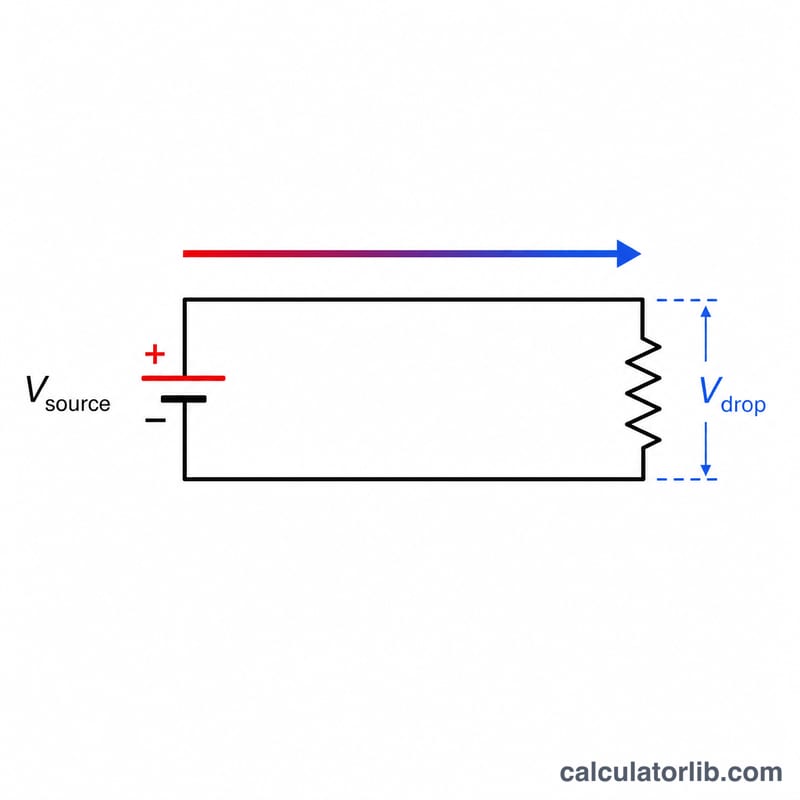
Voltage drop is the loss of voltage as current flows through the resistance of a conductor. Expressed as a percentage of the source voltage, VD% tells you how much of your supply voltage is lost in the wiring before it reaches the load. Keeping this value low ensures appliances, motors and lighting receive enough voltage to operate efficiently and safely.
How to Use This Calculator
Enter the source voltage (the voltage at the supply, e.g. 120 V or 240 V) and the measured or calculated voltage drop across the run. The calculator returns the drop as a percentage and the voltage actually available at the load.
The Formula Explained
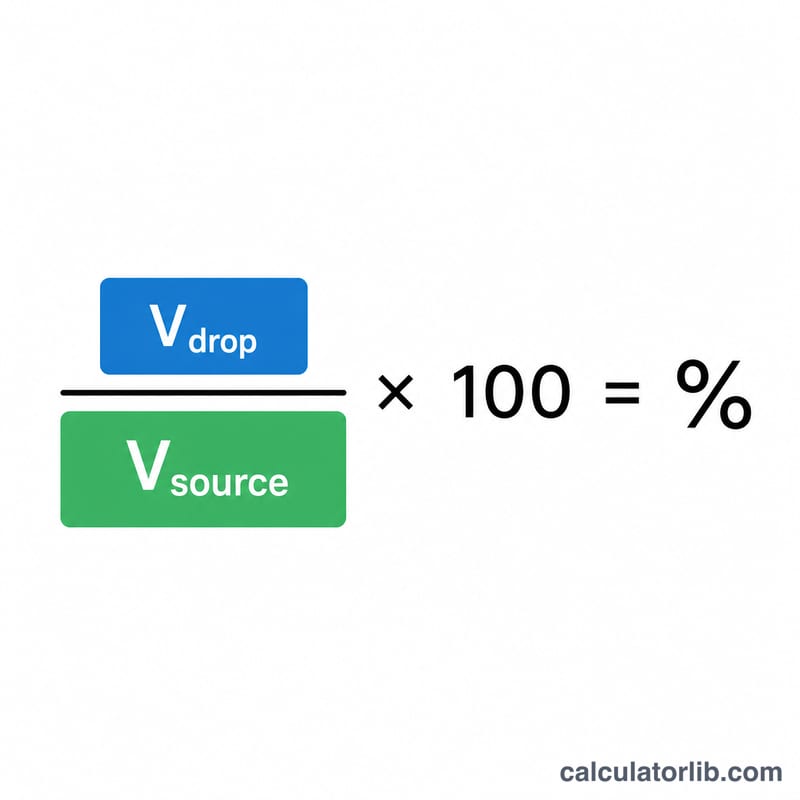
The calculation is straightforward:
$$\text{VD\%} = \frac{V_{\text{drop}}}{V_{\text{source}}} \times 100$$
For example, if a 120 V circuit drops 3.6 V along the cable, the voltage drop percentage is \((3.6 \div 120) \times 100 = 3\%\), leaving 116.4 V at the load. Many electrical guidelines (such as the NEC informational notes) recommend keeping branch-circuit drop under 3% and total drop (feeder + branch) under 5%.
Worked Example
A 240 V feeder shows a 9.6 V drop. $$\text{VD\%} = (9.6 \div 240) \times 100 = 4\%$$ The load sees 230.4 V. This exceeds the 3% branch-circuit guideline, so you may want a larger conductor.
FAQ
What is an acceptable voltage drop? A common recommendation is 3% maximum for branch circuits and 5% for the combined feeder and branch circuit.
How do I reduce voltage drop? Use a larger conductor size, shorten the run, increase the system voltage, or reduce the load current.
Does this depend on AC or DC? No — the percentage formula is the same; just supply the matching source voltage and measured drop.