
What This Calculator Does
Low-voltage systems such as 12V or 24V LED strips, landscape lighting, RV and solar wiring lose a meaningful amount of voltage in the cable itself. Because the operating voltage is small, even a fraction of a volt lost in the wire can dim lights or stop devices working. This calculator estimates the voltage drop along a copper conductor, the voltage actually reaching your load, and the drop as a percentage of the source.
How to Use It
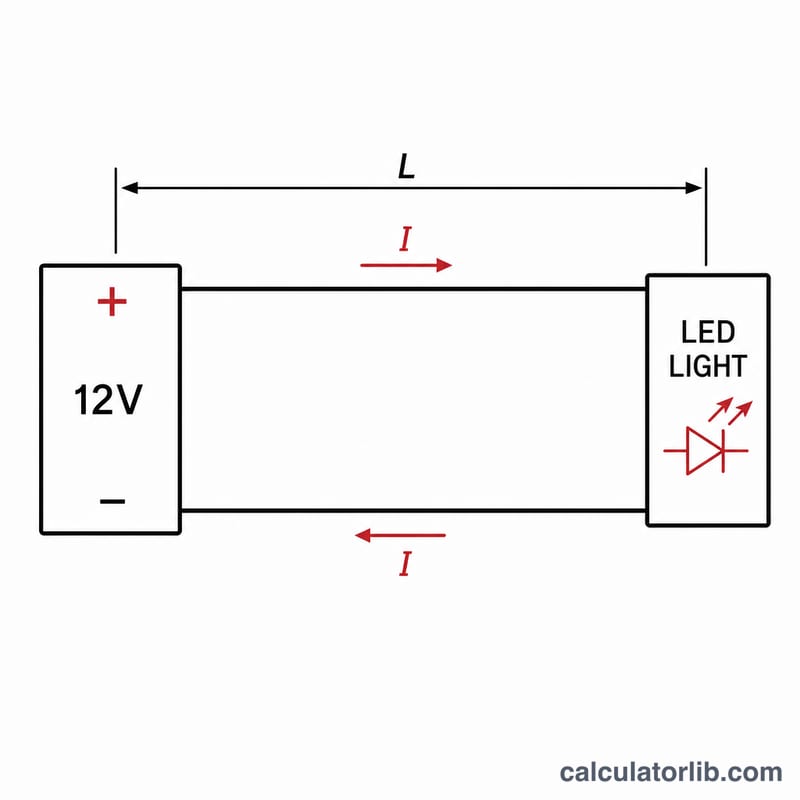
Enter your source voltage (commonly 12 or 24 V), the current draw in amps, the one-way distance from the supply to the load in feet, and the wire gauge (AWG). The tool doubles the length automatically to account for the return conductor, so you only enter the distance once.
The Formula Explained
The core equation is $$V_{drop} = 2 \times I \times L \times R_{unit}$$ where \(I\) is the current in amps, \(L\) is the one-way length in feet, and \(R_{unit}\) is the resistance per foot for the chosen copper AWG size. The factor of 2 covers the full circuit (out and back). The voltage at the load is simply the source minus the drop, and the percentage drop is \(V_{drop} \div V_{source} \times 100\). Designers usually aim to keep drop under 3% for sensitive electronics and under 10% for lighting.
Worked Example
Suppose you run 5 A through 50 ft of 14 AWG copper from a 12 V supply. 14 AWG is about 0.002525 ohms per foot, so $$V_{drop} = 2 \times 5 \times 50 \times 0.002525 \approx 1.26 \text{ V}$$ The load sees about 10.74 V, a drop of roughly 10.5% — enough to justify a heavier gauge.
FAQ
Does this work for AC? It uses DC resistance and is a close estimate for low-voltage AC lighting where reactance is negligible.
Should I enter one-way or round-trip length? Enter the one-way distance; the calculator adds the return path automatically.
How much drop is acceptable? A common rule of thumb is to keep the drop below 3% for electronics and below 10% for lighting circuits.