
What is the Voltage Drop Calculator?
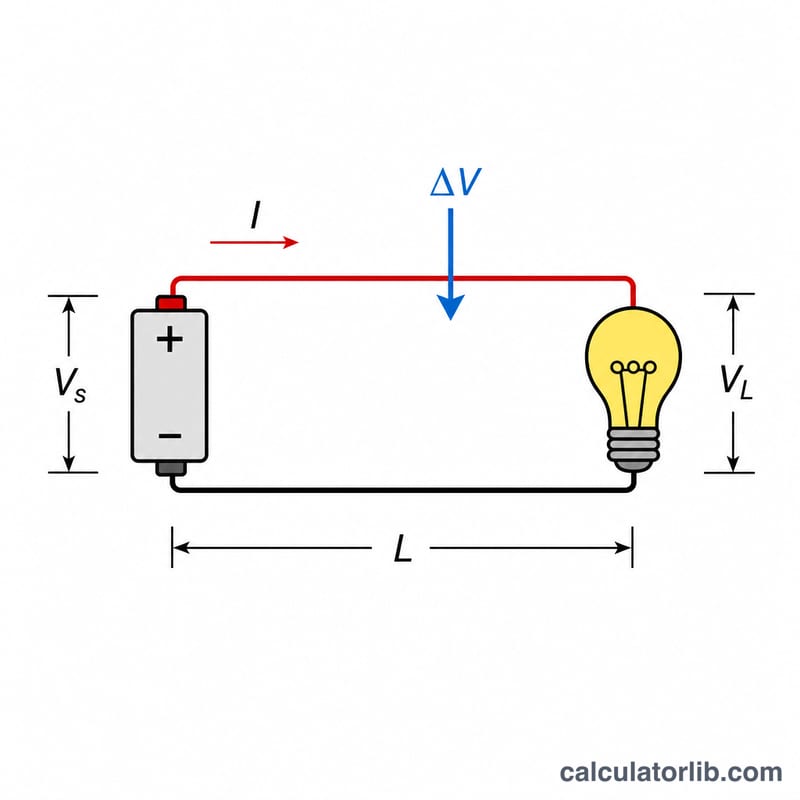
This tool estimates the voltage drop along an electrical cable when current flows through its resistance. Excessive drop wastes energy and can cause lights to dim or motors to underperform. It works for single-phase (or DC) and three-phase circuits with copper or aluminium conductors sized in square millimetres (mm²).
How to use it
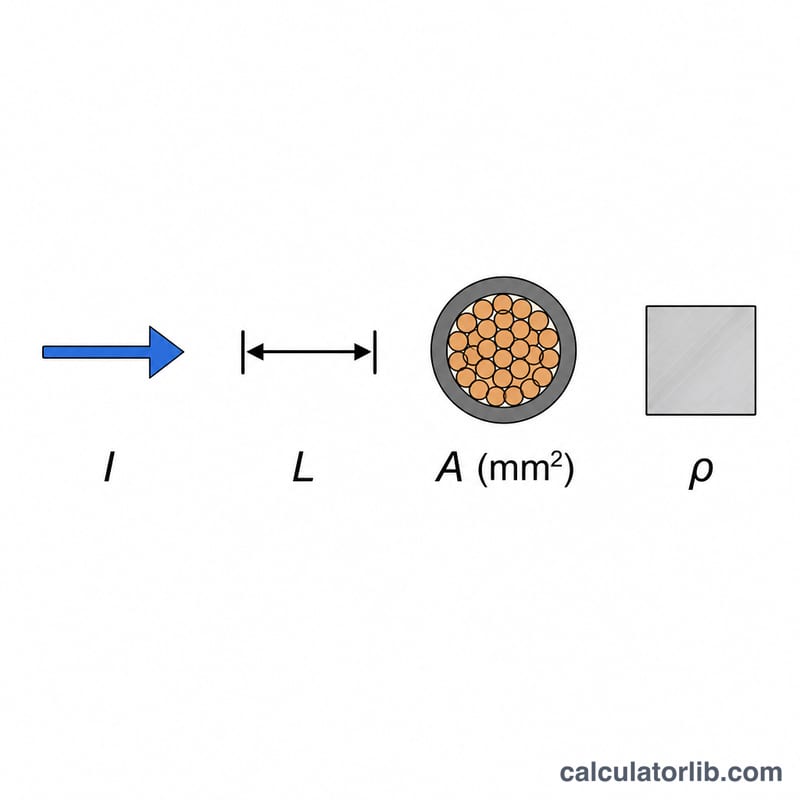
Select the phase system and conductor material, then enter the load current in amperes, the one-way cable run in metres, the conductor cross-section in mm², and the supply voltage. The calculator returns the voltage drop in volts, the drop as a percentage, and the voltage remaining at the load end.
The formula
The voltage drop is:
$$V_{drop} = k \times I \times \frac{\rho \times L}{A}$$where \(I\) = current (A), \(L\) = one-way length (m), \(A\) = cross-section (mm²), and \(\rho\) = resistivity (\(0.0175\) for copper, \(0.0282\) for aluminium in \(\Omega\,\text{mm}^2/\text{m}\)). The factor \(k = 2\) for single-phase/DC (accounting for go and return conductors) and \(k = \sqrt{3}\) for three-phase. The percentage is \(\%V = \frac{V_{drop}}{V_{supply}} \times 100\).
Worked example
A single-phase copper circuit carrying \(16\,\text{A}\) over \(30\,\text{m}\) of \(2.5\,\text{mm}^2\) cable at \(230\,\text{V}\):
$$V_{drop} = 2 \times 16 \times \frac{0.0175 \times 30}{2.5} = 6.72\,\text{V}$$That is \(\frac{6.72}{230}\times100 = 2.92\%\), leaving \(223.28\,\text{V}\) at the load.
FAQ
What drop is acceptable? Many standards recommend keeping total drop under about 3% for lighting and 5% for power, but check your local code.
Why multiply by 2? Single-phase and DC current travels out and back, so total conductor length is twice the one-way run.
Does temperature matter? Resistivity rises with temperature; this calculator uses ~20°C values, so hot conductors will drop slightly more.