
What this calculator does
This is a universal pressure unit converter. Enter a pressure in any one of 15 units and it instantly expresses that value in every other unit, displaying both the absolute-pressure reading and the gauge-pressure reading side by side. Supported units include the Pascal (Pa), hectopascal, kilopascal, megapascal, bar, standard atmosphere (atm), technical atmosphere (at), millimeter and centimeter of water column, millimeter and inch of mercury (mmHg, inHg), Torr, and pound-force per square inch (psi).
Absolute vs. gauge pressure
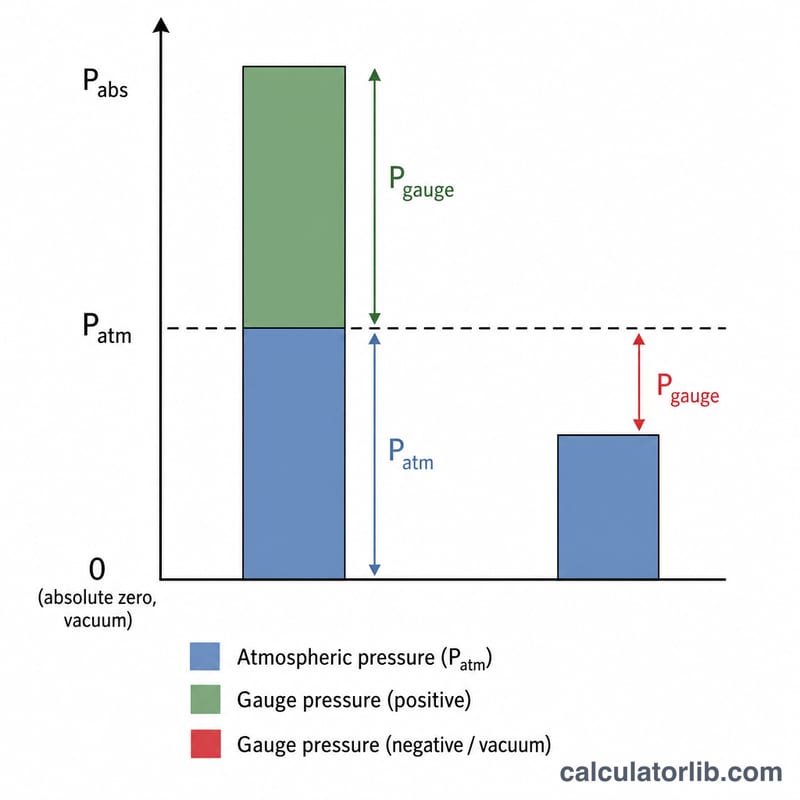
Absolute pressure is measured against a perfect vacuum. Gauge pressure is measured relative to the surrounding atmosphere, so it equals absolute pressure minus the atmospheric reference. The default reference is the standard atmosphere, 101325 Pa, which is the same worldwide. A gauge pressure below atmospheric (vacuum) appears as a negative number, which is correct and expected.
How to use it
Type the pressure value, choose the unit you entered it in, and select whether that value is an absolute or gauge reading. Adjust the atmospheric reference if you need a non-standard baseline, pick a display precision, and read the full conversion table.
The formula explained
Each unit has a fixed factor f (Pascals per unit). The input is normalized to absolute Pascals with $$P_{\text{abs}} = \text{pressure} \times f_{\text{input}}$$ (adding the reference atmosphere if the input is gauge). Gauge pressure is $$P_{\text{gauge}} = P_{\text{abs}} - P_{\text{atm}}.$$ Each target column is then \(P / f_u\).
Worked example
Enter 1, unit Pascal, absolute notation, reference 101325 Pa. Then \(P_{\text{abs}} = 1\ \text{Pa}\) and $$P_{\text{gauge}} = 1 - 101325 = -101324\ \text{Pa}.$$ In bar: absolute = \(1\mathrm{e}{-5}\) bar, gauge = \(-1.01324\) bar. In atm: absolute = \(1/101325 = 9.869\mathrm{e}{-6}\) atm, gauge = \(-0.99999\) atm.
FAQ
Why do mmHg and Torr differ slightly? mmHg uses the conventional mercury definition (\(133.322387415\ \text{Pa}\)) while Torr is defined as \(101325/760 = 133.32236842\ \text{Pa}\). The tiny difference is by definition.
Can gauge pressure be negative? Yes. Any absolute pressure below the atmospheric reference produces a negative gauge value, representing partial vacuum.
Is psi gauge or absolute? The table shows both. In engineering, psig is gauge and psia is absolute; choose the matching column.